You think you know... but you have no idea.
— MTV's DIARY
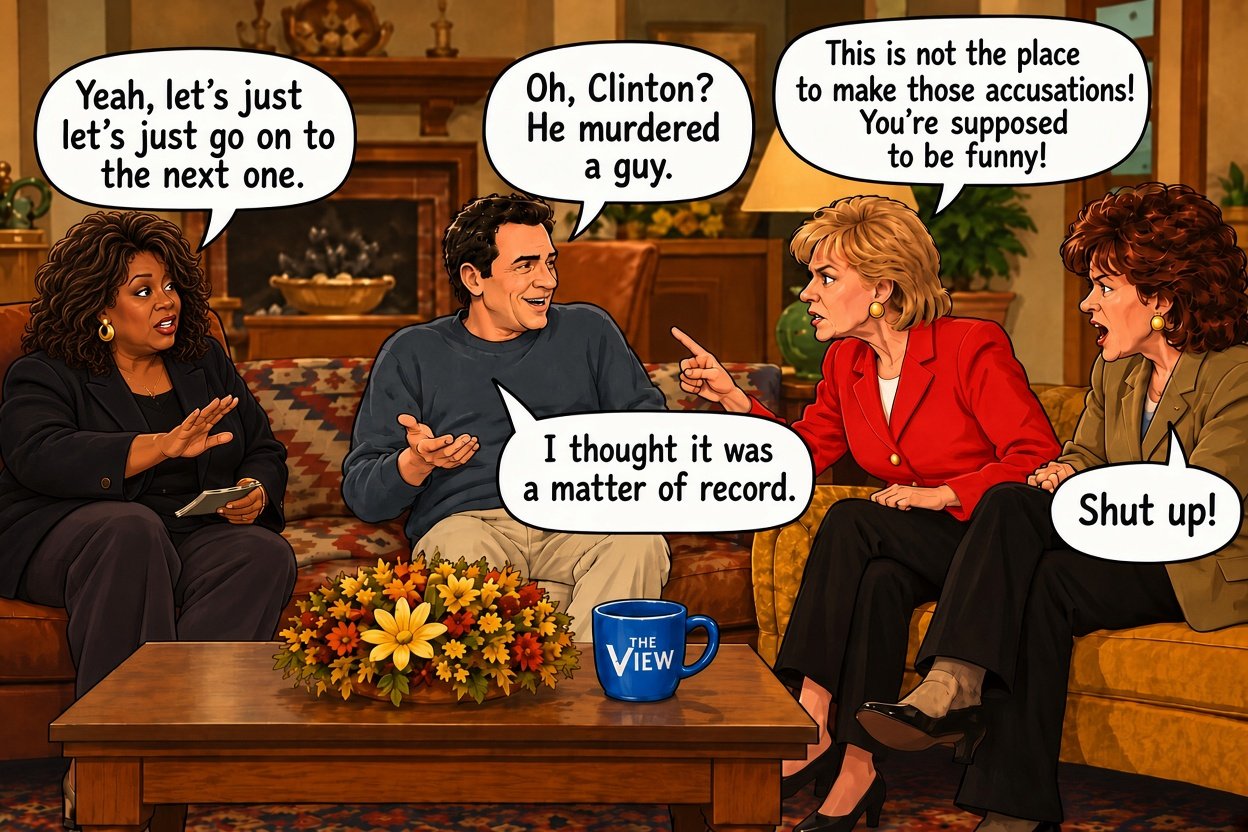
I don't like many Canadians. Just John Candy, Jason Priestley, and Norm Macdonald.
Back in 2013 and 2014, I had something to look forward to on my Monday evening Domino's shifts: a new episode of NORM MACDONALD LIVE. The show wasn't particularly reliable. Some Mondays there would be a new episode waiting for me, and others there would be nothing, a disappointment that could put me in a lousy mood for the rest of the week. When an episode did appear, I did the impossible, some might even describe it as completely reckless. I watched a video podcast, with my phone in my lap, while delivering pizza.
I had a one-sided relationship with a stand-up comic. I consumed every scrap of Norm content I could find. I thought I knew everything about him. But how well do you really know someone who jokingly lies about the basic facts of his own life?
Within the first minute of NORM: THE TALE OF NORM MACDONALD, a caller from Harrison, Arkansas gets on the air with Norm and admits that a couple nights ago, at 5:30 in the morning, he was laughing at Norm clips on YouTube. Comedian Matt McCusker describes the hole you can fall into, and Judd Apatow drops us straight into it. For most of the runtime we're sitting at a desktop computer while clips, articles, and social media posts pile up, a keyboard clacking between them. Apatow put out a call for fans' photos and videos while making the film, so the frame isn't only a conceit. It's also close to how I consumed Norm myself, and I'm still not sure what to make of that. Scrolling doesn't ask much of the person doing it, and for long stretches Apatow seems content to let the clips do the work.
About eight minutes in, Larry King asks Norm whether BASED ON A TRUE STORY, which the cover calls a memoir, is really a novel. "This is a novel, yeah, not a memoir," Norm says. Asked whether to believe any of it, he answers, "It's not facts, but it's truth." The copyright page is no more reassuring. It says the stories begin with the author's recollection of events, which is — by his own admission — spotty, and that several names and identifying details have been changed. Apatow keeps that exchange in, then cuts straight to Norm narrating his childhood from the book. Further on there's the story of sleeping beside the polar bears in the Central Park Zoo. Maybe Apatow is taking a page from Norm himself, trusting that even an invented story can tell us something true about the man.
About eleven minutes in, the film lays out the problem in a montage. Norm is a strict vegetarian who eats "chicken and beef." He asks a crowd, "Do you ever just lie for no reason at all?" He is Scottish, then Polish, then three quarters gypsy. He says he doesn't drink or smoke, and a friend of 15 years, asked about that, says, "I think he did. I'm almost certain, but I have no idea." He left school at 15, never had any schooling, and at one point mentions when he was in college. The film returns to the bit later, cutting together talk show clips in which his son is 3, then 6, then 18, and a 2020 set where Norm, around 60, calls himself "68 years young." Apatow gets his laughs from the pile-up, but the friend's answer is the only one that sounds honest.
Not long after, the film turns to Norm's jobs before fame. In an interview he lists a logging camp and a garbage truck, and I can't say he didn't make some of them up, especially with Apatow cutting in a scene from DIRTY WORK where two workers admit they lied on their resume. Then comes the narration, again from the book. "I specialized in unskilled labor, and I was good at it," Norm says, and if his job was to shovel until eight hours had passed, his body worked on its own. "It had no use for my mind, so my mind would take off to a world of imagination. And that's where stand-up comedy started." That one I believe, because I worked greens maintenance at a golf course, and a lot of my best ideas came from that job.
The film gives the sitcoms little time, and Norm does most of the dismissing himself. As he recalls it, his whole pitch was "I think I can act as good as Jerry Seinfeld." Asked about the acting, he says, "I don't like to act," and he explains that stand-ups make bad actors because the job is "you not relating to anyone." Late in the film, Norm says he's only proud of one thing, and that everything else was "an accident that came from stand-up." Apatow lets that stand as the verdict, without much consideration of whether the shows themselves were any good. I'll answer. I watched every episode of THE NORM SHOW, because how could you go wrong with Norm and a dachshund? And yet, it was at best a C+ show. I couldn't finish a single episode of A MINUTE WITH STAN HOOPER.
I hadn't realized how much of Norm's childhood was spent around old men. His father's friends came over in the evenings for "company," and Norm sat cross-legged in the corner while they told jokes. Later, as the film turns to mortality, Norm says he comes from "a long line of death." Then the narration takes over: "Death is a funny thing." In the book, that passage comes from a scene where Norm visits a dying boy in the hospital, but here it plays as his own philosophy. He says people are in "deep denial of death," and "I'm not." The film cuts straight to a man saying "not a lot of people knew" that Norm "had stomach cancer" early in his career, then fades him out mid-sentence. A 1991 Montreal Gazette article shown on screen reports that his illness began after his 1986 Just for Laughs appearance.
Norm isn't as comfortable with death as that boast suggests. In a radio interview not included in the documentary, he talks himself through an argument: when you're dead you're not alive, and when you're alive you're not dead, so "you and death will never actually cross paths." Asked whether it works, he says, "I'm not successful," and admits the fear returns "in the deep of night," when he gets up late, turns on the bathroom light and looks himself in the eye. I didn't know about the cancer, and as far as I can tell the film never returns to that first diagnosis. I wonder if a brush with mortality that early in his career affected his work afterward.
Earlier, the film includes Norm's Richard Farnsworth story, the one that led me to THE STRAIGHT STORY, about an actor who kept his cancer out of the public eye. At a 2020 show late in the film, Norm jokes that "if I die it won't be as much of a tragedy." A couple of minutes later, the film plays people reacting to the news of his death. His final illness had lasted nine years, and one of them says, "I had no idea." Jeff Ross explains, "Anything that undercuts the comedy, you don't want the audience to know." As a matter of comedy, I think Norm was right to keep it from his audience.
Then there's the special. According to a woman in the film, Norm taped it the night before a long procedure because he didn't want to leave anything on the table "in case things went south." I've watched it, the one where he sits at a laptop, and it's hard to laugh when you know how close he was to death. I'm not sure the material was great, either. Because of Covid, he never got the chance to refine the material in front of an audience, and I think it shows. It reminds me of the albums released after Tupac died. He was in the studio constantly because he thought he might die young, but with all the music he left behind, I doubt he would have considered every recording a finished song.
I think I know why I spent so much time watching Norm. John Candy died when I was a kid, and Chris Farley and Phil Hartman followed while I was in middle school. I learned early that the people I admired weren't necessarily going to be around for long. Philip Seymour Hoffman came later. I didn't grow up watching him, but as an adult I started seeing everything he made the moment it came out, and then he died on the day the Seahawks won the Super Bowl. With Norm, the habit took the form of watching whatever clips and episodes I could find online. I watched while he was still around to make more.
Near the end, Norm tells a crowd that he feels love when he does stand-up, and that "here is better than out there." What I felt watching Norm was different. I was watching alone, and he never knew I was there. He had a room full of strangers laughing with him. Apatow closes with one last ridiculous gag and The Highwaymen singing "Live Forever." It feels right for Norm. But what stays with me comes right before it. He says he'll try to say it "as unironically as possible, okay?" and then says, "I love you."
Final Verdict: 84 out of 100
Sidenote: Here's the link where you can watch the old NORM MACDONALD LIVE episodes. https://archive.org/details/Norm_Macdonald_Live
But don't watch these while driving, unless you have one of those fancy cell phone holders. Safety first.