Dutch (Retro)

by Edward Dunn


DUTCH (1991) PG-13 107 Minutes Director: Peter Faiman Writer: John Hughes Ed O'Neill, Ethan Randall, JoBeth Williams
CAST Ed O'Neill...Dutch Dooley Ethan Randall...Doyle Standish JoBeth Williams...Natalie Standish Christopher McDonald...Reed Standish Ari Meyers...Brock E.G. Daily...Hailey L. Scott Caldwell...Homeless Woman Kathleen Freeman...Gritzi Mickey Jones...Truck Driver

DUTCH (1991)

DUTCH is one of those movies that was on basic cable all the time in the '90s and early 2000s. I was never completely enamored with the film. When it was on, I'd maybe watch a few comedic scenes before changing the channel. There was something missing. Nothing major, nothing I could easily identify, but enough to keep me from becoming particularly attached to it. I still feel that way, although having watched it again, I find there's considerably more to appreciate than I previously realized. In fact, I think DUTCH is worth watching once or twice…all the way through, in spite of its flaws.

The setup is simple. At a country-club Thanksgiving party, Natalie Standish runs into her ex-husband Reed, who tells her he has to leave for London in the morning. He hasn't told their son Doyle, who is away at a boarding school in Georgia and expecting to spend the holiday with his father. Natalie calls to break the news, and Doyle accuses her of trying to buy his approval of her new boyfriend. Dutch has a better idea. "There's no better way for two guys to get to know each other than to spend a couple of days in a car," he says, and when Natalie warns him that Doyle doesn't want to know him, he brushes it off. "I've handled some pretty tough birds in my time." When the smoke cleared, he says, he almost always ended up with a new friend.

A working-class man fetching a kid from a fancy school reminded me of OVER THE TOP, where Sylvester Stallone picks his estranged son up from military school and tries to make up for lost time in one long drive. DUTCH takes the same trip (minus the arm wrestling competition) and swaps the father for a stand-in, a man with no claim on the boy and every reason to want one.

Class is the movie's first argument, and it announces itself at the party. Natalie tells the women that Reed got her pregnant when she was a barhop at the country club, married her to avoid scandal, and then beat her in court. Asked to point out her new boyfriend when he arrives, she says they'll know him when they see him. Dutch confirms it by telling the room he doesn't care for caviar, since he makes it a rule never to eat anything a fish deposits in a riverbed. Reed is played by Christopher McDonald, who is playing a villain again, and the mustache is a nice touch. When Natalie asks whether he would ever play fair, he answers, "I wouldn't dare lose." That one line covers the whole marriage.

In the car, Doyle takes over the class argument. He lists what gives Dutch away: cheap shoes, a ridiculous hairstyle, a crude vocabulary, and his mother's taste in men. Asked whether working class is bad, Doyle allows that a solid economy needs hand workers, and Dutch tells him he used to drive a cement truck, that his father was a bricklayer, and that his mother worked in a hotel laundry. "You must be very proud," Doyle says. "I am," Dutch answers. But the movie takes care to show that Dutch isn't poor. He says he makes a pretty good living, more than Reed gives Natalie, and that his money doesn't count in Doyle's neighborhood "because I worked for it." Later he admits he had $200 in his wallet when he told Doyle they had $20, suggesting that at least some of their hardship has been self-imposed. When Doyle suggests a telephone, Dutch calls his refusal "old-fashioned, pigheaded, working-class" masculine pride. He isn't proving he can rough it. He's proving he doesn't have to ask anyone for help.

I shudder to think what Doyle would have become without Dutch. He looks like a future Wall Street sociopath, a kid who answers "What makes you think you're so superior?" with "I don't have to think." He threatens to have Teddy written up and predicts a career at Burger King for him. But beneath all that arrogance is a boy who spends most of the movie miserable, and not only because Dutch is there. Teddy's reply, "At least I have a father," is the one insult in that scene he leaves unanswered.

When his mother tells him his father is going to Europe, there's a long silence on the line before he goes after her instead, accusing her of wanting his approval of her new boyfriend. Teddy then comes back to invite him to Thanksgiving at his own parents' house, the same Teddy Doyle mocked for being enrolled because his father is an employee, and Doyle says he couldn't handle that much fun. Later he demands his father's London number from a woman on the phone, insisting he has a letter promising his father would pick him up. Dutch's plan, as Doyle describes it to Brock, is to "drag me around until I break," and his insistence that he doesn't break sounds like a kid with practice. Dutch may not be changing Doyle so much as giving him room to show what was already there.

Dutch is right about one thing: there's no better way for two guys to get to know each other than a couple of days in a car. I've taken plenty of eight- or ten-hour day trips with a friend who didn't have a driver's license, so I did all the driving. With enough tiredness, you eventually become incapable of being anything other than yourself. If the other person still likes you, you've probably got a friend for life. I also took a trip to Northern California with another friend. We were both pretty quiet, and spending hours in a car didn't suddenly make us more talkative. He couldn't stand my leisurely driving, either; by the time we reached Oregon, he'd taken the wheel. But we spent plenty of weekends watching football together, and I don't think either of us needed much conversation to enjoy the other's company. Spending that much time together doesn't necessarily make two people closer. Sometimes it just shows you how different they are, and that tells you little about how close they already were.

Doyle's guard begins to slip during the drive. Dutch starts out in control, with Doyle gagged in the back seat while he drives the back roads and offers an apology of sorts. "I'm not 100% sure those undershorts I jammed in your mouth to shut you up were clean or not," he says. The first real crack comes at the fireworks store, which is based on a real one. According to the AFI Catalog, the producers found a big one in Kimball, Tennessee, while driving the route from Atlanta to Chicago, and Hughes wrote it into the script.

On the second viewing I noticed something smaller, right before Dutch goes in. Doyle starts to get out of the car to follow him, then changes his mind. When Dutch returns, Doyle points out that fireworks are illegal in Illinois, and Dutch says this is Tennessee, so it doesn't matter. Dutch rattles off his haul: M-80s, dragon tongues, Jersey stinkers, and Bombay bugles, along with a bag of pretzels and a deck of racy playing cards. The store shares its lot with a gas station, which Dutch is quick to say is no place to set anything off. Soon Doyle is calling him "a great big, demented child," and Dutch is giggling.

A few other bits worked for me. I missed what might be the best gag of the trip on my first viewing: Dutch gets squirted in the mouth with moisturizer while he sleeps in the front seat, and afterward he keeps licking his lips like he can't quite place the taste. Mickey Jones has a small role as a truck driver, and I was glad to see him, since I know him from his Bob Dylan days and HOME IMPROVEMENT. And those Pan Am bags really were indestructible. I probably still have one in a closet somewhere, picked up at a yard sale.

The turning point comes after Brock and Hailey, the call girls who give the boys a ride to Hammond, drive off with Dutch's wallet, luggage, and last cigar. Doyle had spent the ride talking to Brock, the first person he opens up to. When she tells him maybe he should stop knocking his mom and try to make things work with her, he says that isn't going to happen, then adds, "But I really like talking to you." Dutch sits down at the gas station and tells Doyle to call his mother and give her the message that "the Dutchboy's calling it quits." Doyle objects that it's sick to cut his mom loose because Dutch can't get along with him. "I blew it. I'm sorry. I'm also out of ideas," Dutch says, and I still can't tell whether he means it or is bluffing. Doyle goes to a phone and calls his father instead. A woman whispers that Mr. Standish is sleeping, and Reed asks who it was. "Some kid," she says. When Doyle comes back, he's the one insisting they can make it home. Once Dutch announces he's calling Natalie, Doyle stops him. "It would really mean a lot to me to not have to call my mother for help." It's Dutch's own male-pride argument coming out of Doyle's mouth, and it's the first time he's on Dutch's side.

The shelter scene is one of the better parts of the movie. After they're told to leave a place where Dutch hoped Doyle could wash the cut on his head, a couple asks Dutch, "The boy's your son?" "That's right," Dutch says, and they send the pair to a center for displaced families. At night Dutch asks Doyle to switch cots because his own won't hold him. "How do you know it'll hold me?" Doyle asks. "Because I'm 15,000 cheeseburgers ahead of you in life."

Then a woman tells Doyle that her husband lost his job in June when an auto-parts company went broke, and that they've been living out of the back of their car. The kid who spent the first half of the movie sneering at Dutch's shoes and hairstyle says, "That's kind of hard." When she asks, "You and your daddy?" there's a long pause before he answers, "Yeah." She asks if he has a mother, if she's in Chicago, if he'd like to be with her right now. "Yes," he says, and after a moment, "Yeah, I would." Dutch, within earshot, smiles. It's where Doyle finally begins peeling away that layer of thinking he's better than everyone else. Afterward Dutch tells him he called Natalie and said they were at the Holiday Inn so she wouldn't worry, and asks if that's okay. "No, that's okay," Doyle says. The shelter has become a secret the two of them share.

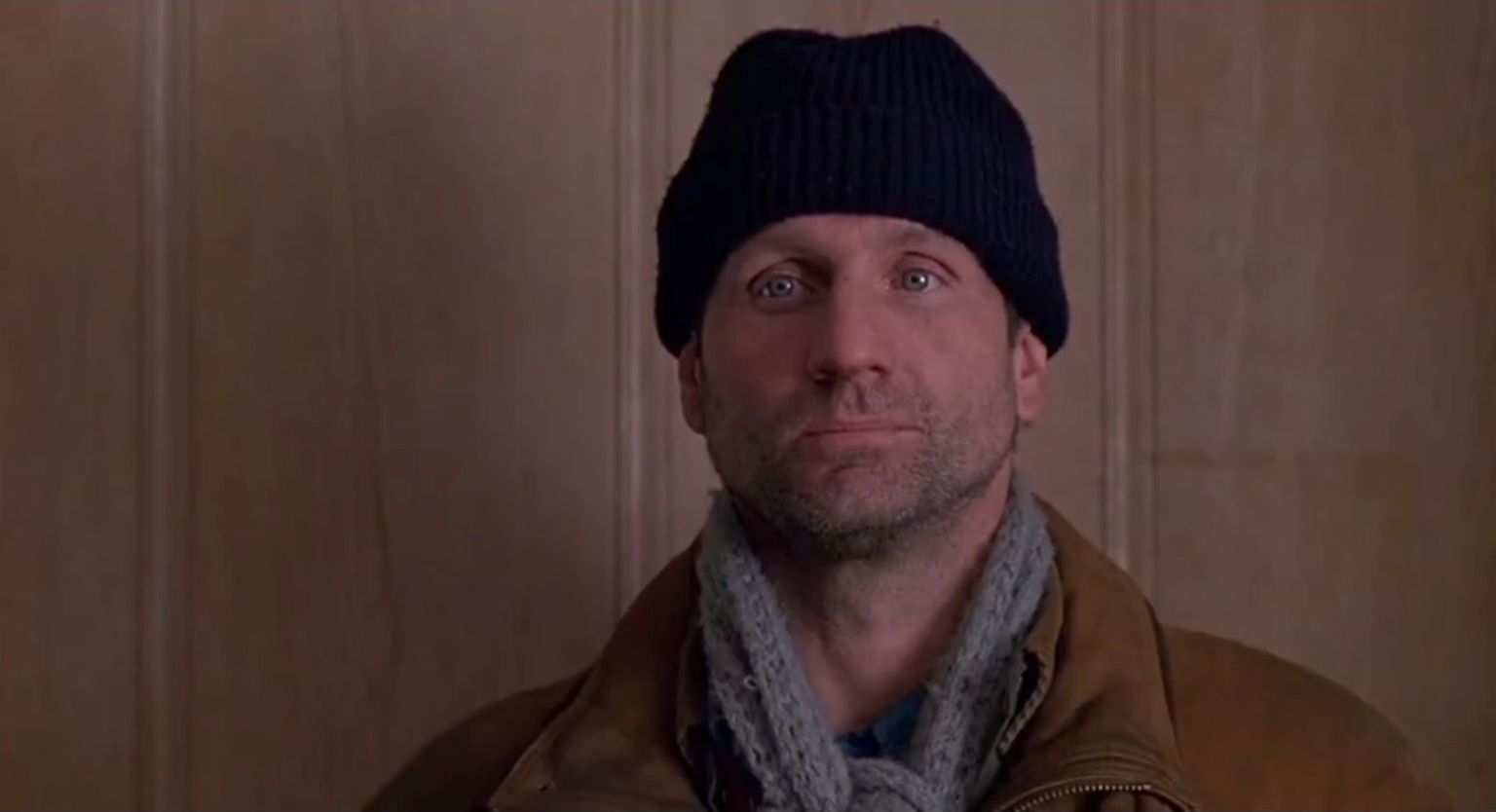
The ending starts well and then loses its nerve. Reed shows up at Natalie's house claiming he canceled an overseas trip to spend the holiday with Doyle, and Doyle calls him on it: "No, you didn't. I called your house, and a lady answered. You lied to me." Reed makes him choose. "Are you coming with me or are you staying here? Your decision is final." Doyle answers, "I'm staying here, Dad." Meanwhile, there's something different about Dutch in this scene. He keeps his hat on indoors, and with the hat framing his face, all you notice are his eyes. I wonder if that was a deliberate choice by the filmmakers, since he could have taken it off right away.

Dutch's confrontation with Reed afterward is the other part that works, because it feels like something the character would really do. Reed has told Natalie he wants her out by Monday. Dutch gets him up to six months, makes him promise to be more respectful, and tells him to work on being a nice guy with his son because he still loves him. "I'm never gonna be his father," Dutch says. "That's your job. You'd better learn to do it." Earlier at the shelter, Doyle told a stranger that Dutch was his father. Now Dutch is telling the boy's actual father that he has a responsibility no one else can fulfill. It's a surprisingly generous thing to say to a man he despises.

Then dinner starts and it goes off the rails. Dutch sends Doyle for his coat, saying he has something in it for his mother, and fires an air pistol while the table laughs. I know they promised that moment. Dutch threatens it in their first fight, and in the shelter Doyle asks, "You still gonna shoot me in the ass?" "Yes." But the payoff could have come anywhere else in the film. A softer joke would have worked better here.

By the end I was thinking DUTCH mostly needed better editing. I know that isn't literally true. The July 1990 draft screenplay already ends with Dutch pulling an air pistol from behind his back at the dinner table. A softer joke would have required more than a simple cut. But the building blocks for a better movie are all there: the class argument in the car, the misery behind Doyle's sneer, the shelter, Dutch facing down Reed. Some of those repairs wouldn't have taken much. It's hard to say how much of the blame belongs to Hughes and how much to Peter Faiman, a director I'd never heard of who turns out to have made CROCODILE DUNDEE. The gag was on Hughes's page, and it survived into Faiman's finished film. Hughes wrote and directed CURLY SUE three months later, and between the two I'd say he lost a step.

That might also explain why DUTCH never stuck with me on basic cable. The scenes I used to catch before changing the channel were the comedic ones, and the best of the movie is in the parts you only see if you stay.

Final Verdict: 72 out of 100


Only the Lonely (Retro)

by Edward Dunn


ONLY THE LONELY (1991) PG-13 104 Minutes Director: Chris Columbus Writer: Chris Columbus John Candy, Maureen O'Hara, Ally Sheedy CAST John Candy...Danny Muldoon Maureen O'Hara...Rose Muldoon Ally Sheedy...Theresa Luna Kevin Dunn...Patrick Muldoon Milo O'Shea...Doyle Bert Remsen...Spats Anthony Quinn...Nick Acropolis James Belushi...Sal Buonarte
The future's uncertain and the end is always near

— The Doors, "Roadhouse Blues"

Watching and rewatching John Candy movies as a child, there was a lot I simply wasn't equipped to pick up on. I saw ONLY THE LONELY more times than I can count, and yet it remained my least favorite of the Candy films I considered at least passable. I kept coming back to it anyway, figuring that if I watched it enough times, eventually I'd catch whatever I had missed. I suppose I finally have, though repetition wasn't really the answer. Like THE BROTHERS KARAMAZOV, ONLY THE LONELY is something that takes a little age and wisdom to appreciate.

ONLY THE LONELY undersold itself on the way out the door. Marketed on Candy's name, it walked into an audience already primed for a comedy, and delivered a drama with comedy folded into it instead. Approached as a Candy vehicle, Rose can read as an obstacle keeping Danny from whatever plot he's supposedly in; approached on its own terms, she is the plot. Not every laugh here earns its place the same way — a few carry the faint whiff of contractual obligation, as if a certain number of jokes per reel came bundled with the casting — but the ones that land hardest belong specifically to Danny rather than generically to Candy. The cutaways where guilt sends him spiraling into some worst-case vision of what's happened to his mother the moment he's out of the house are funny precisely because they're symptoms: a joke built out of one particular man's particular damage reads differently than a pratfall would, and that's the difference between a bit and a character trait.

That distinction was deliberate. Columbus has said casting Candy meant reaching past the persona: "We got the 'real' John Candy, beyond the facade." Hughes described the same choice in blunter terms, admiring the nerve it took for Candy to say, in effect, "The things I do best, I'm gonna set them aside and try something else." And Belushi — cast as Sal, the one member of the ensemble whose whole job is comic relief — supplies the best evidence the gamble paid off: recalling a scene where his character is scripted to laugh at something Danny says, he admitted flatly, "That was me really laughing, not my character." A film that gets an actual, unplanned laugh out of its designated comic relief has found a funnier register than asking him to be funny ever could.

Danny and Theresa like each other almost on contact, and the film doesn't dress that up as some slow thaw. A cop who spends his shifts around whatever trouble the public generates and a mortuary cosmetician who spends hers making up the dead to look presentable for viewing turn out to have more in common than either would probably admit, both drawing a paycheck in regular proximity to death, only at different stages of the process. The film gets specific comic mileage out of that overlap rather than treating it as incidental set dressing: Danny asks her out mid-shift, with an actual body in front of him, and the scene plays the mismatch for exactly what it is instead of cutting away from the discomfort. He leaves on the kind of high only a successful ask produces, grinning at nobody in particular, and walks straight into a clutch of pallbearers arriving for a different service entirely — Candy doesn't have to do anything but let Danny's face catch up to the space he's wandered into, and it's the funniest beat in the sequence for being the least engineered.

None of that chemistry would matter much if the film then spent its second half correcting Theresa, the way THE BREAKFAST CLUB — Sheedy, six years earlier — eventually does to Allison: introverted and strange until a makeover scene reintroduces her as conventionally pretty and, not coincidentally, more legible to Emilio Estevez. ONLY THE LONELY doesn't run that play. Theresa stays quiet, stays a little odd, and the film lets the oddness stay hers rather than something to be talked out of her: she styles her corpses to resemble movie stars, a private flourish that isn't being performed for Danny, evidence of an interior life running at full strength whether anyone appreciates it or not. Danny's interest in her arrives without an asterisk requiring she eventually stop being that person.

Why the performance works as well as it does gets easier to understand once the line "Ever since my dad died I've been in charge" is set next to the man delivering it, not just the character saying it. Candy lost his own father at five, decades before anyone thought to build him a part around that kind of premature responsibility, and Columbus didn't back into the resemblance by accident — he wrote ONLY THE LONELY with Candy specifically in mind, and Candy knew it: "Nobody thinks of me in this kind of role," he told Columbus once he understood what had been done for him. "Thanks so much." None of that amounts to Candy simply playing himself. Danny is a fictional Chicago cop with a fictional dead father, and nothing in his file matches Candy's own biography point for point. What the record does explain is the specific muscle the role asked him to use, and how rarely audiences had been allowed to watch him use it for this long.

Candy turned forty about a month into the shoot, a milestone his own father never reached — dead at thirty-five, meaning by his own reckoning Candy had already outlived him. Months later, taping a Tonight Show spot built around the finished film, he was reportedly more rattled than his friend Robert Crane Jr. had ever seen him, pulling back his jacket backstage to show off sweat rings and asking if there was any way out of going on at all; Crane's answer, as he remembers it, was that Maureen O'Hara and Johnny Carson had made that impossible. Candy had spent years being funny in front of millions. Now he was promoting a film built around the part of himself audiences weren't accustomed to seeing, and backstage he was sweating through his shirt.

Go. Marry that girl. Have lots of Irish-dago mutts.

— Rose Muldoon

Rose's whole contradiction sits in two lines spoken minutes apart. "I don't hurt people," she says at one point, flat, a statement of fact about herself. Then, not long after, walking back something she's done: "I don't mean to hurt people. Really." The second version concedes what the first one denies, and the gap between them is close to her entire arc in miniature — not a woman who doesn't hurt people, but one who's spent a long time believing the denial hard enough to keep functioning, sabotaging Danny's chances and her own peace with roughly equal enthusiasm and calling neither one intentional.

She's a cartoon only if you don't look closely. Played broadly, an overbearing widowed mother running interference on her adult son's love life reads like a type assembled from other movies' spare parts; played as specifically as O'Hara plays her, she reads like somebody's actual mother — the kind of figure who turns up often enough in large Irish-Catholic families that the surprise isn't that she exists, it's how rarely she gets written this precisely. The film gives her prejudice a specific shape rather than a generic one, too: Theresa's family is Sicilian and Polish, not Irish, and Rose's objections keep circling back to that fact in ways that have nothing to do with whether Theresa is good for Danny. None of that earns her tactics a pass for being recognizable — the crack about Theresa's figure and the insinuation about her drinking aren't secondhand prejudice relayed from somewhere else, they're things Rose says to Theresa's face at dinner, with Danny sitting right there to hear it. The large-Irish-family defense explains where Rose comes from. It doesn't extend to where she's willing to take it.

The screenplay's small mechanics do more work than the film's reputation as pleasant-but-slight generally credits them for. It opens on a death and very nearly turns on another: the corpse two men carry into the bar early on isn't an atmospheric flourish, it's the reason Danny meets Theresa and her father at all — remove that corpse from the scene and there's no movie. Near the end, a different death does the opposite kind of work: Doyle, an old man with no family and few friends left to notice he's gone, dies right as Danny is packing to leave for Florida with Rose. Doyle is the future Danny suddenly realizes he might be building for himself. What lets him reach her at all is a smaller, neater piece of plotting: Theresa is the one who has to prepare Doyle's body, and by the time Danny works up the nerve to go after her, her train has already left the station. He doesn't beat the clock — he uses what he has instead, a police connection with enough pull to get a departed train stopped so he can still get to her. One death opens the picture by putting Theresa in Danny's path; a second one closes it, not with good timing but with Danny using what his job gives him.

Spats gets there first, structurally speaking. His "don't spend your life full of regrets" lands early enough that it's easy to file away as a barroom platitude, the kind of thing regulars say to each other without either one really listening — right up until it turns out to be the exact instruction Danny eventually follows. There are smaller pleasures around the edges, too, like Columbus finding room for John Davis Chandler, his wonderfully unsettling Bleak from ADVENTURES IN BABYSITTING, in a cameo that lasts barely long enough to register. Recognizing him doesn't change anything, but that's part of the pleasure: even the margins have faces in them.

The reconciliation at the train station gets everything right and still feels rushed getting there. Danny's apology, his confession, Theresa's admission that she loves him too, his promise that she comes first now — the content of the scene is exactly what the rest of the film has patiently earned, and it still plays like the movie is in more of a hurry to close than its characters ever were to open up. What surrounds that scene does more of the real work than the scene itself. Rose gets her own small ending on a plane instead of a train, holding Nick's hand because her son finally gave up a seat instead of a duty. Danny's whole arc has been one of accommodation — his brother, his mother, his own fear of what happens if he stops managing everyone — and the last real choice he makes in the film is the culmination of all the smaller choices he's begun making for himself. Theresa's version of the same idea is quieter and arguably braver: having already walked away once, cleanly, she's the one who has to decide whether to risk being disappointed by the same man twice. And Danny's final vision — Rose and Nick fending off hijackers together mid-flight — was surely meant as pure comic relief, an overprotective son's fantasy played for a laugh. It lands differently now, carrying a weight the joke couldn't possibly have anticipated.

What the film is really about, underneath the plot mechanics, is easier to see if you set the romantic resolution aside and look at how crowded it is with lonely people. Danny, Theresa, Rose, Nick, even Doyle at the end — each represents a different response to the possibility of being left alone, and the closest thing the film has to a moral is that the risk of connection is worth taking over the certainty of not being hurt by it. It's a modest, well-worn point for a film to make, and ONLY THE LONELY earns it anyway, mostly by refusing to let anyone get there easily.

There's a detail from the shoot itself worth sitting with rather than explaining. The train station scene, the one this review has already flagged as too brief, was filmed on location in Niles, Michigan, dressed with Christmas lights for the occasion. During that same stretch of location work, Candy was known to sit up in his hotel room unable to sleep alone, holding court in a bathrobe with an ice bucket of drinks, pulling people in to talk rather than let the room go quiet. None of that explains the performance he gives in that station. It doesn't need to — the two are simply true at the same time, in the same town.

Final Verdict: 86 out of 100

Sidenote: Jim Belushi isn't exactly being asked to stretch much here — sleazy cop is comfortably inside his wheelhouse — but I like him in the part. Sal shows up in short bursts, gets his laughs, and never hangs around long enough to wear out his welcome.