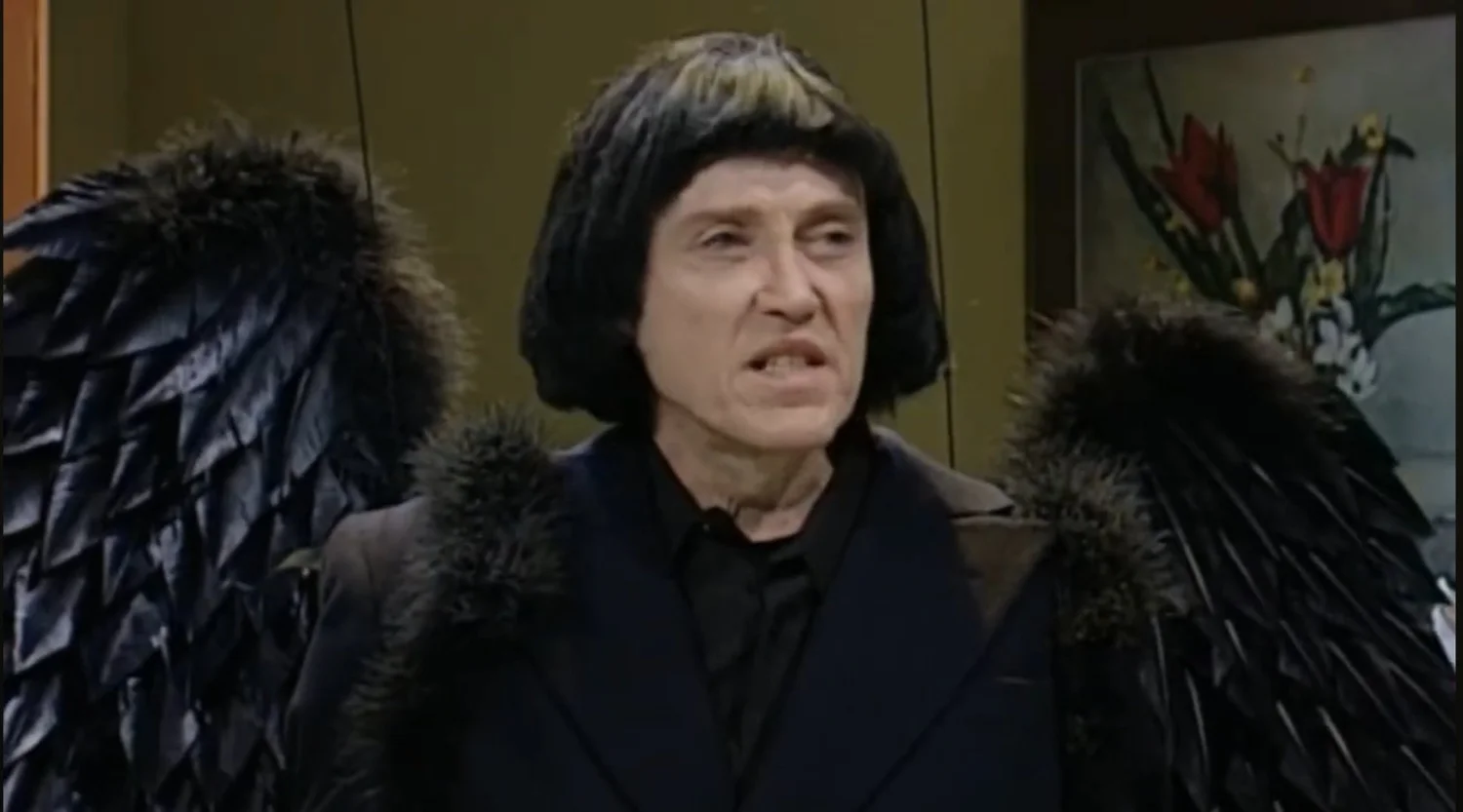
The Prophecy

by Edward Dunn


THE PROPHECY (1995) R 98 Minutes Director: Gregory Widen Writer: Gregory Widen Christopher Walken, Elias Koteas, Virginia Madsen
CAST Christopher Walken…Gabriel Elias Koteas…Thomas Daggett Virginia Madsen…Katherine Henley Eric Stoltz…Simon Viggo Mortensen…Lucifer Amanda Plummer…Rachael Moriah Shining Dove Snyder…Mary Adam Goldberg…Jerry
The Prophecy still

THE PROPHECY is a film about angels in which every angel is either a monster, a doormat, or barely adequate. Gabriel is petty and murderous. Lucifer is self-serving. Simon, the film's closest thing to a heroic angel, is less good than he is simply not terrible. The beings who emerge from the whole affair with any moral standing are the humans — the "talking monkeys," as Gabriel contemptuously calls us. Whether that's a deeply intentional statement about the value of the human soul or a happy accident, THE PROPHECY doesn't pause long enough to tell you.

A second war is brewing in Heaven. Gabriel, archangel and deeply aggrieved middle manager of the cosmos, has decided that God made a mistake by favoring humans over angels. We have souls. Angels don't. This is, to Gabriel, an intolerable situation, and he intends to correct it by finding the most evil human soul in recorded history — a Korean War colonel — and weaponizing it for his side. An angel named Simon has hidden the soul inside a young Navajo girl named Mary to keep it from him. Thomas Daggett, a failed seminarian turned homicide detective, gets pulled in through a crime scene and spends most of the film catching up with the rest of us. Writer-director Gregory Widen draws from real sources — Revelation, the Epistle to the Hebrews, the general Old Testament tradition of angels as dangerous rather than comforting — and clearly did some reading. These are not the kind of angels who help baseball teams win the pennant. Whether any of it coheres into a functioning mythology is a different question.

Christopher Walken is one of my favorite actors, and I'll state that upfront because it's relevant to what follows. THE PROPHECY is the performance people are doing when they do a Christopher Walken impression — not the later self-parody material, but the genuine article. The halting rhythm, the tilted head, the way he lands on a word like he discovered it mid-sentence and isn't sure how he feels about it yet. Gabriel is written as an alien being who has studied human behavior without ever understanding it, and Walken plays him accordingly: not as a villain trying to be charming, but as something that is trying to pass as human and missing by just enough to be alarming. The scene where he licks blood from a crime scene — tasting it the way a sommelier would, curious and clinical and faintly disgusted — tells you everything about who this character is in about four seconds. A small wink he deploys from the back of a police cruiser does the same in one.

That same quality surfaces when Gabriel settles onto the school steps to chat with a group of children — calm, focused, faintly interrogative, with the specific warmth of someone who has studied warmth but never quite felt it. He even recruits a boy to blow his trumpet, coaching him with eerie intensity: "Put your lips there. Pucker your lips and blow. Just a little bit. This trumpet's special."

THE SIMPSONS nailed this exact frequency years ago in a throwaway bit about Christopher Walken reading GOODNIGHT MOON to a group of kids:

"Good night, room. Good night, moon. Good night, cow jumping over the moon. Please, children, scooch closer. Don't make me tell you again about the scooching. You in the red, chop-chop."

— THE SIMPSONS, BABF17

Gabriel is that bit — played completely straight. For ninety-eight minutes.

The chemistry between Walken and Adam Goldberg, who plays Jerry, a zombie pressed into reluctant service as Gabriel's driver and general errand corpse, is the one thing you wish there were more of. Goldberg brings jittery, hyper-verbal energy; Walken brings glacial calm; together they generate real comedy in a way the film rarely manages elsewhere.

Thomas Daggett and Katherine Henley, the humans the film nominally centers, are considerably less interesting than the supernatural beings pursuing them. Elias Koteas tries to animate a character whose backstory — failed seminarian, crisis of faith, traded the priesthood for a homicide unit — feels written to fill a role rather than become a person. Virginia Madsen has even less to work with; Katherine exists primarily to be imperiled and occasionally brave. The film's central irony is that the humans are its moral argument but not its dramatic engine. The angels are driving, and whenever we return to Thomas and Katherine, you can feel the movie idling.

Viggo Mortensen arrives late as Lucifer and briefly takes the film hostage. His interpretation is the smartest choice in the movie: not horns-and-fire, but intimate, personal, almost fond of the humans he's supposedly condemned. He speaks softly and projects the menace of someone who likes you and would destroy you anyway. The intervention is entirely self-interested — Gabriel's war threatens to upset his own arrangements — which is exactly the right motivation for the character. He shows up, solves the problem, and leaves. It's a small role, and it leaves a bigger mark than it should.

What THE PROPHECY cannot solve is its own internal logic. The rules governing what angels can and cannot do shift based on what the scene requires. The soul-in-a-child subplot, which positions Mary's body as a container for a Korean War colonel's evil, is treated with a matter-of-factness the film never interrogates. Lucifer's eleventh-hour arrival resolves the war in a way that sidelines the human characters at the exact moment the film needs them most. The movie is thematically murky and literally hard to see — what's meant to feel ominous sometimes just feels underlit. None of these are fatal problems on their own. Together they make for a film that flickers to life whenever Walken is on screen and goes dark when he isn't.

THE PROPHECY is not a successful film by most measures. It is, however, a film that contains Christopher Walken licking blood from a crime scene, Viggo Mortensen crouching in the dirt and being quietly terrifying, and the implicit argument that human beings — ridiculous, mortal, talking monkeys that we are — are more interesting than angels because we have something angels don't. That's not nothing. It's just not quite enough.

Final Verdict: 60 out of 100

Sidenote: Definitely show this to someone who has never seen it. You'll really get a kick out of their confusion.

Sidenote 2: Yeah, that's Steve Hytner playing the coroner in the movie. You know, the hack comedian from SEINFELD. And no, it's not distracting at all.


Bushwhacked (Retro)

by Edward Dunn


BUSHWHACKED (1995) PG-13 90 minutes Director: Greg Beeman Writers: John Jordan, Danny Byers, Tommy Swerdlow, Michael Goldberg Daniel Stern, Jon Polito, Brad Sullivan CAST Daniel Stern...Max Grabelski Jon Polito...Agent Palmer Brad Sullivan...Jack Erickson Ann Dowd...Mrs. Patterson Anthony Heald...Reinhart Bragdon Tom Wood...Agent McMurrey Blake Bashoff...Gordy Michael Galeota...Dana Art Evans...Marty
“Scout's Honor — the Hostage Crisis. Day one.”
EyeWitness America

I almost saw BUSHWHACKED on my eleventh birthday. It was August 1995, and the decision came down to two movies. I invited a couple of friends, and after a week of phone tag we settled on BABE instead. My mom drove us to the Everett 9 Cinemas on Everett Mall Way. Thirty years later I had to buy a DVD drive to watch the one we didn't pick.

BUSHWHACKED began life as a HOME ALONE spinoff, with Stern reprising Marv in his own movie. By the time it reached theaters the character had been renamed Max Grabelski, but not much else had changed. The leather jacket was different. The routine was the same.

It is worth pausing on where Stern was at this point. He had spent the early part of his career doing genuinely interesting work — BREAKING AWAY, DINER, THE WONDER YEARS narration — the kind of roles that suggested an actor with real range and a particular gift for quiet, lived-in characters. Then HOME ALONE happened. Marv made him famous in a way his better work never had, and the years that followed were largely an attempt to stay in that lane. BUSHWHACKED is somewhere near the end of that attempt. By 1995 the lane was narrowing and the material was getting thinner, and you can feel it in every scene.

The setup has genuine potential. Max Grabelski is a courier who has been making regular late-night deliveries to a millionaire named Reinhart Bragdon, pocketing fifty-dollar tips and not asking questions. When he shows up one night to find the mansion on fire and a gun in his face, he grabs the weapon and runs. Bragdon turns up dead. Max is the obvious suspect. What the film doesn't bother to develop is the more interesting story underneath — that Max had been cultivated as a fall guy over multiple visits, set up by someone he thought he had a friendly arrangement with. That's almost noir territory. BUSHWHACKED doesn't notice.

Instead it pivots. On the run and out of options, Max finds himself mistaken for the scout leader of a ranger troop and ends up chaperoning a group of kids into the wilderness. The film decides this is the movie it wants to be, and everything that came before it is quietly abandoned.

Daniel Stern is a strange fit for this part. He has always been better bouncing off somebody else than carrying a whole movie on his back. That was true in BREAKING AWAY, true in DINER, and even true in HOME ALONE, where Joe Pesci gave Marv something to play against. Here he is out there on his own, flailing, and after a while the flailing starts to feel less funny and more desperate.

The character doesn't help. Max is supposed to read as a lovable screwup, but Stern plays him as sneaky and sniveling in a way that never quite invites you in. There is a difference between a character who makes bad decisions and a character you don't want to spend time with. BUSHWHACKED doesn't seem aware of the distinction. Even physically, he never convinces as a delivery driver — he looks less like someone who has spent years jumping in and out of a truck and more like Jeff Goldblum waiting to explain chaos theory. The job is just a costume, like everything else in the movie.

Stern himself briefly returned to the headlines earlier this year after being cited for soliciting a prostitute. The charge was dismissed after he completed an education program, which is more closure than BUSHWHACKED ever manages.

The supporting cast is better than the movie around them. Jon Polito and Anthony Heald both seem to be acting in a slightly different film — one that takes the crime angle more seriously than BUSHWHACKED does. Polito brings his usual blustery authority, while Heald, who played the slimy Dr. Chilton in SILENCE OF THE LAMBS, is slippery enough to make Reinhart Bragdon feel like a real villain instead of just a plot device. Even the smaller roles help. Art Evans shows up briefly as Max's boss and instantly makes the delivery company feel more believable than the script ever does. And Brad Sullivan, as the real scout leader, has that rigid, humorless authority figure energy that used to show up in a lot of 90s kids movies. For brief stretches, they make you wonder if a better movie was hiding in here somewhere.

There are moments where the comedy actually lands — a smoke signal sequence where the distress call comes out as “Belp Belp,” and a campfire scene where the kids calmly diagnose every red flag Max ignored. But they are islands. The film can't build anything around them.

BUSHWHACKED lists four writers, and the movie feels like it. The first act sets up a mildly interesting crime farce involving mob money and a faked death. Then Max ends up with the scout troop and the film abruptly resets into a children's wilderness adventure. The result feels less like one story than two different ideas stapled together and hoping nobody notices.

Watching it now, what struck me most was how little the film's version of scouting resembled anything I actually experienced. I was the same age as these kids when BUSHWHACKED came out in August of 1995. I had just finished Cub Scouts and decided I was not quite dorky enough to continue to Boy Scouts. Trips like this were never a handful of kids wandering around the mountains with one adult. They were organized camps, designated sites, and a small army of parents hovering nearby. If my own dad was working nights or weekends, I would end up going with another kid and his father and sharing a tent. That was the reality. BUSHWHACKED turns it into something closer to a children's adventure novel, where a complete stranger can show up in a leather jacket and loafers, claim to be the scout leader, and no parent notices anything is wrong.

Once you notice that gap between reality and the movie's version of it, the rest of BUSHWHACKED starts to unravel pretty quickly. The cartoon logic extends well beyond the scouting. The parents never notice the absence of camping gear. The real scout leader gets his head glued to a steering wheel and the cops, assuming he's their suspect, rip it loose and move on. Later, when the rope bridge is cut, the correct response would be helicopters and a full search and rescue operation within the hour. BUSHWHACKED treats it as a mild inconvenience.

The money plot doesn't hold up much better. The film gestures at worn currency scheduled for destruction as the basis for the scheme, which is almost a clever idea, but the mechanics of how a private courier ends up delivering mob money never get explained in any satisfying way. Pull on any thread and the whole thing unravels. The movie even seems dimly aware of the problem. In one campfire scene Max lays out his situation as a hypothetical, and the kids immediately identify every red flag he ignored. “Only a sucker would fall for that,” one of them says. The film accidentally wrote its own critique.

BUSHWHACKED wants you to feel good about Max by the end. He saves a kid, earns his scout badge, and everyone forgives everything. It is a tidier resolution than CELTIC PRIDE managed, and at least the film gives Max a concrete moment of courage to hang the redemption on. But the more you think about it, the more the whole arc collapses.

The kids would have been fine without him. Better than fine. If Max had never stolen the scout leader's Hummer and taken his place, they would have had a normal overnight trip with an experienced scout leader, come home the next morning, and none of what follows would have happened. The bears, the rope bridge, the criminals with guns — Max didn't save these children from danger. He created it. The film asks you to applaud him for resolving a crisis that was entirely his fault.

My friends and I made the right call that August. BABE was the better movie by any measure, and thirty years later it still holds up in a way BUSHWHACKED doesn't. But there is something quietly satisfying about finally watching the one we didn't pick, even if the experience mostly confirms what eleven-year-old me suspected from the trailer — that it was going to be a lot of Daniel Stern falling down and not much else.

Final Verdict: 44 out of 100