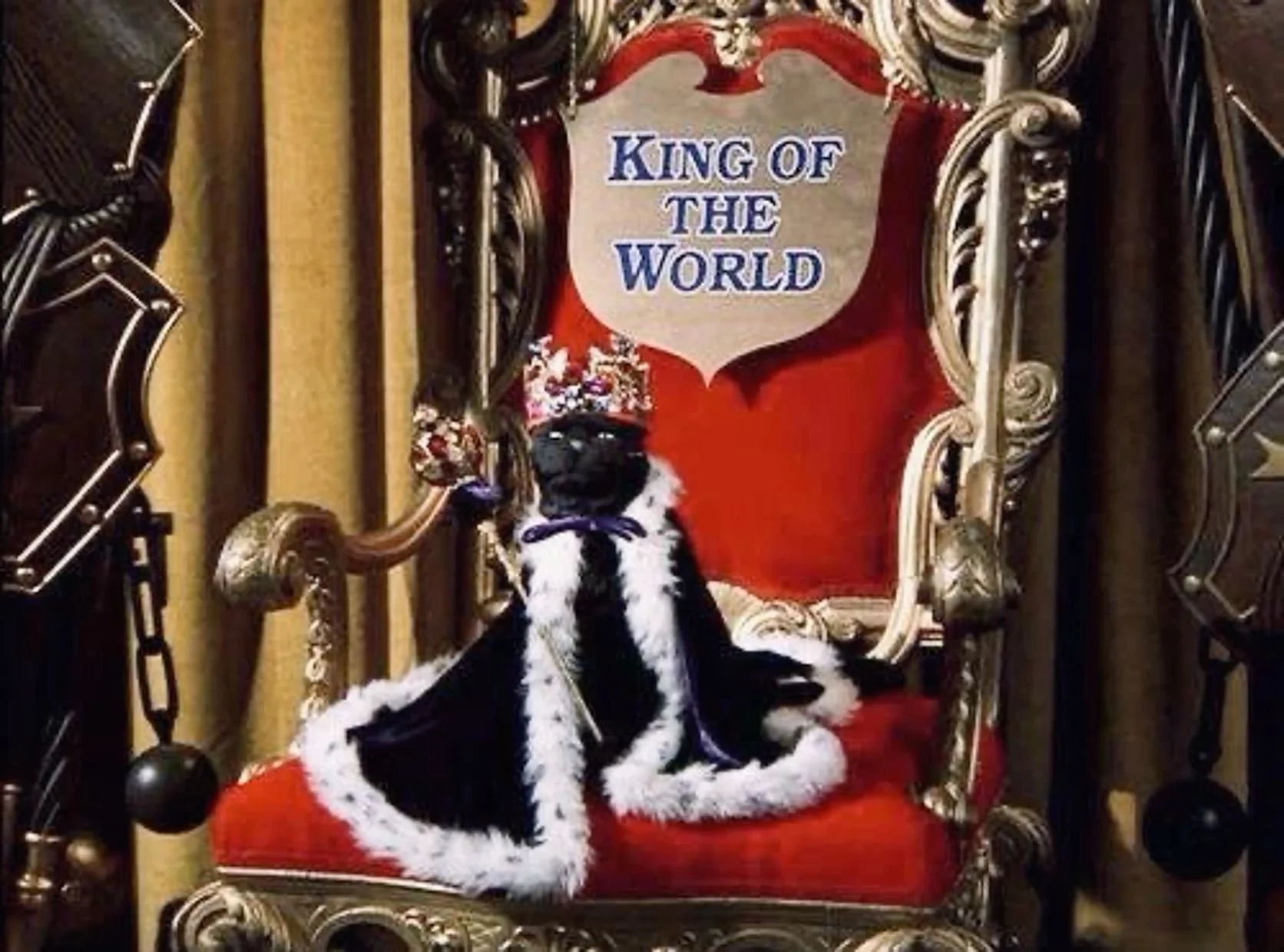
I'm not a big fan of witches unless they help the Mariners win baseball games, or there's a talking cat hell-bent on world domination. But the spooky witches, the ones who kidnap children and make them disappear? As far as I'm concerned, they can stay in SCARY STORIES TO TELL IN THE DARK.
I was six years old when THE WITCHES came out, and at that age, what I saw in a theater was entirely up to my parents. With three siblings in the mix, we were lucky to make two trips to the movies a year, and 1990 had already spent one on NINJA TURTLES at the now-defunct Snohomish theater — how a place with wooden seats that comfortable went out of business, I still don't understand — and was saving the other for HOME ALONE. THE WITCHES never had a shot. Which was probably for the best, since the imagery would've frightened me. My little sister, I mean.
Luke doesn't get an inciting incident so much as an inciting absence. His parents' deaths are handled almost entirely offhand — dialogue calls it only "an accident," full stop, and the movie moves on. It's restraint you don't expect from a film this eager to show you a woman's face peeling off later, and it works because grief isn't really the scene's subject. The subject is Helga, who becomes parent and mentor in the same motion, arming her newly orphaned grandson with the specialized knowledge he's going to need. There's a Grand High Witch ruling over all the world's witches, and nobody has ever actually seen her. Witches give themselves away through smell, not appearance: clean children smell to a witch like fresh dog's droppings, Helga explains, so the dirtier you are, the safer you are. There's no cauldron anywhere in this mythology, Dahl's or the movie's. Luke's hero training amounts to learning that personal hygiene may get him killed.
By the time Luke and Helga check into the hotel, Rowan Atkinson has already shown up as Mr. Stringer, the manager, and even the witches find him insufferable — one calls him "that ridiculous manager" on her way to drinks. Atkinson plays him exactly the way you'd expect from the guy who'd spend the mid-90s as an easily-flustered police inspector on THE THIN BLUE LINE, years before that show existed to compare him to: pompous, procedural, no match for a grandmother willing to invent a health code violation on the spot. It's a smaller, stiffer performance than Mr. Bean, and that's the point — Stringer's comedy comes from thinking he's in charge of something. Jim Carter runs the kitchen as the Head Chef, two decades before he'd spend six seasons keeping Downton Abbey's below-stairs staff in line as Mr. Carson, and it's funny watching him lose his composure over a mouse in his trousers with the same fussy dignity he'd later bring to Downton's table settings. The animatronic mice came from Jim Henson's Creature Shop, the same workshop that would also give 1990 moviegoers Splinter in NINJA TURTLES. Henson died that May, with THE WITCHES opening in the UK nine days later. Both rodents emerged from the same workshop in the same brief, strange stretch of time — one of them in the movie my family actually went to see.
Nobody at the hotel blinks at the RSPCC either. Mr. Jenkins, working the room, brings up "this RSPCC," only for Miss Ernst herself to start asking what the letters stand for before Miss Irvine quietly feeds her the answer: "Cruelty to Children." Miss Ernst recovers with an "Oh, of course," and everybody goes straight back to networking. Dahl invented the RSPCC himself, incidentally — it's on the door in the book too, not something the movie added — and there's something wonderfully brazen about a society devoted to cruelty to children hiding behind the Royal Society for the Prevention of it. Nobody needs decades of institutional distrust to be suspicious of an organization whose name is that perfectly respectable. It has the same overcompensating quality as Fat Tony's Legitimate Businessman's Social Club: the harder the name insists there's nothing to worry about, the more I start wondering what's happening behind the door. SOUTH PARK pushes the banquet-room version even further: in "Ginger Kids," Cartman's cult books the Sunset Room at the Airport Hilton for sacrifice cages, a lava pit, and a full refreshment buffet, and nobody at the hotel seems particularly interested in the agenda.
By the time Luke gets his shot at the soup, the witches have already told him exactly what they think should happen to him. When they smell him out earlier, the order comes fast: "Search out this small lump of dung! Find it! It must be exterminated immediately!" This isn't a one-scene flourish, either — the Grand High Witch's actual policy for England's children is that they "shall be rubbed out. Destroyed." Regardless of how much Dahl means this as fairy-tale wickedness, "exterminated" is a loaded word to put in your antagonists' mouths for a plan to eliminate every child in a country, and the rhetoric of eradication doesn't stop there. Luke's answer is to turn their own weapon back on them. He empties the stolen bottle of Formula 86 Delayed Action Mouse-Maker into the witches' own soup, and the Grand High Witch spends her last scene as a person becoming exactly what she planned for every child in England.
Dahl hated where the movie ends up, and it's not hard to see why. His own ending doesn't have anyone turning back into a boy. Luke asks Grandmamma how long a mouse-person lives, and she lands on nine years — three times an ordinary mouse's span. That's close enough to what she might have left at eighty-six that Luke realizes they'll grow old together and, not long afterward, die together. "That would be perfect," Grandmamma says, and the book means it as peace, not tragedy. The actual ending isn't the soup or the transformation at all. It's the two of them plotting to raid the Grand High Witch's castle — Formula 86 for her successor and assistants, cats to finish the job — before taking her money-making machine and worldwide records and spending whatever years they have left wiping out witches everywhere. That's the same shared mortality that makes their conversation land so hard, turned into a life's mission. Dahl gives Luke and his grandmother a shared deadline and calls it a happy ending.
The movie can't quite let go of that ending either, even as it works to get away from it. Luke gets almost the same bedside scene: "How long do mice live, grandma?" ... "I really am happy to be a mouse, you know." "I know, my darling." Helga even wonders aloud whether some good witch might change him back, the way Dahl's grandmother never does. Then, inside about two minutes of screen time, one does — off-handedly, with barely a line of dialogue to explain it, cutting straight to a chaotic transformation scene that plays more like a fire alarm than a miracle. Bruno never gets his own version of the scene at all; the last line of dialogue before the credits is Luke calling after Miss Irvine, "Don't forget Bruno!" The address book survives the rewrite too, scaled down to fit the new ending — Dahl's worldwide records become "the name and address of every witch in America," and Luke and Helga are already talking about taking the campaign to New York. It's the same device doing the opposite job in each version: in the book, the list gives two people with limited time left a life's work. In the movie, it feels more like a sequel pitch left over from an ending the film has otherwise decided it doesn't want.
THE WITCHES is an efficient adaptation. Ninety-one minutes covers Helga's backstory, the full hotel plot, two transformations, and a climax without ever feeling like a book being sprinted through — right up until that last stretch, where it suddenly has to solve a problem Dahl never considered a problem in the first place. The camera has its own version of that same overreach. Roeg spent the seventies making DON'T LOOK NOW and THE MAN WHO FELL TO EARTH, movies where making you visually uncomfortable was part of the point, and he can't fully set that instinct aside here. Half the time it works — a low angle on the Grand High Witch turns an ordinary hallway into something worth flinching from. The other half, the same instinct gets pointed at a kid opening a hotel room door, and the effect is less unsettling than exhausting: style reaching for a reaction the scene hasn't earned. Still, that's a smaller miscalculation than the one the movie saves for its ending. It's a film confident enough to trust Dahl with a woman's face peeling off, and not confident enough to trust him with a boy who stays a mouse.
Final Verdict: 74 out of 100
Sidenote: Yes, I know — the talking cat I was referring to, Salem Saberhagen, is technically a warlock, not a witch. But he was sentenced by the Witches' Council, so I'm counting it.