
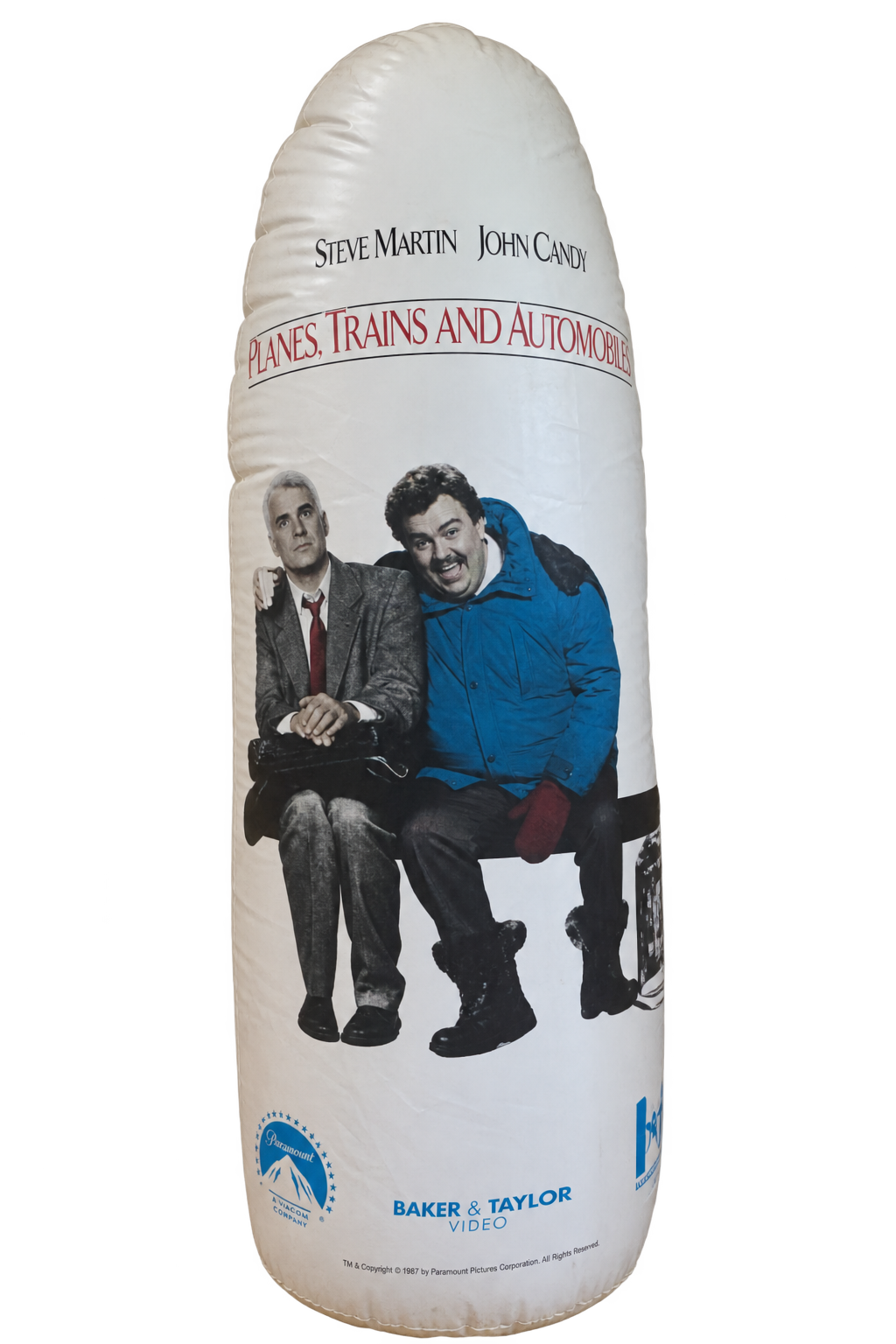
In 1995, my dad took me to a yard sale where I came away with a pristine pair of Reebok basketball shoes, a Chicago Bulls Starter jacket, and, for reasons I can't entirely explain, a four-foot inflatable punching bag advertising PLANES, TRAINS AND AUTOMOBILES. The shoes and jacket were the real prizes, so I doubt my dad paid more than a dollar or two for the inflatable. I punched Steve Martin and John Candy around for a while before relegating them to a corner, where I'd occasionally return to give them another beating. The funny thing is, I hadn't even seen the movie. It would be several more years before I finally watched it, and longer still before I realized that this ridiculous yard-sale afterthought was advertising what would become my favorite movie.
There's nothing like the whole family gathering around the TV at Thanksgiving for a little P-T and A. I've been recommending exactly that for years: first at the end of my DUMB AND DUMBER TO review, when that movie left me wanting a John Hughes experience, and again at the end of my JOHN CANDY: I LIKE ME review. Both times it was a one-line recommendation, which is considerably easier than explaining why a movie means so much to you. PLANES, TRAINS AND AUTOMOBILES is my favorite movie. That isn't necessarily the same as the best movie ever made.
For this review, I watched it twice. The first time I kept pausing, and it turns out a paused frame of John Candy's face is a better lesson in acting than most of the movies I've reviewed. The second time I watched straight through with my parents in the room, mostly to make sure I wasn't looking at it through rose-colored glasses. It still holds up.
Hughes got the idea from a trip of his own. According to the Candy biography, he spent five days trying to get from New York to Chicago for Thanksgiving, and along the way he met a loud, guileless traveling salesman who "knew everything about this kind of situation." Hughes turned those two perspectives into Neal Page, the man who expects a three-hour commute, and Del Griffith, the man who anticipates the unexpected. Neal's whole philosophy fits in a sentence he tosses to a colleague on his way out of the office: "I get in the elevator, I get in the taxi, I get on the plane, then I'm home." Every step is a handoff he assumes will go through. Neal later admits he's spent too much time away from home himself, so experience can't be the whole difference. Del goes with the flow, "like a twig on the shoulders of a mighty stream," and his flow gets him a rental car while Neal's planning gets him keys to one that isn't there. Neither approach works alone. Del's car goes on Neal's Diners Club card, which Del claims turned up in his own wallet, and by the end of that night it has burned. Neal's control survives exactly as long as nothing goes wrong. I walk around the world more like Neal, but when I encounter someone like Del, I'm inclined to meet him halfway. I'll entertain a conversation, even when I'd rather be left alone. That doesn't mean I'm always more patient than Neal, just that I'm better at hiding my impatience.
The film's train stalls out, and the passengers are told to walk a mile and a half to a highway where trucks will take them into Jefferson City. My own worst train ride wasn't nearly so dramatic. I took Amtrak to Vancouver with my sisters for a day trip on a bitterly cold day, and the train kept stopping for reasons nobody explained. What should have taken a couple of hours took five or six, which still left time for dinner and a walk through Stanley Park before heading home. The train was playing THE SANTA CLAUSE 2 on a loop, and I watched it at least three times. On the return trip it was still playing, so I found something else to do. There wasn't a thing I could do about the delays. The only decision left was which window to stare out of.
A modern version of this movie would probably be a lot shorter. There's less face-to-face interaction now, and many of the inconveniences that bring Neal and Del together could be handled on a phone. A stolen credit card can be frozen in seconds, a missing rental sends you searching for another on an app, and the pair would probably take twelve different Ubers home. But technology can't do much about weather or system failures. On November 13, 2026, an FAA communications problem caused the first nationwide ground stop since January 2023. According to the Associated Press, an American Airlines flight from Wichita to Chicago sat on the runway for about an hour before returning to the gate. Passengers were told it was because of "air traffic conditions in Chicago." Back in the movie, Neal's wife, Susan, says, "I don't understand what Wichita has to do with a snowstorm in Chicago." Neal's plane at least made it to Wichita. This one never left.
The first motel confrontation arrives earlier than I remembered. Neal's blowup starts about 23 minutes in, and Del's answer is over by the 26-minute mark, which leaves more than an hour for the film to live with what was said. Neal's lines are also the funniest in the scene, and that's by design. "It's like going on a date with a Chatty Cathy doll" is a joke before it's an insult. So is "Honey, I'd like you to meet Del Griffith. He's got some amusing anecdotes for you. And here's a gun so you can blow your brains out." Hughes lets us laugh, and then lets Del answer. Del doesn't argue that he's good company. He admits he talks too much, adds that he also listens too much, and lands on the line that sums him up: "I like... I like me. My wife likes me. My customers like me 'cause I'm the real article. What you see is what you get."
It hadn't occurred to me how much of Neal's anger has nothing to do with Del. He's already furious about a cab, a flight, and a hotel line, and Del is the one person within reach. A deleted scene at the Page house suggests Neal's troubles extend beyond this trip. Someone says he's been "traveling nonstop for two years" and that "when he is here, his mind is somewhere else." That's a version of Neal the finished film leaves mostly unexplored. The bonus footage also contains a longer version of Del's speech, including "I like people, Neal. People are my business" and "Flaws, fat and boring stories. I'm flesh and blood. I'm a human being." Neal apologizes afterward. I suspect he'd have come to his senses eventually anyway, but the theatrical cut doesn't resolve the argument so neatly. Instead, the next morning finds Del kissing Neal's ear and holding his hand in his sleep. It's played for laughs, but putting that scene immediately after their confrontation feels like a deliberate choice. Moving on to the comedy is a smart move, because if you stay with that scene, it makes you a little sad.
Del almost didn't work. The original screenplay described him as a "slovenly, grotesque slob," and Hughes's son James remembers an airport scene full of sight gags, with Del eating a chili dog and smoking. Editor Paul Hirsch told Vanity Fair that test audiences started to perceive John Candy as taking advantage of Steve Martin, and some of them walked out. The fix was a single exchange. Hirsch restored a few lines at the train station, where Del asks Neal for his address so he can repay him for the ticket. Neal tells him it's a gift, and Hirsch says that one exchange changed the audience's attitude toward Del. The movie remembers it, too. About half an hour later, when Neal accuses him of stealing the credit card, Del says he was going to send it back "with whatever the rental car charge was, plus interest. But you didn't give me your address. What was I supposed to do?" It's a punchline, but it only works because we already know Del asked.
I'd say Candy did the rest. Catherine O'Hara describes him as "completely open" on screen, and says that when Del delivers his "I like me" speech, you want to turn on Neal for having hurt him. That's the test-screening problem in reverse, and it's why the stammer in "I like... I like me" gets me. Del doesn't say it like a man announcing his best quality. It sounds more like a man making sure it's still true. Martin remembers that Candy's longer confession near the end made him cry every time, but the biography says test audiences laughed, and James Hughes recalls Hirsch feeling that the movie had come screeching to a halt. Earlier, restoring a few lines had made Del more sympathetic. Here, cutting most of a beautifully performed confession allowed Neal to discover the truth himself. I think John Hughes made the right decision. Candy didn't need a longer speech to break our hearts, and Neal needed the opportunity to show how much he'd changed. Having watched ONLY THE LONELY before revisiting this, I could see the beginnings of the quieter, more vulnerable performance Candy would give in that film four years later.
Neal tries to end it at 44:19. He frames it as a favor, saying he thinks he's the one holding Del up. Del insists that isn't true, and Neal drops the pretense: "we'll get to where we're going a lot faster if we were alone." Del says, "OK. I see," and then there are ten seconds without a line of dialogue. About six minutes after Neal walks off, Del is back, saying he'd had a feeling "somehow, someday, our paths would cross again." The film never argues that Neal is wrong to be worn out by Del. Del is exhausting, and the movie lets us feel it. What it keeps asking is what that exhaustion is worth. I think of the two men as having separate missions. Neal's is to get home, and he says so out loud, repeatedly. Del's is to forget, for a while, that he's lonely, and he never says so, which is probably why Neal can't see it. From Neal's side of the table, Del is a delay. From Del's, Neal is a chance not to be alone.
The motel scene toward the end, where they're drinking and eating Doritos, might be one of my three favorite scenes in the movie, and it works because neither mission has anywhere left to go. The car has burned, and nothing can move until morning. Del is outside in the cold. Neal asks himself what he did to get hooked up with this guy, then opens the door anyway: "You're going to freeze to death out there." Nothing in the plot requires it. In their first motel room, nearly everything Del did irritated Neal. Here, with their circumstances even worse, they actually enjoy each other's company. They work their way through miniature bottles of liquor, agree it's probably a bad combination, then toast their wives, which hits differently on a second viewing, but I'll come back to that. Neal says he'll look back on all of this and laugh someday, then admits he's laughing already. They find chips in the bed, and one of them wonders why he feels like he's at summer camp. Neal finally likes Del, and the movie doesn't stop to say so. I don't think this film is only about friendship. It's about discovering the value of someone you had no desire to know. Circumstances keep throwing Neal and Del together, but eventually Neal chooses to go back.
I said I'd come back to the toast. The film plants Marie in plain sight. About thirteen minutes in, Del tells Neal he has a motto: "Like your work. Love your wife." During the "I like me" speech, he says, "My wife likes me." Alone in the cold outside the motel, he says, "Well, Marie, once again, my dear, you were as right as rain." When Neal tells him that at least he has "a woman you love to grow old with," Del answers, "Love is not a big enough word for how I feel about my wife," and they drink to the wives. None of it is a lie, exactly. Del talks about Marie in the present tense because that's where his feelings are. The closest he comes to telling Neal the truth is at 43:38, when he says, "I haven't been home in years," and then takes it back as "a figure of speech." At the end of the trip, Neal says, "Say hello to Marie for me. I feel like I know her," and Del's answer is "Yeah." When the truth finally lands, the film replays the clues for Neal: "My wife likes me." "You've got a woman you love to grow old with, right?" "I haven't been home in years." Of those three lines, the middle one is Neal's own, played back to him. The last echoes three times.
What the film doesn't say, I can't stop thinking about. It tells us that Marie has been dead for eight years, and it spends two sentences on it: "I don't have a home. Marie's been dead for eight years." The longer version, the biography says, covered her illness and why Del sold the house, and I don't need it. Everything else is my guess. Del spent his working life on the road, so I suspect he was gone a lot. I sometimes wonder whether a little time apart was actually good for their marriage. The film never says either way. What it does give me is Del telling Neal, "I don't want to argue, all right? Let's not fight," in a tone that doesn't sound improvised. It sounds like something he's said before, and I'd love to know who he said it to. I'm equally curious about his childhood, and the finished film gives me nothing. The bonus footage offers a single line, "My father was a salesman," attached to a tip for tired feet, and I'll take it. The image I keep is a small one. Moments after Del tells Neal he's one lucky guy and Neal says, "I know," Neal hugs his wife, and Del stands off to the side, awkwardly gripping his hat. For a man who never stops talking, he has nothing to say.
I think this is a movie that wants other people in the room, which seems right for a story about being stuck with someone. Twelve or fourteen years ago, I was watching it at a friend's house, with only the two of us there. I'd been curating the evening like James Lipton hosting a film festival, and the main feature had been SPACE JAM, all the way through. It was getting late, and about half an hour into PLANES, TRAINS AND AUTOMOBILES, my friend said he had to go to bed. "Finish the movie if you want, but lock the door on your way out." We'd been friends since middle school, so I took him at his word and stayed. I could have put this movie on first. Instead, I became the houseguest who stays after the host has gone to bed, which makes me Del Griffith, minus the shower curtain rings.
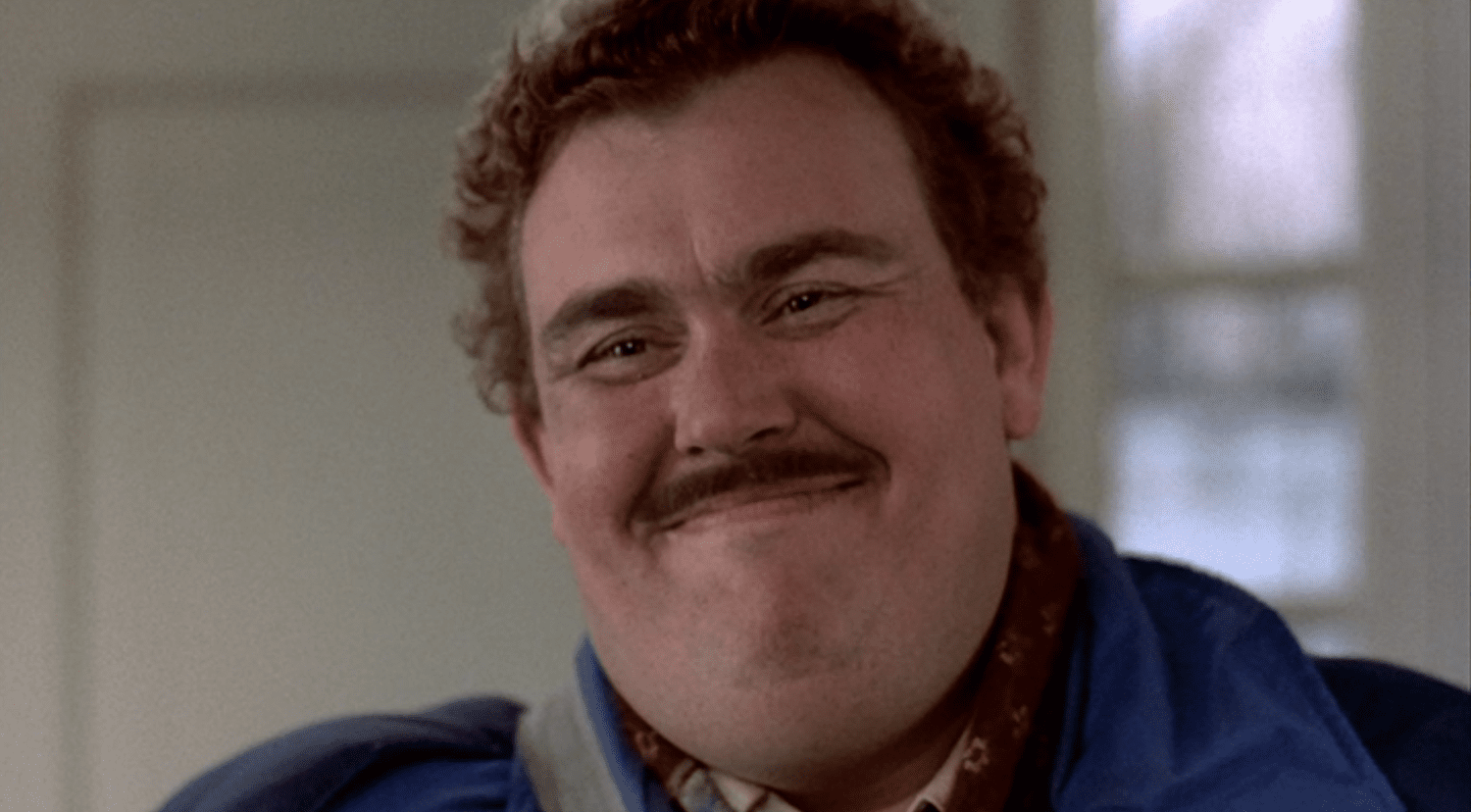
The inflatable I punched around in 1995 had a bit of weight at the bottom, so it popped back up every time. I didn't know it was the most accurate piece of merchandise ever made for this movie. Neal ditches Del, and later, when Del asks, "Are you mad at me?" Neal slugs him in the gut. But Del keeps popping back up, and by the end Neal is the one who goes back for him. The last thing the film gives us is Candy's smile, and you could put it in an art gallery.
Final Verdict: 99 out of 100