
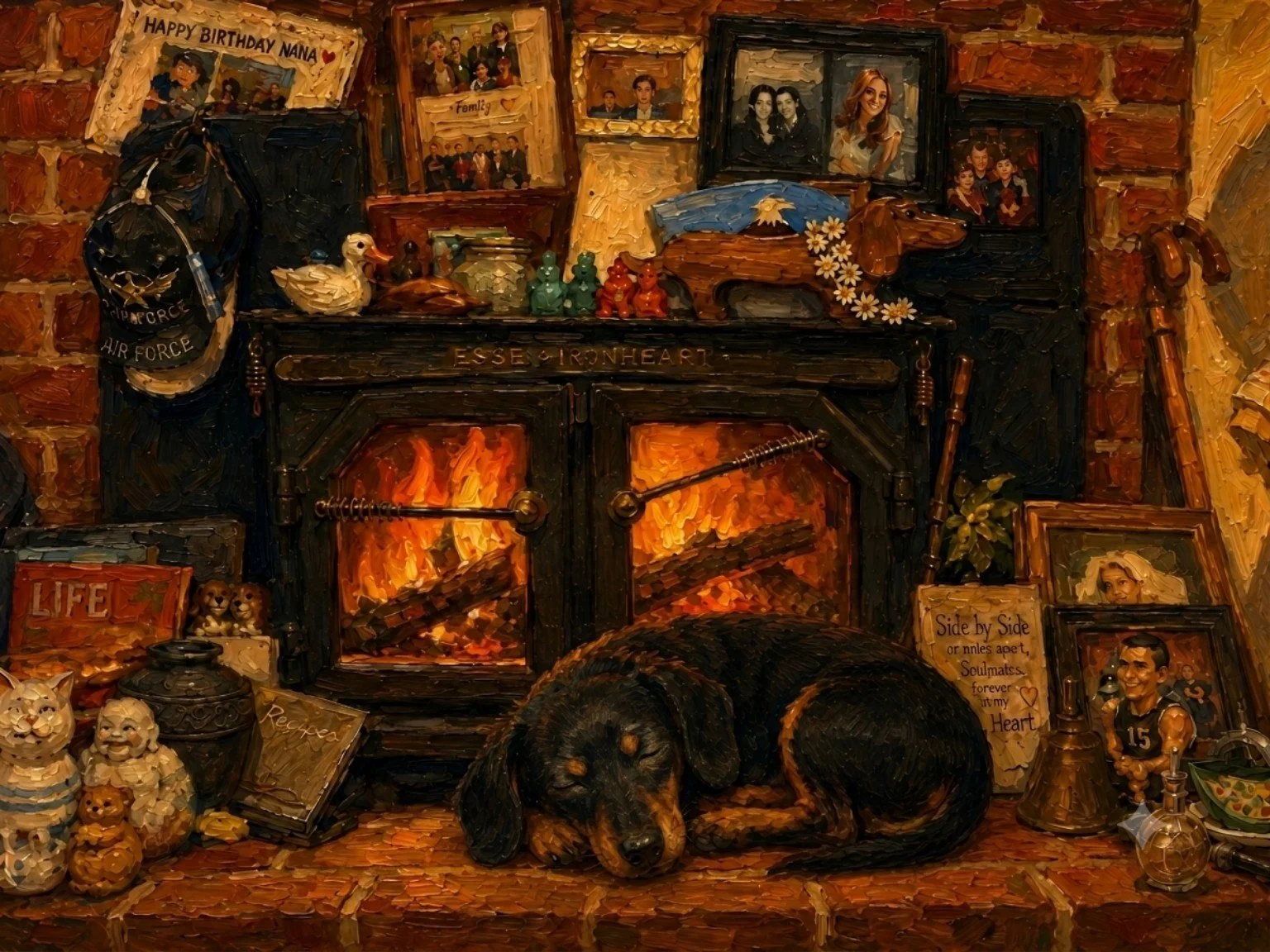
Our dog Butchie was half dachshund and half terrier, with the long body of one and the stubbornness of both. On especially cold winter nights, when my dad lit the fireplace instead of relying on the heater, he'd climb onto the brick hearth and stretch out so close to the slightly open stove doors that it made everyone nervous. There was no convincing him to back away. All we could do was keep an eye on him and make sure he didn't burn himself. He couldn't have explained the physics of heat or the dangers of hypothermia. He simply knew where warmth was. Watching the dog in TO BUILD A FIRE, I found myself thinking about Butchie.
The first fifty seconds of TO BUILD A FIRE aren't Jack London's at all. Before the man or the dog appears, Welles is reciting real history: George Washington Carmack's 1896 gold strike, the hundred thousand who set out for the Klondike, the forty thousand who made it, many of them unprepared for the winter waiting on the other side. It plays like the cold open of a documentary. Anyone catching this on television without knowing London or the story would have every reason to expect a survival-adventure picture, a Grizzly Adams with worse weather. Then the film narrows from a hundred thousand strangers down to one—a newcomer, a chechaquo, one more casualty-in-waiting from that same stampede—and within another few seconds Welles has delivered the story's actual thesis: this man reads the world in pure facts and never once in what those facts might mean. He is, in London's phrase, without imagination. That's not a hero being introduced. That's a diagnosis. Ian Hogg gets almost no dialogue for the rest of the picture, which makes sense: once you've been told exactly why a man is going to die, there's not much reason to let him talk his way out of it.
What "without imagination" costs him becomes clear as the numbers start arriving. Fifty below zero, then seventy-five, then a hundred and seven degrees of frost—the man logs each figure and files it under inconvenience, never converting information into consequence. London's original goes one step further than the movie does: that same failure of imagination, he writes, keeps the man from ever wondering about his own mortality or humanity's place in the universe—a line Welles doesn't read. By cutting it, the film has to make the point some other way. It does, mostly through the dog, who never once needs a thermometer to know that seventy-five below is a killing cold. The whole story is built on this contrast: a man measuring the world in numbers whose weight he cannot feel, walking beside an animal that feels the weight without ever learning the numbers. It's not a stretch to hear something of MOBY-DICK in London's Yukon, though the two men fail in opposite directions. Ahab loads the whale with more meaning than it can bear; London's man strips the cold of every meaning beyond a number. The dog commits neither error. It doesn't need the cold to mean anything. It only needs to understand what the cold demands.
I've felt my face ache in sixteen-degree weather, and that number matters: it is still ninety-one degrees warmer than what the man in the story is walking through. No production insurance covers a real shoot at seventy-five below zero, and no actor signs that release. Whatever Ian Hogg endures on camera is genuine cold, filmed at a survivable temperature, standing in for one that would kill the crew inside the hour. There's nothing dishonest in that; it's simply the same wall the man keeps running into from the other side. He knows it's worse than fifty and no more, with no way to make his body believe even that much. The production knows the real number and has no way to reproduce it. The man cannot even name it: of the man, the actor, and the audience, he is the only one never given the exact figure. He dies on an estimate he already knows is too low.
It's tempting to wonder what happens if the last fire catches—whether the resolve this kind of man is supposed to have would be enough to save him. London had already answered that six years earlier. The 1902 version, published in The Youth's Companion, names the man Tom Vincent, gives him youth and pride instead of a diagnosis, cuts the dog and the old-timer entirely, and finally lets him get a fire going after several failed attempts. He survives with frost-damaged feet and hands permanently scarred by the matches. The 1908 rewrite lowers the temperature further, keeps the same doomed first fire, then removes everything that might let determination rescue him: it adds the old-timer whose warning he ignores, adds a dog whose instinct makes his judgment look worse by comparison, strips his name, and lets every later fire fail. The basic risk is the same—a man alone in weather that can kill him—but what changes is whether resolve can redeem bad judgment. In 1902, it can. By 1908, London had decided it shouldn't, and rewrote the story until it couldn't. The unnamed man on screen is working from the version London ultimately decided was true.
The dog's send-off on the page is a three-part escalation: a soft whine, then a louder one, then—after it catches the scent of death and backs away—one final howl under stars the text describes as dancing, before it leaves for camp. The film's narration skips all three. Whatever whine you hear on screen is Pepper's own performance, not Welles reading London—the movie shows something instead of narrating any of it. But the thing doing the emotional work in that passage was never simple grief. London is precise about the relationship earlier in the story: there was "no keen intimacy" between the two, he writes, and then names exactly what stood in its place—a whip-lash, and the threat of one. The dog stays close to the man for the same reason it stays close to the fire: because distance has a cost. When the provider of both fire and punishment goes quiet, the dog goes and finds the next one. That's the real sadness in it, and it's colder than mourning—not that nothing was ever there, but that what was there was never anything worth grieving. Pepper at least gets a name London never gives the dog. Butchie, stretched across a hearth years before I'd read a word of this, never needed the physics explained to him either. He simply knew exactly where the fire was.
Final Verdict: 84 out of 100