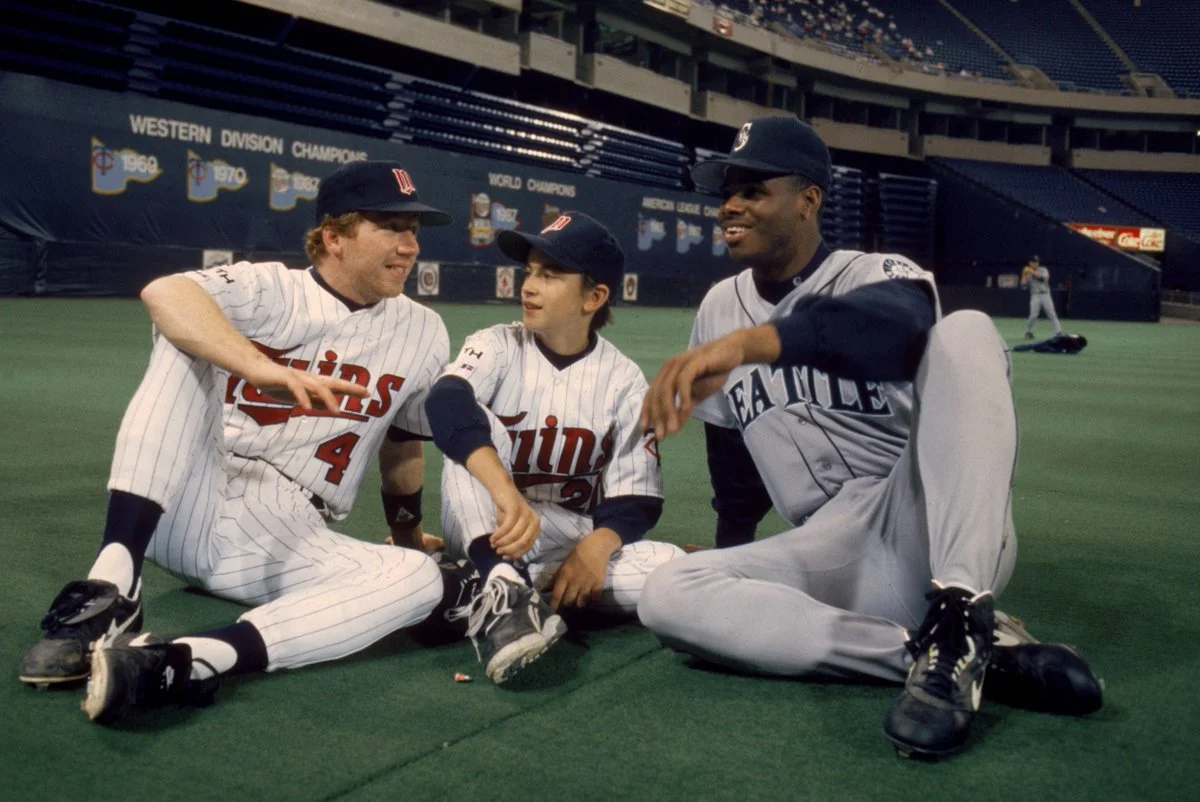
ROOKIE OF THE YEAR is about a child allowed to play adult. LITTLE BIG LEAGUE is about a child forced to become one.
The distinction matters more than it first appears. Henry Rowengartner's fastball is a fluke, a loophole, a summer-long suspension of the rules that govern who gets to stand on a major league mound. Nothing is asked of him beyond showing up and throwing. Billy Heywood's inheritance comes with no such suspension. When Thomas Heywood dies and leaves the Minnesota Twins to his twelve-year-old grandson, the film doesn't hand Billy a fantasy — it hands him a job. Roster decisions, trade negotiations, a clubhouse full of grown men who outweigh him by a hundred pounds and have every reason to resent taking instruction from a kid. Henry gets to play. Billy has to manage.
It's worth sitting with how strange the premise is once you look past its high-concept pitch. Thomas Heywood would have understood, better than almost anyone, what running a baseball team requires — the meetings, the travel, the late nights, the toll. He hands all of it to Billy anyway, with no transition period and no safety net beyond Mac Macnally and a general manager who isn't sure whether to take orders from a child. It is a premise that collapses under literal scrutiny, yet the film still invites questions its fantasy framework cannot entirely contain. The fact that those questions are worth asking is what makes LITTLE BIG LEAGUE more interesting than ROOKIE OF THE YEAR ever needed to be.
Billy has already lost his father before the story begins, and the film is reluctant to dwell on it. Thomas Heywood's death isn't the first hole in this family, it's the second. By the time Billy inherits a baseball team, he has already absorbed the loss that's supposed to be the rarer, harder one for a child to survive — and the film asks him to do it again, in public, with a payroll attached. Billy says as much himself, early on, almost in passing: he'd rather have his grandfather. Not the team. Not the job. His grandfather.
It would be easy to call Billy mature, and the film occasionally settles for that word itself. But maturity isn't quite what's on screen. Maturity can be performed — a kid playing at being older, borrowing the postures of adulthood without believing in them. Billy isn't doing an impression of competence. He simply means everything he says, with a directness that has nothing to do with age. Watching his grandfather's will on video, Billy hears the lawyer prompt him toward the obvious response — isn't it wonderful, his grandfather gave him the Twins — and doesn't take it. He'd rather have his grandfather. The room is full of adults — his mother, a lawyer, Arthur Goslin — and the easy answer was sitting right there for him to pick up. He's telling the truth, the way children do before they learn that adults usually want something gentler. That quality — sincerity, not maturity — is what makes the rest of the film's premise bearable to watch instead of merely strange.
LITTLE BIG LEAGUE is unusually direct about what it thinks adulthood is. When O'Farrell refuses to use a player Billy and Arthur both rate higher, Arthur tells him, with all due respect, that he's acting like a first grader — and he isn't wrong. O'Farrell's response is to mock Billy for playing in the owner's box with his "little buddies" and suggest he go home and build a fort, the age insult as a last resort from a man who's been told he's the one behaving like a child. He's fired within the same scene. The resistance within the clubhouse isn't much better at first — a grown man taking instruction from a sixth-grader is, fairly enough, a hard thing to swallow — but the film repeatedly lets that resentment curdle into something closer to tantrum than principle. Mac Macnally and Lou Collins are the exceptions, and they're exceptions for a specific reason: they're the only adults in the film who respond to Billy as if his age and his sincerity are two different facts, worth treating separately. Everyone else conflates them, and in doing so makes themselves look smaller than the boy they're refusing to take seriously.
There's a small, specific pleasure in watching this movie as someone who grew up rooting for the team on the other side of the ball. Late in the film, Lou Collins gets all of a Randy Johnson pitch and sends it toward the stands — and Griffey takes it away at the wall before it can leave the yard. I remember watching that scene for the first time, younger than Billy is in this movie, and feeling no suspense at all. Of course Griffey caught it. That's what Griffey did. The film isn't asking me to believe something about its fictional world; it's just confirming something I already knew about the real one.
For all the responsibilities the film places on Billy, it never mistakes him for a child genius. Half the Twins roster ends up crowded around a chalkboard, trying to solve a math word problem from Billy's own homework: if Joe can paint a house in three hours and Sam can do it in five, how long would it take them together? They get nowhere until Jim Bowers produces the answer. Billy, fluent in trade value and bullpen management and reading a pitcher's mechanics the way other kids read comic books, has nothing to add to his own assignment. He is not a genius. He is a baseball savant, and the difference matters — his gift has a shape, and that shape happens to be exactly what a baseball team needs from him and nothing else.
That narrowness is its own kind of warning sign. The friendships survive, but they no longer occupy the center of Billy's life. Baseball does. The job is technically optional — Mac would run things, Arthur would run things, the team would survive a season without a twelve-year-old owner attending every game — but managing wasn't even part of what Billy inherited. He takes it on himself, and the film never seriously asks whether he should have. He can handle the job. That's not the same as belonging in it, and the film is more honest about the difference than its premise has any right to be.
Jason Robards appears in LITTLE BIG LEAGUE just long enough to haunt the rest of it. Thomas Heywood gets a handful of scenes before the video will makes his death official, and the film doesn't ask Robards to do much in them beyond be warm, be wise, and be gone. That's enough. Robards has the kind of presence that doesn't need screen time to accumulate weight — he carries the authority of a man who makes the bequest feel emotionally plausible, even when the logistics remain absurd. Every adult who fails Billy afterward, every player who resents him, every ounce of resentment Billy has to absorb without complaint, traces back to a grandfather who survives only as a video recording. Robards isn't in the movie to dominate it. He's there so that his absence has a face.
That's the case for the movie. The case against it is shorter, but harder to ignore.
The film knows what baseball mythology sounds like. Billy says as much himself, in a speech to his own players about playing in the same outfield as DiMaggio and Mantle, stepping into the batter's box where Ted Williams once stood — Fenway and Yankee Stadium invoked by name, treated as something closer to sacred ground than real estate. It's a good speech. The trouble is what the film does with the real thing once it gets there. Billy's own trip to Fenway amounts to him asleep through most of it — the one park in the movie steeped in exactly the history he finished describing moments earlier, and he isn't awake to see it. The Metrodome, where the bulk of the movie lives, is the opposite kind of problem: a controlled, artificially lit interior that never once looks like the cathedral Billy describes in his own dialogue. Comiskey Park gets closer — one of the few moments in the film where baseball feels like a place rather than an environment — but it's a brief exception in a movie that otherwise keeps choosing the version of the sport with the natural light switched off, even as its dialogue keeps reaching for something grander.
The performances tell a similar story. Luke Edwards is convincing exactly where the film needs him to be — on a mound, in a dugout, reading a clubhouse — and noticeably less so in the scenes that ask him to carry ordinary adolescence, as though the role only fully fits him when there's a baseball in the frame. The supporting cast often compensates, except where the film leaves the most obvious opportunity sitting on the table. Lou Piniella, playing a version of himself, is given almost nothing to do with his own reputation; a manager known for kicking bases and screaming his way through arguments shows up oddly restrained here, and the film never cashes in on the obvious joke sitting right there in his casting. The comedy elsewhere is similarly uneven, landing more often in the margins — Billy's friends get sharper lines than the plot does — than in the scenes the film is clearly building toward. None of this would matter much at ninety minutes. At nearly two hours, a film this thin on plot starts to feel its length, stretching a premise that was always better suited to a tight, economical run at the idea.
The film has its real ending sitting right there in the locker room, and chooses not to use it. Billy tells the team he's retiring — not from ownership, just from the job of running them day to day — and gives them the only reason that's mattered for two hours: he wants to go fishing, he wants to play Little League, he wants to be a kid again before the option disappears. It's the quietest scene in the movie and the only one that fully earns everything this review has spent its time building. Then the film immediately gets nervous about it. Billy walks back outside to find the crowd still waiting for him, and LITTLE BIG LEAGUE closes not on a boy deciding to put the job down, but on a boy walking back into the spotlight one more time, to applause, with triumphant music swelling underneath. The movie wrote the ending it needed. It just didn't trust it enough to let it be the last thing we see.
Final Verdict: 67 out of 100
Sidenote: