Local Hero (Retro)

by Edward Dunn


LOCAL HERO (1983) PG 111 minutes Director: Bill Forsyth Writer: Bill Forsyth Peter Riegert, Burt Lancaster, Denis Lawson CAST Peter Riegert...Mac MacIntyre Burt Lancaster...Felix Happer Denis Lawson...Gordon Urquhart Fulton Mackay...Ben Knox Peter Capaldi...Oldsen
When I feel
that the world is too much for me
I think of the Big Sky
and nothing matters much to me.

— “Big Sky,” Ray Davies / The Kinks (1968)

I found LOCAL HERO the way Mac MacIntyre found Ferness — by accident, through a chain of events I couldn't have planned. I was listening to a Northern Exposure podcast when a producer named Cheryl Block mentioned in passing that Josh Brand had watched this film while developing the show and couldn't stop talking about it. On a whim I pulled it up. I had no prior attachment to it, no childhood memory, no critical framework telling me how to feel. I didn't even know who was in it. What I knew was that a 1983 Scottish film about an oil company trying to buy a village had somehow inspired one of my favorite television shows, and that seemed like enough of a reason. Two hours later I wasn't entirely sure what had happened to me.

I kept trying to find something to compare it to. The better Albert Brooks films came to mind — where a man whose structured, success-driven life quietly dissolves around him without anyone raising their voice. Northern Exposure is the obvious reference point, for reasons that turn out to be less accidental than they appear. You can feel the inheritance everywhere: in the eccentric community that never condescends to its own quirks, in the conversations that drift into philosophy without announcing it, in the humor that arrives sideways and leaves before you've fully registered it. The closest I came was an unlikely one — watching JURASSIC PARK for the first time. Not because the films have anything in common, but because of that specific feeling of discovering a place you don't want to leave. All of these comparisons are slightly wrong. LOCAL HERO slips out from under all of them. It is, stubbornly and completely, its own thing.

It almost wasn't this movie at all. Warner Brothers and Goldcrest, uncomfortable with the little-known Peter Riegert in the lead, pushed hard for Henry Winkler. The Fonz. There is a version of this review where I spend several paragraphs trying to unsee Arthur Fonzarelli feeding ten pence coins into a Scottish phone box, watching the aurora borealis, maybe even racing that motorcycle guy outside the hotel. Forsyth had written the role with Riegert in mind and had no interest in anyone else. What I can tell you is that Riegert's particular quality — understated, slightly opaque, a man whose face doesn't arrive with prior associations already attached — is load bearing. Forsyth held firm. When Riegert apparently told him he'd understand if the politics of Hollywood forced a different choice, Forsyth's response was simple: if you're not in it there's no movie.

The setup is deceptively simple. Mac MacIntyre, a junior executive at Knox Oil and Gas in Houston, is sent to Scotland to buy a small fishing village and its bay for a new refinery. He's chosen for the assignment because of his Scottish surname, a detail that turns out to be something of a fiction — his family changed their Hungarian surname to MacIntyre when they arrived in America because they thought it sounded more American. He is sent to negotiate with his own people and has no people. When he arrives in the fictional village of Ferness he finds a community that is warm, eccentric, and almost comically eager to sell. The expected conflict — scrappy locals defending their way of life against corporate destruction — never materializes because nobody is playing their assigned role. The villagers want the money. Mac finds himself falling in love with the place he's supposed to be buying. The oil company's eccentric billionaire owner is more interested in finding a comet than running an oil company. The film keeps setting up a confrontation and then quietly declines to have it.

Ferness is a village where everyone has at least three jobs and nobody thinks this is unusual. Gordon Urquhart runs the hotel, tends bar, drives a taxi, fixes lobster creels on the beach, and happens to hold power of attorney for the entire community in negotiations with a multinational oil company. The reverend is African — he came as a student minister decades ago and never left, which strikes nobody as remarkable. A Soviet fisherman named Victor shows up for the ceilidh and immediately starts discussing currency markets and short-term deposits with Gordon, because of course he does. Early on, Mac and Danny stand on the pristine beach they've been sent to buy and marvel at everything petroleum makes possible — nylon, polythene, dry cleaning fluid, waterproofs. The jets overhead really spoil a very nice area, Mac observes, apparently without irony. The whole village piles into the church to scheme about how to extract maximum money from the oil company, which is either the most Scottish or most human thing in the film, possibly both. And somewhere in the background, a man on a motorcycle nearly runs people down every time they walk out of the hotel, unexplained, unremarked upon, permanent.

LOCAL HERO was made in 1983, before the internet, before smartphones, before the average person spent their waking hours staring at a screen in a city that had forgotten what the night sky looked like. And yet it feels urgently contemporary in a way that has nothing to do with nostalgia. The film is quietly obsessed with scale — specifically with what happens to a person when something reminds them of their actual size in the universe. Happer, one of the most powerful men in the world, pays a therapist to abuse him and dreams of having a comet named after him. Mac arrives from Houston, where, as Forsyth noted, you can't readily look up and see the stars. Ferness has no such problem. The sky over Scotland keeps interrupting the business of buying and selling — a meteor shower stops Mac cold, the aurora borealis stops an entire community mid-thought, and when Happer finally arrives by helicopter the lights are so extraordinary that his entrance feels less like a business trip than a landing from another world. Ben Knox already understands all of this. He lives on a beach, owns no possessions worth mentioning, knows the night sky like his own backyard, and cannot be bought for any amount of money. The film's argument, delivered without a single speech, is that Ben has the scale of things exactly right — and that understanding your place in the universe doesn't make you small. It makes you free.

Ben Knox is the soul of the film and the hardest character in it to explain. He lives alone in a shack on a beach he has owned for four hundred years, a gift from the Lord of the Isles to an ancestor who helped out with a spot of trouble — killed his brother, something like that. He has eight unplotted objects in the night sky nobody else has bothered to catalog. Coconuts and oranges wash up by the North Atlantic Drift; he accepts them as perfectly normal. Ben cannot be bought. Not for a hundred thousand pounds, not for half a million, not for any beach in Hawaii or Australia. When Mac spreads postcards of tropical beaches in front of him, Ben looks at them politely and notes that they seem like very nice beaches, but he only needs the one. He already has this one. The company is even named after him, in a roundabout way — Knox Oil and Gas, Ben Knox, a coincidence Forsyth plants without explanation or emphasis, the way he plants everything. When Happer finally arrives and the two of them disappear into the shack together, the film stays outside with everyone else. Forsyth said he simply didn't know what they would say to each other. The audience fills it in themselves. Whatever it was, Happer comes out having decided to build an observatory instead of a refinery. Ben stays on his beach. The film considers this a happy ending. It's right.

There is a version of LOCAL HERO that is a slightly better film than the one that exists. It lives in the first act. Mac's Houston life — the migraines, the Porsche, the electrically locked briefcase, the ex-girlfriend who took his camera case, the office where everyone cheerfully discusses buying a country over lunch — needed more room to breathe. The counterweight to Scotland had to be heavy enough that when Scotland dissolves it, the audience feels the full weight of what's happening. As it stands the Houston section moves quickly in a way that slightly softens Mac's transformation. You feel him changing, but you don't fully feel what he was changing from. This is not a guess. David Puttnam identified it himself before the film even opened, calling the first act cuts the film's flaw — the price paid for getting the runtime to a manageable length. When Mac calls Houston two days into his trip and says it feels like he's been in Ferness forever, the line should hit like a small earthquake. It does hit. It just hits a little softer than it might have. Those are the eight points I'm withholding. Not for what's there. For what got cut.

Warner Brothers wanted a different ending. Mac returns to the village, gets embraced by his mates, marries a local girl. The full upbeat Hollywood resolution. Forsyth refused. His original ending was Mac back in his Houston apartment listening to the sounds of the city — no sentiment, no hope, just the noise closing back in. Puttnam negotiated a compromise. Forsyth remembered he had a shot of the village with the phone box in the mid-ground. They added the sound of it ringing. Warner Brothers found it acceptable. That became the ending. The instinct to side with the artist against the studio is almost always correct and the history of Hollywood is full of good reasons for it. This is the rare exception. The compromise produced something neither party was aiming for — genuinely open, genuinely moving, and completely consistent with a film that refused to tell you what to think from the first frame to the last. Mac is back in Houston. The phone is ringing. Whether anyone answers it is entirely up to you. Puttnam said it best — if they had done everything Warner Brothers wanted nobody would be talking about this film today. They compromised on the ending and held firm on everything else. That turns out to be exactly the right set of compromises to make. Most studios get it precisely backwards.

Everything about LOCAL HERO should tip into sentimentality. A man finds a beautiful place and doesn't want to leave. An old eccentric saves a beach from corporate destruction. A lonely billionaire finds connection with a stranger over a shared love of the stars. A community's way of life is preserved. Mark Knopfler playing gentle guitar over Scottish landscapes. Any one of those elements in a lesser film would have you reaching for a bucket. Forsyth avoids it through a combination of techniques that work so naturally you don't notice them operating. The humor cuts through at exactly the right moments. Nobody explains their feelings. The film refuses to linger on its most emotional moments — it lets them happen and moves on before you can be manipulated by them. The rabbit is funny and then it's dinner. The aurora borealis is beautiful and then Mac needs more ten pence pieces. Happer and Ben bond in a shack and the camera stays outside. What remains is something difficult to describe. Not happiness exactly. Not melancholy. Something closer to the feeling the Kinks were reaching for in Big Sky — when the world gets to be too much, think of the big sky, and nothing matters quite so much anymore. I watched this film with no preparation, no nostalgia, no prior attachment, and it still did that to me. That's the only honest thing I can tell you about it.

Final Verdict: 92 out of 100

Sidenote: Just like 3 NINJAS, LOCAL HERO is also freely available on YouTube.

3 Ninjas (Retro)

by Edward Dunn


3 NINJAS (1992) PG 84 minutes Director: Jon Turteltaub Writers: Kenny Kim, Edward Emanuel Victor Wong, Michael Treanor, Max Elliott Slade CAST Victor Wong...Grandpa Mori Tanaka Michael Treanor...Rocky Max Elliott Slade...Colt Chad Power...Tum-Tum Rand Kingsley...Hugo Snyder Alan McRae...FBI Agent Brown Professor Toru Tanaka...Mr. Sakata Joel Swetow...Eddie Patrick Labyorteaux...Fester Kate Sargeant...Emily

There are two versions of 3 NINJAS. Most Americans don't know this. The version that played in U.S. theaters in the summer of 1992 is not the same film that screened across Europe. The European cut runs several minutes longer, closes a subplot the American version leaves dangling, and is modestly — though meaningfully — the superior film. This distinction would have meant nothing to me in the fall of 1992, when I was eight years old and sitting in the Alderwood Village Cinema 12, a $3 second-run house in Lynnwood, Washington, watching the lesser version without knowing another one existed. I wouldn't find out for thirty years.

3 NINJAS exists at the intersection of HOME ALONE and TEENAGE MUTANT NINJA TURTLES, two properties that had recently demonstrated that children consuming large amounts of sugar would pay to watch other children cause chaos and mayhem. The film follows three brothers — Rocky, Colt, and Tum-Tum — who spend their summers training in ninjutsu under their Japanese grandfather, Mori Tanaka. Their father is an FBI agent pursuing an arms dealer named Hugo Snyder, who happens to be Grandpa's former partner. Snyder, believing that leverage is the sincerest form of negotiation, hires a trio of burnout criminals to kidnap the boys.

Victor Wong, best known as Egg Shen in BIG TROUBLE IN LITTLE CHINA, anchors the film in a way it doesn't entirely deserve. If the production was aiming for a Mr. Miyagi figure, they largely achieved it, though Wong is working considerably harder than the material requires. His presence gives the movie a credibility it has no other claim to.

The children do not look remotely Asian. Their mother mentions her Asian side at one point, but she presents as entirely white. This is not a KUNG FU-David Carradine situation where the casting could even pass as half-convincing. The grandfather is Japanese. The grandchildren very clearly are not.

The villain, Hugo Snyder, is played with full cartoonish commitment by Rand Kingsley — think Terry Silver from KARATE KID III, a man who has confused menace with theatrics. His henchman Mr. Sakata, played by Professor Toru Tanaka, is a stocky, intimidating presence who finally gives the boys a credible physical challenge in the third act. Sakata is, briefly, the most interesting antagonist in the film.

The score deserves mention as a cautionary example. It sounds like some guy fucking around on a Casio keyboard, a vague approximation of what Danny Elfman does. There is a great deal of whimsy. None of it lands.

Most of the genuine comic inspiration involves Fester and his two associates, a trio of burnout criminals hired to kidnap the boys. When they're ordered to grab the children, one of them asks, with genuine professional concern, "Could these be like any kids, or did you have some specific ones in mind?" They are menacing one moment and catastrophically stupid the next, and the film is wise enough to lean into this contradiction. "This kidnapping is so much better than armed robbery," one of them observes over stolen pizza, and he is not wrong. Their van has a Die Yuppie Scum sticker on it, which tells you nearly everything you need to know about these men and their life choices. Their plans are hilariously half-baked, just like their brains. When the boys deploy homemade weapons against them — throwing CDs like ninja stars, lobbing pepper bombs, administering what is described as "instant diarrhea" via laxative — the chaos is energetic and occasionally funny. When one of them takes a CD to the face, his anguished "Ooh! Watch my nose, dude! It's bad news already." is delivered with the commitment of a man who has genuinely earned his suffering. Ex-Lax does not cause instant diarrhea. Nobody cares.

The movie also gestures toward kidnapping Emily, the girl next door and Rocky's unofficial love interest, before abandoning the idea entirely. The setup is there. The payoff is not. This is a pattern throughout: ideas are introduced for tension or laughs, then abandoned when the script loses interest. Similarly, I don't believe for a moment that any of the boys would genuinely lose faith in their grandfather. The film requires them to, briefly, and they do, because the script says so.

Most American action films ask the audience to accept certain physical impossibilities — a hundred-pound woman defeating a man twice her size, for example. In this film, three boys systematically dismantle a houseful of grown men. It is the same logic applied to smaller protagonists. In a kids' movie this is arguably forgivable. It is still funny to notice.

I can confirm from personal experience that the film works on its intended audience. In the fall of 1992, my friend Jason, who lived nearby and was, if such a thing is possible, even nerdier than me, had an eighth birthday party. His parents drove two carloads of children to the Alderwood Village Cinema 12, and we watched 3 NINJAS with smuggled popcorn from sack lunch bags. Afterward, we walked across the parking lot to Chuck E. Cheese, play-fighting the whole way there. The movie had done its job. And yet, even then, something didn't sit right with me. I couldn't have articulated it at eight years old, but the feeling was there. The film was fine. It wasn't quite enough.

It would take thirty years to understand why.

The version I saw that day was the American cut. In the European version, the basketball scene plays differently. The boys do not win. The stakes are not Emily's bike — the bullies simply threaten to rearrange their faces, and when the game ends they ride off with the bikes anyway. This is more convincing. The American version has Rocky executing a six-foot slam dunk to win back the bike, which is the kind of moment that feels thrilling at eight and faintly exhausting at forty. More significantly, the European version adds an entirely new sequence after the Snyder plot resolves — the boys walking home, bickering over borrowed bikes, Rocky returning to confront the bullies and recover what was taken. It closes a loop the American version leaves open. The film feels finished.

None of this makes 3 NINJAS a good movie. The European cut is a modest improvement on a film that was adequate to begin with. The American version is good enough for an eight-year-old. I can personally attest to that, though "good enough" is doing real work in that sentence. That's the version getting scored here.

Clearly, what I should have done is decline that birthday invitation. No, Jason, I will not attend a fun birthday party full of neat friends to watch a vastly inferior version of 3 NINJAS. Instead I will convince my parents to drive to a seedy electronics shop in downtown Seattle and purchase a multi-system VCR. And I shall import the uncut VHS tape from Germany. Anything less is pure blasphemy.

Final Verdict: 50 out of 100 (55 if you can find the right bootleg)

Sidenote: Both versions are currently freely available on YouTube...for now.


Celtic Pride (Retro)

by Edward Dunn


CELTIC PRIDE (1996) PG-13 91 minutes Director: Tom DeCerchio Writer: Judd Apatow, Colin Quinn Damon Wayans, Daniel Stern, Dan Aykroyd CAST Damon Wayans...Lewis Scott Daniel Stern...Mike O'Hara Dan Aykroyd...Jimmy Flaherty Marcia Strassman...Carol O'Hara Christopher McDonald...Coach Kimball Vladimir Cuk...Lurch Bill Walton...Himself Larry Bird...Himself

I saw CELTIC PRIDE in a theater in 1996. I was a kid, and I still liked most movies at that point. Even then, something felt off. I couldn't have told you what it was. I just knew that I was supposed to be rooting for these two guys and I wasn't.

It took me thirty years and two viewings to figure out why.

By 1996, the Celtics were no longer a team anyone celebrated. The Bird era was over. The Boston Garden had already closed and was waiting to be torn down. The team was bad — genuinely, embarrassingly bad — stuck in the kind of rebuilding purgatory that has no romantic name. This was after Larry Bird, and well before Paul Pierce. If you were a Celtics fan in 1996, you were a person in mourning who hadn't fully accepted it yet.

I came to the Celtics later, and sideways. Seattle still technically had a team when Ray Allen got traded to Boston, but nobody was paying attention anymore. You don't abandon a franchise. Sometimes a franchise abandons you first.

The setup is simple enough. Two Boston superfans kidnap Utah Jazz star Lewis Scott the night before game seven of the NBA Finals, hoping to keep him out of the game long enough for the Celtics to win a championship. They didn't exactly plan it — they blacked out, and Scott was just there when they came to. But they make the conscious decision to keep him, which is where the moral accounting should begin. It never really does.

CELTIC PRIDE wants you to find this charming. Two lovable obsessives doing a desperate thing for the team they love. The problem is that Lewis Scott didn't do anything to them. He's just very good at basketball. Mike and Jimmy are committing a felony against a man whose only offense was being employed by the wrong franchise.

A movie built on this premise has two options. It can commit to the comedy and make everything weightless enough that the audience never stops to think about it. Or it can acknowledge the darkness and do something honest with it. CELTIC PRIDE tries to split the difference and ends up with neither.

This is a movie that has opted out of consequence entirely. A police officer shows up while Scott is being held at gunpoint and just walks away. Later, Mike's wife learns about the kidnapping and doesn't call the police. By the end, Scott himself covers for them. And in case that wasn't enough, they receive a hundred thousand dollars for their trouble. It isn't just saying the kidnapping was fine. It's saying everyone benefited from it.

The closest comparison I can think of is BIG FAN, a 2009 film that takes a similar premise — obsessive fan, athlete, a line that gets crossed — and never blinks. That film understands that this kind of story only works if you're willing to look directly at what fanaticism actually costs. CELTIC PRIDE keeps looking away.

Daniel Stern is the most capable actor in the cast and the most wasted. Anyone who has seen him in DINER or BREAKING AWAY knows what he can do with a character who is quietly falling apart. There are traces of that here — the divorce, the failed athletic dreams that Carol's therapist has already diagnosed — but it never follows through on any of it. Instead it asks him to ride the goodwill of his HOME ALONE persona until the wheels fall off. Mike O'Hara had the potential to be genuinely tragic. He ends up being Marv with a Celtics jersey.

Dan Aykroyd is a different problem. His best work has always leaned into his strangeness — BLUES BROTHERS, GHOSTBUSTERS, even CONEHEADS finds the right vehicle for his particular energy. Jimmy Flaherty needed someone whose obsession reads as unhinged and human simultaneously. Aykroyd comes across as unhinged and alien. The Boston accent doesn't help. It hits the broad markers but never finds the rhythm, and by the third scene the accent begins to overwhelm the character.

Christopher McDonald is playing a familiar variation of himself. In this case, that's exactly what the movie requires — a coach radiating Tom Thibodeau levels of sideline stress.

Damon Wayans, to his credit, is competent. That sounds like faint praise and it is, but competent is the ceiling in a film this untethered. He's playing the only character with any grounding in actual consequence, and he doesn't oversell it. The press conference apology is a good example — his character explains his back problems come from carrying a sorry excuse for a team all season. It lands somewhere between groan and laugh, which is probably the best CELTIC PRIDE ever manages.

There is something performative about the fandom here that never goes away. Mike and Jimmy feel less like obsessives and more like two men doing an impression of what fanaticism looks like. The jerseys, the memorabilia, the superstitions — it all reads as a costume rather than a life. A real fanatic has a specificity to their devotion that is almost impossible to fake. These two could take the jerseys off and go home.

CELTIC PRIDE is rated PG-13, which means the real texture of Boston sports fandom in that era is completely off the table. Anyone who has spent time around that particular strain of New England loyalty knows it has edges it was never going to touch. What you're left with is a sanitized version — fandom as the studio imagined it.

The best thing in CELTIC PRIDE is a peripheral character named Ilyalurtz Bronfermakher, listed in the credits simply as Lurch. He is a seven foot Eastern European player on the Jazz roster who gets approximately four minutes of screen time and is more fully realized than anyone the script is focused on. Vladimir Cuk, who plays him, was a real basketball player before he was an actor, and the cadence he brings to the role is not something you could coach. When Lurch tells his coach he has got the bad crap, and then misses a sure slam dunk, it is the funniest moment in the movie. When he is finally called off the bench late in the game and informs the coach he will be giving them some of that death row shit, you almost wish the movie was about him instead.

The most unexamined relationship in the movie is Mike's wife Carol. Carol is established early as the voice of reason — she has been holding divorce papers for years, her therapist has diagnosed the obsession, she has clearly had enough. Then the kidnapping happens and she just stops being a person. She doesn't report it. She roots for the Jazz to protect her husband from consequences. And presumably stays married to him at the end. CELTIC PRIDE spends the first act building her as someone who finally sees clearly, then quietly asks her to forget all of it. She never gets an explanation and neither does the audience.

CELTIC PRIDE closes with two scenes that tell you everything. After the Celtics win, a police officer asks Lewis Scott if these two men have perpetrated a crime against him. Scott looks at Mike and Jimmy and says "I know these two jerks, they're my friends." No consequences, no accountability, no acknowledgment that anything wrong occurred. The victim absolves his kidnappers because the movie needs a tidy ending and couldn't think of a better way to get there.

And then, seven months later, Mike and Jimmy are outside Deion Sanders' house. In a better movie this might have worked as a jokey button that sends the audience out laughing. Here it just confirms what you already suspected. CELTIC PRIDE doesn't just let them off the hook. It endorses them, suggests that kidnapping athletes is simply what devoted fans do, and that getting away with it once is a reasonable argument for doing it again. CELTIC PRIDE mistakes the absence of consequence for charm. They are not the same thing.

I knew something was wrong with this movie when I was a kid. Thirty years later I can finally explain it. CELTIC PRIDE is a movie about getting away with it. Unfortunately that applies to the filmmakers too.

Final Verdict: 33 out of 100


Air Bud (Retro)

by Edward Dunn


AIR BUD (1997) PG 98 Minutes Director: Charles Martin Smith Writers: Paul Tamasy, Aaron Mendelsohn Kevin Zegers, Michael Jeter, Bill Cobbs CAST Kevin Zegers...Josh Framm Michael Jeter...Norm Snively Bill Cobbs...Arthur Chaney Wendy Makkena...Jackie Framm Eric Christmas...Judge Cranfield Brendan Fletcher...Larry Willingham Norman Browning...Coach Barker Nicola Cavendish...Announcer Stephen E. Miller...Principal Pepper Shayn Solberg...Fog Frank C. Turner...Referee

There are two kinds of people in this world — those who like golden retrievers, and...just kidding, there's only one kind of people.

I should also tell you upfront that before writing this review, I read a 348-page book about the real dog, Buddy. To be fair, at least a third of it is about the author.

I'll admit I tried watching AIR BUD once before and checked out after twenty minutes. The IMDb rating of 5.4 didn't exactly inspire confidence, and I went in looking for immediate absurdity rather than what the movie actually is — a family sports film that isn't in any hurry to earn its premise. That was my mistake, not the movie's.

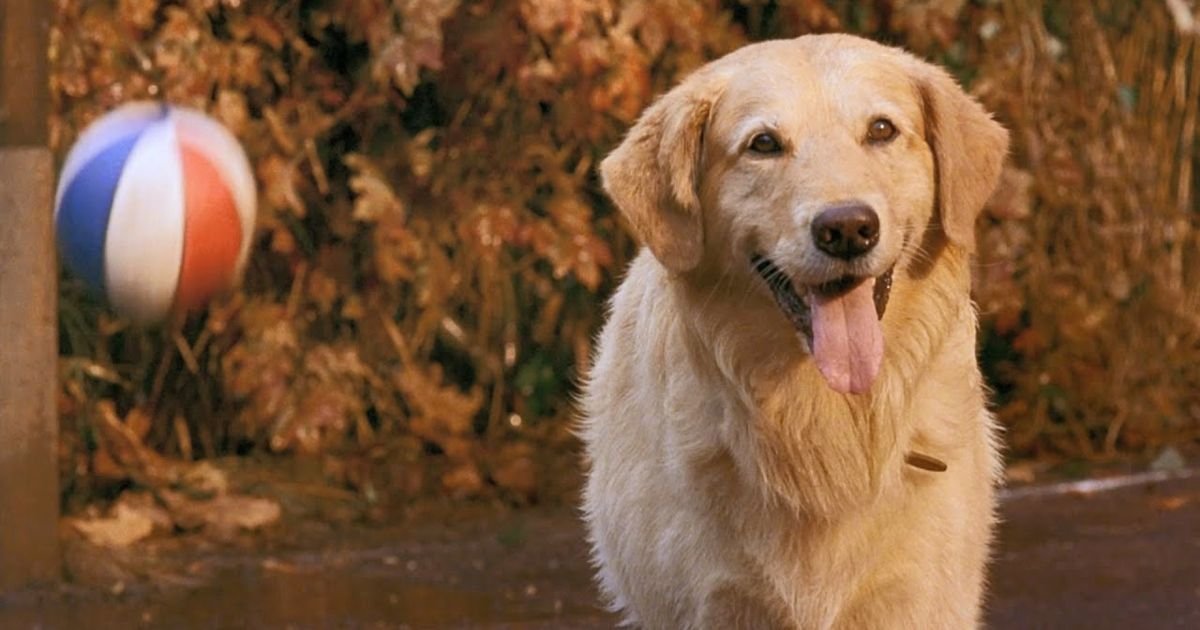
GO, BUDDY! — the book written by Kevin DiCicco, the man who found and trained Buddy — changed my approach entirely. The real story isn't what you'd expect. He was a scraggly, pinecone-obsessed stray that DiCicco stumbled across in the Sierra Nevada, nursed back to health, and then discovered almost by accident had a peculiar gift for basketball.

The talent snowballed organically — AMERICA'S FUNNIEST HOME VIDEOS, then David Letterman's Stupid Pet Tricks, then Disney. Hollywood didn't manufacture Buddy. It just scaled up something that already existed.

Knowing that going in makes the movie feel less like cynical product and more like a document of something that actually happened to a real animal. That's a better starting point for a review.

AIR BUD opens with a kid who has lost his father and a dog who has lost his dignity. Josh Framm is twelve, quiet, and new to Fernfield, Washington — though you'd pick up on the Pacific Northwest setting less from anything the movie tells you and more from the casual Shawn Kemp references. The grief isn't milked. The movie establishes it, respects it, and then lets the dog do the therapeutic heavy lifting.

What's refreshing about AIR BUD is how unapologetically sincere it is about all of this. It knows exactly what it is — a movie about a golden retriever who plays basketball — and it never once tries to be anything else. There's no winking at the camera, no meta-commentary, no attempt to justify its own premise. It simply commits, which turns out to be harder to pull off than it looks.

The villain of the piece is Norm Snively, an alcoholic clown who loses Buddy during a disastrous birthday party performance in the opening scene. Michael Jeter plays him with a particular brand of desperation that edges closer to the seedy birthday clown from UNCLE BUCK than broad slapstick. He's not scary exactly, but he's genuinely unsettling in the way that only a failing clown can be. The movie wisely never tries to rehabilitate him. He crashes his truck into a lake while drunk, shows up uninvited to a championship basketball game, and eventually gets his case dismissed by a judge who can barely conceal his contempt. It's a fitting end for a man who opened the film by nearly choking on a plate-spinning stick.

The abusive coach who throws basketballs at children gets fired early enough that the movie doesn't have to spend much time justifying it. In his place comes Arthur Chaney, played by Bill Cobbs, a retired pro who has quietly ended up as the school handyman. The movie doesn't explain how he got there, and it doesn't need to. Cobbs brings enough quiet authority to the role that you fill in the blanks yourself. There's a dignity to the character that the film earns without spelling anything out — a private man with a complicated past who decides to invest in a lonely kid and a dog. He brings genuine warmth to what could have easily been a throwaway mentor role, and he elevates every scene he's in, including a courtroom moment late in the film that works almost entirely because of him.

One of the film's more underrated choices is what it doesn't do. There are maybe three songs in the entire movie, including a track you'd hear at any basketball game, and even the film score barely makes its presence known. For a mid-90s family film, that's almost radical restraint. AIR BUD trusts the story and the performances to do the work. Deliberate or not, it was the right call.

AIR BUD also gets the ratio right. There is enough dog without it ever overwhelming the human story, and enough human story without the dog feeling like an afterthought. That balance is harder to achieve than it sounds — either the animal becomes a gimmick or the humans overwhelm it. Here the two storylines breathe together. Josh's grief arc has room to develop alongside Buddy's presence rather than being swallowed by it. The chemistry between Kevin Zegers and Buddy feels genuine, and a lot of it is. Much of the film is simply the two of them playing together, loosely edited but emotionally real.

If the film has a structural weakness it's that the basketball stakes never quite build the way they should. The championship game arrives almost without warning — announced in a single throwaway line from a commentator — and the movie hasn't done enough work to make you feel the journey to get there. Ironically, the original concept had Buddy helping a struggling team reach the finals through a proper playoff arc. That version of the film would have given the basketball more weight. What we get instead is competent but a little thin. Though there's a case to be made that this was partly intentional — the abusive coach who opened the film was obsessed with winning, and replacing him with Chaney meant shifting the value system away from trophies and toward something less measurable. A full championship run might have sent the message right back in the wrong direction.

Here's where the review takes a turn.

The dog who played Buddy was actually named Buddy. Kevin DiCicco found him as a scraggly stray in the Sierra Nevada in 1989, nursed him back to health, and gradually discovered that this particular dog had an inexplicable affinity for basketball. The trick was less graceful than it looks — a slightly deflated ball covered in olive oil, propelled off Buddy's nose and into the basket — but it was completely real. No CGI, no camera tricks. Roger Ebert apparently assumed it was digital effects, which says less about the movie and more about how low his expectations were going in.

Buddy made his name on AMERICA'S FUNNIEST HOME VIDEOS and David Letterman's Stupid Pet Tricks before Disney came calling. He also made a one-episode cameo as Comet on FULL HOUSE — specifically for a basketball scene with Kareem Abdul-Jabbar, which makes perfect sense.

Buddy was already older than he looked during filming. DiCicco had found him as a stray and never knew his exact age. The production touched up the white on his muzzle for certain shots. By the time the movie came out in the summer of 1997, Buddy had been diagnosed with bone cancer. He had his right hind leg amputated that fall and began chemotherapy. Disney quietly distanced themselves, concerned that a three-legged dog undergoing cancer treatment might upset the children they were marketing the film to. You can't entirely blame them for the logic even if the coldness of it stings.

Buddy died in February 1998, in his sleep. He was ten minutes away from meeting his own puppies.

Kevin DiCicco did genuine good with Buddy's fame. Hospital visits, charity appearances, bringing joy to kids who needed it. That counts for something. But the real story around Buddy is messier than the movie it inspired. There were legal disputes, questions of ownership, a franchise that grew well beyond anyone's original intentions — one DiCicco never really benefited from. As recently as 2024 he was facing homelessness. The man who found a stray dog in the woods and turned him into a cultural phenomenon doesn't own the rights to that phenomenon.

None of this tarnishes Buddy. That's the thing about dogs — they stay pure even when the humans around them get complicated. The contracts, the disputes, the sequels don't touch him. What survives is the image of a golden retriever bumping a basketball into a hoop like it's the most natural thing in the world, and the collective memory of every kid who saw it and believed.

At some point Buddy stopped belonging to one person and started belonging to culture. That's how myth works. The human discovers, the dog performs, the audience believes, and the story detaches from its origin. What defines him is simpler than any of that.

GO, BUDDY! ends with a chapter written from the perspective of Buddy II, one of five golden retriever puppies gathered around a basketball, each one carrying something forward. The game continues. That's not a bad note to end on — for the book, for the dog, or for this review.

Final Verdict: 74 out of 100


The Last Boy Scout (Retro)

by Edward Dunn


THE LAST BOY SCOUT (1991) R 105 Minutes Director: Tony Scott Writer: Shane Black Bruce Willis, Damon Wayans, Chelsea Field CAST Bruce Willis...Joe Hallenbeck Damon Wayans...Jimmy Dix Chelsea Field...Sarah Hallenbeck Noble Willingham...Sheldon Marcone Taylor Negron...Milo Danielle Harris...Darian Hallenbeck Billy Blanks...Billy Cole

Friday night's a great night for football
You can feel it in the air like lightning on the edge of the night
You can feel it everywhere, but it's party time in Cleveland tonight
Friday night's a great night for football
Catching as tight ends, ready to do it

—THE LAST BOY SCOUT

The Last Boy Scout opens with Billy Blanks—yes, the Tae Bo guy—playing an NFL running back who's about to have the worst game of his life. He's Billy Cole, strung out on pills and pressure. Blackmailed mid-game, he's told to rush for 150 yards or lose everything—his spot, his fix, his life. He pops a handful, eyes go blank in the locker room, then hits the rainy field running on pure instinct.

Ball's snapped. Pitch-out. He tucks and runs. Defensive back barrels in—Cole pulls a gun from under his jersey, pumps three shots through the guy's helmet. Blood and fiberglass everywhere. Keeps going. Another DB dives—Cole blows out his knee. Pandemonium. Players running, cops sprinting, the goalpost collapsing. Cole crosses the line, drops the ball, turns, smiles, and says, "I'm going to Disneyland..." Puts the gun to his helmet. Bang.

It's brutal and absurd—and we're barely past the kickoff. Football's just another racket—players get chewed up, the dream dies on camera, and nobody stops the broadcast. The NFL wanted nothing to do with this movie, so the teams are the Stallions and the Cats instead of actual franchises. The only time you should see the word "stallion" is on the back of a license plate frame about Italians.

Cut to Joe Hallenbeck, the last boy scout—disgraced ex-Secret Service turned PI, sleeping off a bender in his car under the freeway. Dead squirrel lands on his chest courtesy of neighborhood kids. He wakes, stuffs a .38 in a kid's face ("Hey, motherfucker"), then realizes and lets go. Vomit on the lawn, Camel lit, Seagrams rescued. Jimmy Dix gets his own version: ex-QB, coke spoon in the mirror, flashing back to glory days on the field—seventy thousand screaming, perfect spiral, feeling alive—now this.

From there, it's the same pattern: rigged games, senators taking bribes, painkillers handed out like Tic Tacs so players can grind through the damage. Villains like Milo exude slick, dramatic, prissy menace. The bad guys monologue with campy flair while the heroes trade insults through gunfire. It gets so excessive, the darkness starts feeling ridiculous instead of scary.

Hallenbeck's a mess—marriage wrecked, daughter hates him—but he still operates by some code: protect family, team up with Dix (even if they just insult each other). Dix talks about his wife getting killed during his best game, their kid lived 17 minutes. That lands harder than Dix getting thrown from an overpass. The banter's sharp ("Smile, you fuck"—Hallenbeck to his own reflection). But the two of them keep showing up anyway—protecting family, refusing to quit. In a world this rotten, being the last boy scout isn't naive—it's just what's left.

The Last Boy Scout works. It's unapologetically '90s, made for people who want their action movies bitter and loud. The original script had Joe donate the money to charity—they kept it. That's the whole movie: when everything's broken, the only honest move is to stop pretending otherwise.

Final Verdict: 85 out of 100


The Wrecking Crew

by Edward Dunn


THE WRECKING CREW R 122 Minutes Director: Ángel Manuel Soto Writer: Jonathan Tropper Jason Momoa, Dave Bautista, Morena Baccarin CAST Jason Momoa…Jonny Hale Dave Bautista…James Hale Temuera Morrison…Governor Peter Mahoe Claes Bang…Marcus Robichaux Jacob Batalon…Pika Frankie Adams…Haunani “Nani” Palakiko Miyavi…Nakamura Morena Baccarin…Valentina Roimata Fox…Leila Hale Stephen Root…Detective Rennert / Sergeant Karl Rennert Maia Kealoha…Lani Lydia Peckham…Monica Robichaux David Hekili Kenui Bell…Alekai Mark R. Black…Monty Josua Tuivaralagi…Kai Stephen Oyoung…Akihiko

THE WRECKING CREW needed to do exactly one thing: let Momoa and Bautista be themselves in a buddy action comedy. That’s it. That’s the whole ask.

For about twenty minutes, it almost works. The opening has a loose, easygoing rhythm—clichés included—like the movie briefly knows what it is. Then something shifts. Simple setups get tangled. Key information gets withheld until the third act, not for suspense but because the script can't figure out when to say it. The early momentum disappears. What replaces it: scenes where characters tell each other things they already know purely so the audience can catch up. It’s storytelling that arrives breathless and scrambling, like trying to finish an assignment ten minutes before class starts.

That scramble becomes unavoidable near the end, when the movie stops pretending and just dumps the entire plot in one rushed conversation. Marcus Robichaux wants to build a casino resort in Hawaii—on Hawaiian Home Lands, no less. Gambling needs legalizing first. The governor's been bought for twelve million. Yakuza muscle gets imported for enforcement. The father dug up financial records through Robichaux's wife. A kid downloaded the dirty transactions. Torture happened. Murder followed. It's delivered at auction speed, frantic and graceless, as if someone suddenly remembered this information was supposed to matter.

The characters operate on the same convenience. James is positioned as hyper-competent—former SEAL, always three steps ahead, the kind of guy who reads a room before he enters it. Except he walks into a house where someone's missing and his kids are hiding, and doesn't register that anything's wrong until a phone call explains it to him. He also keeps an unlocked weapons stash in a house with children, not because it reflects who he is, but because the next scene needs firepower. His competence flickers on and off depending on what the plot requires in that exact moment.

The tone never settles on what kind of movie it wants to be. There's a scene where they infiltrate a party in Hawaiian shirts, played for pure cartoon logic—total farce. But everything around it insists on being taken seriously. People are dying, lives are unraveling, and yet we're supposed to accept both the goofy disguise routine and the weight of their murdered father. It wants HOBBS & SHAW’s irreverence one minute and genuine stakes the next, but keeps hedging between them instead of choosing.

What makes this more frustrating is how much raw material is sitting right there, unused. Jason Momoa has the kind of natural charisma where you’ll watch him do anything—here, he's playing Jonny like the fun brother who never quite grew up—but the movie barely lets him breathe. Dave Bautista is locked into restrained, responsible dad mode as James, and that could be a smart contrast, but their dynamic never gets enough space to build.

Meanwhile, their father—whose death is supposed to motivate everything—was apparently a terrible dad. Jonny even says something like “he wasn’t a father to anyone.” The movie still expects us to care about avenging him anyway, as if that detail doesn’t complicate things.

The ending plays out with that oddly detached FAST & FURIOUS casualness, where the movie just sort of stops. Big stakes dissolve in seconds, consequences vanish offscreen, and everyone wanders away like they’ve got other plans. After all the plot scrambling and the tonal mess, the finish feels indifferent—like even the movie ran out of patience for itself.

I watched THE WRECKING CREW twice, which is once more than necessary. The second viewing doesn't add clarity—it just makes the shortcuts sharper and more irritating. It's not a disaster. It's something more deflating: a movie that takes two actors who should have made this easy and turns it into a chore.

Final Verdict: 43 out of 100


Playdate

by Edward Dunn in


PLAYDATE PG-13 93 Minutes Director: Luke Greenfield Writer: Neil Goldman Kevin James, Alan Ritchson, Sarah Chalke CAST Kevin James...Brian Jennings Alan Ritchson...Jeff Eamon Sarah Chalke...Emily Alan Tudyk...Simon Maddox Stephen Root...Gordon Isla Fisher...Leslie Benjamin Pajak...Lucas Banks Pierce...CJ Hiro Kanagawa...Colonel Kurtz Paul Walter Hauser...“Zach Galifianak-ish”

For those of you who think I can’t review two Kevin James movies in a row—like I’m going to run out of jokes, or it’ll start sounding redundant—challenge accepted.

“Do I look like a child predator?” Kevin James asks early in PLAYDATE, standing in a park in a windbreaker that’s practically begging for a restraining order. Honestly? I bought it. I can believe him as the awkward stepfather everyone assumes is a creep. What I don’t buy—not for a single second—is Kevin James as a forensic accountant.

The suit looks like it’s on him for the first time in his life. He doesn’t even bother to wear glasses. Oh, don’t get confused—he keeps them perched on top of his head, because in Hollywood, glasses are shorthand for “this is a smart guy doing smart things.” But actually crunching numbers? Please. I could see him as a zookeeper, an IPS driver, or maybe a high school biology teacher who does mixed martial arts to save the music program.

Anyway, Brian gets fired and slips into stay-at-home dad mode, which means he ends up in that weird daytime purgatory of parks, small talk, and pretending you’re not desperate for adult conversation. That’s where Alan Ritchson shows up as Jeff, and he’s the funnier of the two. Jeff has this infectious, manic energy—like he just chugged three energy drinks and decided friendship is a contact sport. I can see why Brian ends up in his orbit, even if Jeff gives off a “this guy has seen some shit” vibe.

Is Ritchson playing the same character as Reacher? It’s hinted. I think he missed the fine print on his Amazon contract: “If you want to get renewed for another season, you have to do a movie with Kevin James.”

Sarah Chalke plays the wife, Emily—you may know her as the other Becky Conner—and yes, she seems a little too attractive for him. The movie knows it too and says it out loud. That kind of self-awareness goes a long way here, and it’s part of why PLAYDATE ends up better than you’d expect.

Then the movie remembers it needs a plot. Jeff kidnaps CJ, and the story never quite gives you an airtight reason. We find out the kid is his—or so it seems—until the villain shows up and snatches him back, because we need movement, not clarity. The pacing stays brisk. It never turns into a slog, which is more than I can say for a lot of these algorithm-built streaming movies. It all builds to a bizarre final standoff involving Maddox, Colonel Kurtz, and an entire army of CJs.

We also get an appearance by the doofus from COBRA KAI (Paul Walter Hauser), and he’s cast perfectly in this. Jeff refers to him as “Zach Galifianak-ish,” and that’s about right. He leans into the weirdness enough to be memorable. The movie could’ve used more of that energy.

PLAYDATE is a solid C. Not an “I didn’t deserve it” C like I got in high school—a real C. Some of the jokes are dumb, but not all of them. Yes, this is a movie you can watch with your family. If I were grading on a curve, I might bump it up—because contemporary family movies are god-awful. But I’m not grading on a curve. If you need something harmless in the background, this’ll do.

Final Verdict: 72 out of 100


Guns Up

by Edward Dunn in


GUNS UP
R
91 Minutes
Director: Edward Drake
Writer: Edward Drake
Kevin James, Christina Ricci, Luis Guzmán

CAST
Kevin James...Ray Hayes
Christina Ricci...Alice Hayes
Maximilian Osinski...Antonio Castigan
Luis Guzmán...Ignatius Locke
Melissa Leo...Michael Temple
Leo Easton Kelly...Henry Hayes
Keana Marie...Siobhán Hayes
Timothy V. Murphy...Lonny Castigan
Joey Diaz...Charlie Brooks
Francis Cronin...Danny Clogan
Solomon Hughes...Ford Holden
Miroslav Barnyashev...Harry the Hammer

Here Comes The Boom

In case you missed it the first time—and you probably did—GUNS UP is on Paramount Plus.

GUNS UP is the kind of movie that starts with a bad sign and never really recovers: our hero is named Ray Hayes. Even his name is kind of lazy. Ray Hayes. No parent gives their kid a first name that rhymes with their last. That’s like naming your child “Ben Denn,” then being shocked when he grows up to make questionable decisions.

Ray begins the film making a life-changing decision. He can either keep his police job—where he’s probably making six figures and gets great benefits—or work as an enforcer for some shady criminal enterprise where he can maybe make a few more dollars. Naturally, Ray goes the Doug Heffernan route—dumb, stubborn, and convinced it’ll all work out. He takes the enforcer job, and he’s still there five years later, like this was always part of the plan.

We find Ray embedded in a strange, multi-ethnic gang, the kind you only see in bad ’80s movies. He and his wife, Alice, are saving up for a diner. As soon as he has enough, he’s out. Now that he finally has the money to quit, things get complicated—because that’s how these movies work. You know something will pull him back.

That “something” is Lonny Castigan, and the minute he takes over, Ray’s exit plan is dead.

We’re also supposed to believe Ray’s kids don’t know what he does for a living. I could see the young boy not figuring it out, but he has an 18-year-old daughter. Even Meadow Soprano was hip to what her father was up to.

To get out, Ray agrees to kill Antonio—but he can’t bring himself to do it. He just wants to scare him and run him out of town. Then a third guy barges in, there’s a scramble for the gun, it goes off, and Antonio takes it in the head by accident. Messy, loud, and it sets the rest of the film in motion.

I like many of the character actors here. Luis Guzmán. Christina Ricci. Joey Diaz. Unfortunately, they’re underutilized. You spend the whole time waiting for them to do something interesting, and the script doesn’t let them. They show up, they deliver their lines, and the movie hustles past them to the next burst of violence.

Instead, everything becomes completely preposterous. We find out the wife has her own criminal past. She apparently took Lonny’s eye after his gang killed her parents. Sure. The dialogue doesn’t help much either, relying on generic tough-guy lines like: “We finish what we start.” “No more running, we finish this.”

By the end, it’s less a crime thriller than a conveyor belt of gunfire.

Who is this for? Families looking for a wholesome night in… plus an orgy of violence?

I’ve enjoyed Kevin James’s work and defended him plenty of times, but there’s absolutely no excuse for this movie.

Final Verdict: 48 out of 100