Bushwhacked (Retro)

by Edward Dunn


BUSHWHACKED (1995) PG-13 90 minutes Director: Greg Beeman Writers: John Jordan, Danny Byers, Tommy Swerdlow, Michael Goldberg Daniel Stern, Jon Polito, Brad Sullivan CAST Daniel Stern...Max Grabelski Jon Polito...Agent Palmer Brad Sullivan...Jack Erickson Ann Dowd...Mrs. Patterson Anthony Heald...Reinhart Bragdon Tom Wood...Agent McMurrey Blake Bashoff...Gordy Michael Galeota...Dana Art Evans...Marty
“Scout's Honor — the Hostage Crisis. Day one.”
EyeWitness America

I almost saw BUSHWHACKED on my eleventh birthday. It was August 1995, and the decision came down to two movies. I invited a couple of friends, and after a week of phone tag we settled on BABE instead. My mom drove us to the Everett 9 Cinemas on Everett Mall Way. Thirty years later I had to buy a DVD drive to watch the one we didn't pick.

BUSHWHACKED began life as a HOME ALONE spinoff, with Stern reprising Marv in his own movie. By the time it reached theaters the character had been renamed Max Grabelski, but not much else had changed. The leather jacket was different. The routine was the same.

It is worth pausing on where Stern was at this point. He had spent the early part of his career doing genuinely interesting work — BREAKING AWAY, DINER, THE WONDER YEARS narration — the kind of roles that suggested an actor with real range and a particular gift for quiet, lived-in characters. Then HOME ALONE happened. Marv made him famous in a way his better work never had, and the years that followed were largely an attempt to stay in that lane. BUSHWHACKED is somewhere near the end of that attempt. By 1995 the lane was narrowing and the material was getting thinner, and you can feel it in every scene.

The setup has genuine potential. Max Grabelski is a courier who has been making regular late-night deliveries to a millionaire named Reinhart Bragdon, pocketing fifty-dollar tips and not asking questions. When he shows up one night to find the mansion on fire and a gun in his face, he grabs the weapon and runs. Bragdon turns up dead. Max is the obvious suspect. What the film doesn't bother to develop is the more interesting story underneath — that Max had been cultivated as a fall guy over multiple visits, set up by someone he thought he had a friendly arrangement with. That's almost noir territory. BUSHWHACKED doesn't notice.

Instead it pivots. On the run and out of options, Max finds himself mistaken for the scout leader of a ranger troop and ends up chaperoning a group of kids into the wilderness. The film decides this is the movie it wants to be, and everything that came before it is quietly abandoned.

Daniel Stern is a strange fit for this part. He has always been better bouncing off somebody else than carrying a whole movie on his back. That was true in BREAKING AWAY, true in DINER, and even true in HOME ALONE, where Joe Pesci gave Marv something to play against. Here he is out there on his own, flailing, and after a while the flailing starts to feel less funny and more desperate.

The character doesn't help. Max is supposed to read as a lovable screwup, but Stern plays him as sneaky and sniveling in a way that never quite invites you in. There is a difference between a character who makes bad decisions and a character you don't want to spend time with. BUSHWHACKED doesn't seem aware of the distinction. Even physically, he never convinces as a delivery driver — he looks less like someone who has spent years jumping in and out of a truck and more like Jeff Goldblum waiting to explain chaos theory. The job is just a costume, like everything else in the movie.

Stern himself briefly returned to the headlines earlier this year after being cited for soliciting a prostitute. The charge was dismissed after he completed an education program, which is more closure than BUSHWHACKED ever manages.

The supporting cast is better than the movie around them. Jon Polito and Anthony Heald both seem to be acting in a slightly different film — one that takes the crime angle more seriously than BUSHWHACKED does. Polito brings his usual blustery authority, while Heald, who played the slimy Dr. Chilton in SILENCE OF THE LAMBS, is slippery enough to make Reinhart Bragdon feel like a real villain instead of just a plot device. Even the smaller roles help. Art Evans shows up briefly as Max's boss and instantly makes the delivery company feel more believable than the script ever does. And Brad Sullivan, as the real scout leader, has that rigid, humorless authority figure energy that used to show up in a lot of 90s kids movies. For brief stretches, they make you wonder if a better movie was hiding in here somewhere.

There are moments where the comedy actually lands — a smoke signal sequence where the distress call comes out as “Belp Belp,” and a campfire scene where the kids calmly diagnose every red flag Max ignored. But they are islands. The film can't build anything around them.

BUSHWHACKED lists four writers, and the movie feels like it. The first act sets up a mildly interesting crime farce involving mob money and a faked death. Then Max ends up with the scout troop and the film abruptly resets into a children's wilderness adventure. The result feels less like one story than two different ideas stapled together and hoping nobody notices.

Watching it now, what struck me most was how little the film's version of scouting resembled anything I actually experienced. I was the same age as these kids when BUSHWHACKED came out in August of 1995. I had just finished Cub Scouts and decided I was not quite dorky enough to continue to Boy Scouts. Trips like this were never a handful of kids wandering around the mountains with one adult. They were organized camps, designated sites, and a small army of parents hovering nearby. If my own dad was working nights or weekends, I would end up going with another kid and his father and sharing a tent. That was the reality. BUSHWHACKED turns it into something closer to a children's adventure novel, where a complete stranger can show up in a leather jacket and loafers, claim to be the scout leader, and no parent notices anything is wrong.

Once you notice that gap between reality and the movie's version of it, the rest of BUSHWHACKED starts to unravel pretty quickly. The cartoon logic extends well beyond the scouting. The parents never notice the absence of camping gear. The real scout leader gets his head glued to a steering wheel and the cops, assuming he's their suspect, rip it loose and move on. Later, when the rope bridge is cut, the correct response would be helicopters and a full search and rescue operation within the hour. BUSHWHACKED treats it as a mild inconvenience.

The money plot doesn't hold up much better. The film gestures at worn currency scheduled for destruction as the basis for the scheme, which is almost a clever idea, but the mechanics of how a private courier ends up delivering mob money never get explained in any satisfying way. Pull on any thread and the whole thing unravels. The movie even seems dimly aware of the problem. In one campfire scene Max lays out his situation as a hypothetical, and the kids immediately identify every red flag he ignored. “Only a sucker would fall for that,” one of them says. The film accidentally wrote its own critique.

BUSHWHACKED wants you to feel good about Max by the end. He saves a kid, earns his scout badge, and everyone forgives everything. It is a tidier resolution than CELTIC PRIDE managed, and at least the film gives Max a concrete moment of courage to hang the redemption on. But the more you think about it, the more the whole arc collapses.

The kids would have been fine without him. Better than fine. If Max had never stolen the scout leader's Hummer and taken his place, they would have had a normal overnight trip with an experienced scout leader, come home the next morning, and none of what follows would have happened. The bears, the rope bridge, the criminals with guns — Max didn't save these children from danger. He created it. The film asks you to applaud him for resolving a crisis that was entirely his fault.

My friends and I made the right call that August. BABE was the better movie by any measure, and thirty years later it still holds up in a way BUSHWHACKED doesn't. But there is something quietly satisfying about finally watching the one we didn't pick, even if the experience mostly confirms what eleven-year-old me suspected from the trailer — that it was going to be a lot of Daniel Stern falling down and not much else.

Final Verdict: 44 out of 100

The Rip

by Edward Dunn


THE RIP 113 Minutes Director: Joe Carnahan Writers: Joe Carnahan, Michael McGrale Ben Affleck, Matt Damon, Steven Yeun CAST Matt Damon...Lieutenant Dane Dumars Ben Affleck...Detective Sergeant JD Byrne Steven Yeun...Detective Mike Ro Teyana Taylor...Detective Numa Baptiste Sasha Calle...Desiree “Desi” Molina Catalina Sandino Moreno...Detective Lolo Salazar Scott Adkins...FBI Agent Del Byrne Kyle Chandler...DEA Agent Mateo “Matty” Nix Néstor Carbonell...Major Thom Vallejo Lina Esco...Captain Jackie Velez
So the cops knew Internal Affairs was setting them up, but they played along so they could catch the real killer.
—Homer Simpson, THE SIMPSONS, 6F23

The title is deliberately vague, which turns out to be fitting—it could be about Rip Torn, Rip Van Winkle, Rip Hamilton, or a documentary about a guy engraving tombstones. URBAN DICTIONARY will tell you a rip is a monster hit from a bong. But in this movie, it’s simpler: a rip is robbing a stash house — money no one can claim. That looseness isn’t just in the title. It bleeds into everything else.

The movie opens with Jackie’s murder. From there, it settles into a mode where no one trusts anyone. Everyone is a potential liability, everyone’s a suspect, and no one’s motives are entirely clean. Even Mike Ro, who the movie quietly positions as someone to watch, is hard to read. Is he doing a dirty job, or just stuck inside a system where everyone’s already compromised?

THE RIP is built to entertain, and on that level — while the bullets are flying — it does work, even if that forward motion ignores basic logic. It’s the kind of movie where you stop caring exactly why someone is being shot, as long as the choreography looks good.

Part of the issue is that the plot is over-engineered, stacking OCEAN’S ELEVEN–style reveals — tactics and timelines held back just to be “cleverly” unveiled. In a straight heist flick, that’s part of the fun. Here, with real stakes like bodies dropping and careers imploding, it feels evasive by design. THE RIP wants that gotcha satisfaction without dealing with the mess it’s making.

The story feels cobbled from real cop stories and heist-movie tricks, but that real-life edge gives THE RIP a seriousness it wouldn’t have otherwise — even when the script takes a few shortcuts to keep the plot moving.

Still, there are moments that pull you out of it. There’s a scene where Ben Affleck’s JD, alone in a bathroom, takes off his shirt to dry his face — a move so exaggerated it borders on parody. Paper towels exist. Hand dryers exist. The shirt comes off, the face is dried, and back on it goes. It’s not symbolic enough to mean something, and not natural enough to feel real. It plays less like psychological distress than a brief pause where you can almost hear Ben Affleck saying, “hey, check me out, I hit the gym at 53.”

JD doesn’t help matters. Is there anyone named JD in fiction who isn’t a total douche? Jermaine Dupri remains the lone exception. The movie wants him to carry real moral weight—but it feels more like a performance than real pressure.

Oddly, the most likable character is Wilbur, the cash-sniffing beagle. He’s cute, efficient, and refreshingly uncomplicated, unlike the humans around him. The movie could have used more of him. He’s also got one of those names that feels like it wandered in from another era — you mostly hear “Wilbur” now in MR. ED reruns — which gives him an unintended charm. He’s certainly easier to root for than most of the people in THE RIP.

Kyle Chandler pops up as Matty, and if you’re looking for FRIDAY NIGHT LIGHTS–era nobility, adjust your expectations. The only lights he seems headed for are red and blue — no football fields in sight, Coach Taylor. Chandler brings a steady, professional presence, but even he can’t ground a story that keeps flipping between that Ice-T procedural grit and convenient plot shortcuts.

It’s not dumb or lazy—it’s entertaining, competently made, and engaging in the moment. It’s the kind of movie that’s fun while it’s running, but doesn’t hold up when you hit pause—like a stash-house rip that falls apart if anyone looks too close.

Final Verdict: 60 out of 100


Roofman

by Edward Dunn in , ,


ROOFMAN Review
ROOFMAN R 126 Minutes Director: Derek Cianfrance Writers: Derek Cianfrance, Kirt Gunn Channing Tatum, Kirsten Dunst, LaKeith Stanfield
CAST
  • Channing Tatum...Jeffrey Manchester
  • Kirsten Dunst...Leigh Wainscott
  • LaKeith Stanfield...Steve
  • Juno Temple...Michelle
  • Peter Dinklage...Mitch
  • Ben Mendelsohn...Ron Smith
  • Uzo Aduba...Eileen Smith
  • Melonie Diaz...Talana
  • Emory Cohen...Otis
  • Molly Price...Sgt. Katherine Scheimreif

It’s a tale as old as time: robbing McDonald’s through the roof after they close. Except the employees are still there, and because he’s such a nice guy, he locks them in the fridge. Don’t worry—he calls the authorities afterward so they can get out. As if nothing could possibly go wrong in the time between him leaving and help showing up. It seems so easy and straightforward, it’s a wonder I haven’t done it yet.

ROOFMAN opens right in the middle of Jeffrey Manchester’s routine—dropping through ceilings and calmly cleaning out registers like he actually works at McDonald’s. He’s good at it, but eventually he gets caught. After robbing 45 different McDonald’s locations, Manchester is sentenced to 45 years in prison.

Prison doesn't agree with him. Almost immediately, he's scanning routines and weaknesses like he's back casing a McDonald’s. His escape is hiding in a false bottom he built in a box truck—low-tech in concept, but it actually takes some decent planning and work to pull off. This isn’t a movie about a criminal mastermind—it’s about persistence and not getting noticed.

Once he’s out, Manchester disappears into the world’s most bizarre safe house: a Toys “R” Us. He shuts off the cameras and moves into an inconspicuous corner of the store, surviving on a steady diet of Peanut M&M’s and whatever merchandise he can flip at the local pawn shop. It’s a middle-aged man living out a childhood fantasy as a survival strategy, like an alternate version of BIG where Tom Hanks never gets to go home. Here, Manchester isn’t liberated by the toy store — he’s imprisoned by the neon aisles and shiny new toys, spying on the employees with baby monitors.

Channing Tatum drops the usual MAGIC MIKE charm and plays Manchester with this low-key, vacant energy that actually works. He’s not going for swaggering outlaw or cool rebel—just a socially awkward guy who's oddly polite while making one bad decision after another. Even in that dumb blonde wig for the fake passport photo, he lets himself look a little pathetic, and it makes for a better movie.

Ginger-haired freak, Kirsten Dunst shows up and does what she’s been doing for the last decade—playing grounded wife/mom types with a quiet sadness humming underneath. It’s the kind of role she’s been playing since FARGO, and she’s still very good at it. Here, her weariness plays off Manchester’s blank detachment: she feels everything, he feels almost nothing, and somehow that makes their scenes land without forcing it.

The problem is that ROOFMAN eventually falls into the familiar “based on a true story” trap. Once Manchester meets Leigh, the trajectory becomes obvious. He grows attached to her kids. He lives a lie he can’t sustain. You know he’s going to disappoint everyone involved, and you know how it’s going to end long before the movie gets there. At over two hours, it lingers too long on Jeff’s isolation, stretching what could have been a tight 90-minute oddity.

Still, there’s an offbeat weirdness that kept me watching. Strange without feeling random, quiet without being dull. A movie about a grown man surviving on pawned toys and candy sounds like a stretch, but it’s more engaging than the premise suggests.

Final Verdict: 65 out of 100


Guns Up

by Edward Dunn in


GUNS UP
R
91 Minutes
Director: Edward Drake
Writer: Edward Drake
Kevin James, Christina Ricci, Luis Guzmán

CAST
Kevin James...Ray Hayes
Christina Ricci...Alice Hayes
Maximilian Osinski...Antonio Castigan
Luis Guzmán...Ignatius Locke
Melissa Leo...Michael Temple
Leo Easton Kelly...Henry Hayes
Keana Marie...Siobhán Hayes
Timothy V. Murphy...Lonny Castigan
Joey Diaz...Charlie Brooks
Francis Cronin...Danny Clogan
Solomon Hughes...Ford Holden
Miroslav Barnyashev...Harry the Hammer

Here Comes The Boom

In case you missed it the first time—and you probably did—GUNS UP is on Paramount Plus.

GUNS UP is the kind of movie that starts with a bad sign and never really recovers: our hero is named Ray Hayes. Even his name is kind of lazy. Ray Hayes. No parent gives their kid a first name that rhymes with their last. That’s like naming your child “Ben Denn,” then being shocked when he grows up to make questionable decisions.

Ray begins the film making a life-changing decision. He can either keep his police job—where he’s probably making six figures and gets great benefits—or work as an enforcer for some shady criminal enterprise where he can maybe make a few more dollars. Naturally, Ray goes the Doug Heffernan route—dumb, stubborn, and convinced it’ll all work out. He takes the enforcer job, and he’s still there five years later, like this was always part of the plan.

We find Ray embedded in a strange, multi-ethnic gang, the kind you only see in bad ’80s movies. He and his wife, Alice, are saving up for a diner. As soon as he has enough, he’s out. Now that he finally has the money to quit, things get complicated—because that’s how these movies work. You know something will pull him back.

That “something” is Lonny Castigan, and the minute he takes over, Ray’s exit plan is dead.

We’re also supposed to believe Ray’s kids don’t know what he does for a living. I could see the young boy not figuring it out, but he has an 18-year-old daughter. Even Meadow Soprano was hip to what her father was up to.

To get out, Ray agrees to kill Antonio—but he can’t bring himself to do it. He just wants to scare him and run him out of town. Then a third guy barges in, there’s a scramble for the gun, it goes off, and Antonio takes it in the head by accident. Messy, loud, and it sets the rest of the film in motion.

I like many of the character actors here. Luis Guzmán. Christina Ricci. Joey Diaz. Unfortunately, they’re underutilized. You spend the whole time waiting for them to do something interesting, and the script doesn’t let them. They show up, they deliver their lines, and the movie hustles past them to the next burst of violence.

Instead, everything becomes completely preposterous. We find out the wife has her own criminal past. She apparently took Lonny’s eye after his gang killed her parents. Sure. The dialogue doesn’t help much either, relying on generic tough-guy lines like: “We finish what we start.” “No more running, we finish this.”

By the end, it’s less a crime thriller than a conveyor belt of gunfire.

Who is this for? Families looking for a wholesome night in… plus an orgy of violence?

I’ve enjoyed Kevin James’s work and defended him plenty of times, but there’s absolutely no excuse for this movie.

Final Verdict: 48 out of 100


Robot and Frank

by Edward Dunn


ROBOT AND FRANK
PG-13
89 Minutes
Director: Jake Schreier
Writer: Christopher D. Ford
Stars: Peter Sarsgaard, Frank Langella, Susan Sarandon


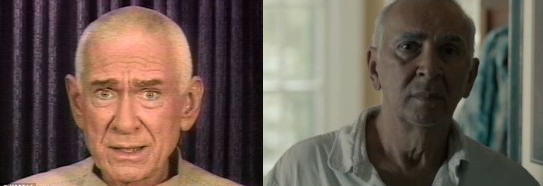
Frank and the Heaven's Gate Dude; the resemblance is uncannyCast
Frank Langella--Frank
James Marsden--Hunter
Liv Tyler--Madison
Susan Sarandon--Jennifer
Peter Sarsgaard--Robot (voice)

'Before allowing a machine to take over a part of your life, make sure that you know the true price you will be paying.'-OUTER LIMITS, S07E01, FAMILY VALUES (the episode with Tom Arnold)

Isaac Asimov's 'Laws of Robotics' aren't real laws. Lazy science-fiction writers often forget this. Do you know how many cats those 'Roomba' vacuum cleaners have killed? Zero, thus far, but who knows what the future holds.

Frank is a retired cat burglar. As a gift, he receives a robot, to help with household chores. But this android is capable of so much more. As a machine, he has no moral qualms about robbing people. His only responsibility is to serve Frank, as Frank sees fit. With two 'men', Frank can plan a heist.

This fictional robot is not comparable to A.I., BICENTENNIAL MAN, or 'Urkel-Bot'. Those characters were played by actors pretending to be robots. Although, strangely enough, only in BICENTENNIAL MAN, does Robin Williams come close to resembling a human being.

We're dealing with robot-looking robots here. A human-sounding, robot-looking android. If you want to hear my thoughts on robots that look like people, and whether it's okay to make love to a robot that looks like your wife's friend. You'll have to wait.

Frank's robot behaves like an impressionable child, a nagging wife, and a criminal mastermind. He's got a 'KITT', from KNIGHT-RIDER, demeanor. Resembling a LEGO STAR WARS SNOWTROOPER.

More than anything, ROBOT AND FRANK is a little boring. It seems as though the film maker was trying hard to make a point. But I can't decipher what that point actually was. That's not to say this film didn't explore interesting issues, it certainly did. One of those issues: man's emotional attachment to robots. But if you really wanted to explore this attachment, you could have just as easily watched FUTURAMA, or that movie with 'Number 5' and Steve Gutenberg.

Final Verdict: 72 out of 100