Merv

by Edward Dunn in ,


MERV PG 105 Minutes Director: Jessica Swale Writers: Dane Clark, Linsey Stewart Zooey Deschanel, Charlie Cox, Patricia Heaton CAST Zooey Deschanel...Anna Finch Charlie Cox...Russ Owens Patricia Heaton...MJ Owens David Hunt...Jack Owens Chris Redd...Vice Principal Desmond Ellyn Jameson...Jocelyn Jasmine Mathews...Rebekah Gus...Merv

THE MERV-U-MENTARY

If you clicked MERV hoping for Merv Griffin: nope. No one’s singing “I’ve Got a Lovely Bunch of Coconuts.” That’s a joke—for my readers over 80. Instead, we get something quieter and very modern: two exes who share joint custody of a rescue terrier mix because they can’t stand each other but can’t let go of the dog.

Anna is an optometrist; Russ is a teacher played by Charlie Cox (post-Daredevil), looking like he wandered off a Marvel set into the world’s most low-stakes crisis. Anna is an angry, brittle workaholic who seems allergic to joy, and Russ is a sad sack with a permanent apology-face. You’ve met this guy: “We swear he’s fine, but he looks like he cries in his car.”

Merv—the dog—is the one with depression. That’s not me projecting; the movie tells us Merv is sad because his parents aren’t getting along. The veterinarian even suggests Xanax, and Anna and Russ react like she’s talking about heroin. I’m not exaggerating.

Nothing cheers Merv up. Not the house, not toys, not even a trip to a Florida beach in December. (I can’t really blame him for that last one.) Once they’re in Florida, Anna shows up because she “misses the dog”—but what she really misses is Russ. They end up at a dog birthday party, where they meet a “spiritual animal healer” who channels Merv’s feelings and basically tells them the dog wants mom and dad back together. I kept waiting for Merv to roll his eyes and walk out. At this point, I was about three minutes away from turning the movie off, but Merv looked so genuinely embarrassed by the “healer” that I stayed.

All I wanted was a bland Christmas movie with an adorable dog—and I didn’t want the dog to die. That’s the bar now. I didn’t even know about dog boots before this. Apparently, we’re putting tiny boots on terrier mixes so they don’t freeze their paws in Boston snow. Do dogs in Boston actually need boots? Probably not. Are they adorable? Begrudgingly yes. Gus (the real dog) steals every scene anyway—mostly with hangdog eyes that say, “Fix your shit, humans.”

Zooey Deschanel plays Anna, and I mostly know her from Elf. Everyone else seems to find her quirky and charming; I’ve never quite understood her appeal. Twenty years later, and we’re still doing the “adorkable” thing—just with more edge and fewer ukuleles. She plays Anna like someone who treats every room as a group project nobody asked for—defensive, prickly, and convinced she’s the only adult present.

Patricia Heaton pops in as Russ’s mom, delivering a concentrated dose of the prickly matriarch role she patented decades ago. It’s basically Debra Barone if she retired to Florida and switched to high-end box wine. She’s not on screen long enough to anchor the movie, but she’s a needed shot of sitcom professionalism—landing more punchlines with a silent, weary blink than the rest of the humans do with their actual dialogue.

There’s a running subplot about Anna not being able to have kids. The movie treats it like a late reveal, but Anna and Russ spend the whole film orbiting the issue before finally saying it out loud like it’s a twist.

The movie actually gets one thing right: Russ’s rebound dog, Angelina. He gets her after it looks like he and Anna won’t reconcile. It’s a very human move: “Fine, I’ll just get another emotional support dog.” Angelina’s role is pretty transparent, but the movie isn’t wrong—dogs know when something is missing in your life. Or at least they know when you’re sad and eating more snacks than usual.

Buck the dog made Married… with Children. Without him, it was just a show about assholes who lived together. Same idea here. Merv (and later Angelina) are the moral center of the movie. Watching them, you think, “These people can’t be all bad. They take care of their dogs.” The humans act out, sulk, and overcomplicate everything. The dogs just exist, and somehow they make everyone else more watchable.

The ending is kind of sweet, I have to admit, even though it’s telegraphed from the beginning. If you’ve seen a couple holiday movies, you know where this is going: big gesture, heart-to-heart, dog in the middle, some tasteful Christmas lights in the background. It works. It’s not winning any awards, but it serves a purpose.

One practical question: how did they get Angelina a personalized sweater in less than 24 hours? Is there a secret emergency monogram service for emotionally fragile dog owners?

MERV isn’t great, but it knows exactly what it is. It’s a paint-by-numbers Christmas movie about broken people using a rescue terrier mix to patch the hole in their lives.

Final Verdict: 60 out of 100

Playdate

by Edward Dunn in


PLAYDATE PG-13 93 Minutes Director: Luke Greenfield Writer: Neil Goldman Kevin James, Alan Ritchson, Sarah Chalke CAST Kevin James...Brian Jennings Alan Ritchson...Jeff Eamon Sarah Chalke...Emily Alan Tudyk...Simon Maddox Stephen Root...Gordon Isla Fisher...Leslie Benjamin Pajak...Lucas Banks Pierce...CJ Hiro Kanagawa...Colonel Kurtz Paul Walter Hauser...“Zach Galifianak-ish”

For those of you who think I can’t review two Kevin James movies in a row—like I’m going to run out of jokes, or it’ll start sounding redundant—challenge accepted.

“Do I look like a child predator?” Kevin James asks early in PLAYDATE, standing in a park in a windbreaker that’s practically begging for a restraining order. Honestly? I bought it. I can believe him as the awkward stepfather everyone assumes is a creep. What I don’t buy—not for a single second—is Kevin James as a forensic accountant.

The suit looks like it’s on him for the first time in his life. He doesn’t even bother to wear glasses. Oh, don’t get confused—he keeps them perched on top of his head, because in Hollywood, glasses are shorthand for “this is a smart guy doing smart things.” But actually crunching numbers? Please. I could see him as a zookeeper, an IPS driver, or maybe a high school biology teacher who does mixed martial arts to save the music program.

Anyway, Brian gets fired and slips into stay-at-home dad mode, which means he ends up in that weird daytime purgatory of parks, small talk, and pretending you’re not desperate for adult conversation. That’s where Alan Ritchson shows up as Jeff, and he’s the funnier of the two. Jeff has this infectious, manic energy—like he just chugged three energy drinks and decided friendship is a contact sport. I can see why Brian ends up in his orbit, even if Jeff gives off a “this guy has seen some shit” vibe.

Is Ritchson playing the same character as Reacher? It’s hinted. I think he missed the fine print on his Amazon contract: “If you want to get renewed for another season, you have to do a movie with Kevin James.”

Sarah Chalke plays the wife, Emily—you may know her as the other Becky Conner—and yes, she seems a little too attractive for him. The movie knows it too and says it out loud. That kind of self-awareness goes a long way here, and it’s part of why PLAYDATE ends up better than you’d expect.

Then the movie remembers it needs a plot. Jeff kidnaps CJ, and the story never quite gives you an airtight reason. We find out the kid is his—or so it seems—until the villain shows up and snatches him back, because we need movement, not clarity. The pacing stays brisk. It never turns into a slog, which is more than I can say for a lot of these algorithm-built streaming movies. It all builds to a bizarre final standoff involving Maddox, Colonel Kurtz, and an entire army of CJs.

We also get an appearance by the doofus from COBRA KAI (Paul Walter Hauser), and he’s cast perfectly in this. Jeff refers to him as “Zach Galifianak-ish,” and that’s about right. He leans into the weirdness enough to be memorable. The movie could’ve used more of that energy.

PLAYDATE is a solid C. Not an “I didn’t deserve it” C like I got in high school—a real C. Some of the jokes are dumb, but not all of them. Yes, this is a movie you can watch with your family. If I were grading on a curve, I might bump it up—because contemporary family movies are god-awful. But I’m not grading on a curve. If you need something harmless in the background, this’ll do.

Final Verdict: 72 out of 100


Guns Up

by Edward Dunn in


GUNS UP
R
91 Minutes
Director: Edward Drake
Writer: Edward Drake
Kevin James, Christina Ricci, Luis Guzmán

CAST
Kevin James...Ray Hayes
Christina Ricci...Alice Hayes
Maximilian Osinski...Antonio Castigan
Luis Guzmán...Ignatius Locke
Melissa Leo...Michael Temple
Leo Easton Kelly...Henry Hayes
Keana Marie...Siobhán Hayes
Timothy V. Murphy...Lonny Castigan
Joey Diaz...Charlie Brooks
Francis Cronin...Danny Clogan
Solomon Hughes...Ford Holden
Miroslav Barnyashev...Harry the Hammer

Here Comes The Boom

In case you missed it the first time—and you probably did—GUNS UP is on Paramount Plus.

GUNS UP is the kind of movie that starts with a bad sign and never really recovers: our hero is named Ray Hayes. Even his name is kind of lazy. Ray Hayes. No parent gives their kid a first name that rhymes with their last. That’s like naming your child “Ben Denn,” then being shocked when he grows up to make questionable decisions.

Ray begins the film making a life-changing decision. He can either keep his police job—where he’s probably making six figures and gets great benefits—or work as an enforcer for some shady criminal enterprise where he can maybe make a few more dollars. Naturally, Ray goes the Doug Heffernan route—dumb, stubborn, and convinced it’ll all work out. He takes the enforcer job, and he’s still there five years later, like this was always part of the plan.

We find Ray embedded in a strange, multi-ethnic gang, the kind you only see in bad ’80s movies. He and his wife, Alice, are saving up for a diner. As soon as he has enough, he’s out. Now that he finally has the money to quit, things get complicated—because that’s how these movies work. You know something will pull him back.

That “something” is Lonny Castigan, and the minute he takes over, Ray’s exit plan is dead.

We’re also supposed to believe Ray’s kids don’t know what he does for a living. I could see the young boy not figuring it out, but he has an 18-year-old daughter. Even Meadow Soprano was hip to what her father was up to.

To get out, Ray agrees to kill Antonio—but he can’t bring himself to do it. He just wants to scare him and run him out of town. Then a third guy barges in, there’s a scramble for the gun, it goes off, and Antonio takes it in the head by accident. Messy, loud, and it sets the rest of the film in motion.

I like many of the character actors here. Luis Guzmán. Christina Ricci. Joey Diaz. Unfortunately, they’re underutilized. You spend the whole time waiting for them to do something interesting, and the script doesn’t let them. They show up, they deliver their lines, and the movie hustles past them to the next burst of violence.

Instead, everything becomes completely preposterous. We find out the wife has her own criminal past. She apparently took Lonny’s eye after his gang killed her parents. Sure. The dialogue doesn’t help much either, relying on generic tough-guy lines like: “We finish what we start.” “No more running, we finish this.”

By the end, it’s less a crime thriller than a conveyor belt of gunfire.

Who is this for? Families looking for a wholesome night in… plus an orgy of violence?

I’ve enjoyed Kevin James’s work and defended him plenty of times, but there’s absolutely no excuse for this movie.

Final Verdict: 48 out of 100


The Naked Gun

by Edward Dunn


THE NAKED GUN PG-13 85 Minutes Director: Akiva Schaffer Writers: Akiva Schaffer, Dan Gregor, Doug Mand Liam Neeson, Pamela Anderson, Paul Walter Hauser CAST Liam Neeson...Lt. Frank Drebin Jr. Pamela Anderson...Beth Davenport Paul Walter Hauser...Capt. Ed Hocken Jr. Danny Huston...Richard Cane CCH Pounder...Chief Davis Kevin Durand...Sig Gustafson Liza Koshy...Detective Barnes Eddie Yu...Detective Park Moses Jones..."Not Nordberg Jr."

It was inevitable, wasn’t it? In an era where IP is king, someone was always going to dust off the Police Squad files and try to make them print money again. Producer Seth MacFarlane is a fan of the originals—you can feel the reverence in the attempt—but loving a classic and understanding why it worked are two very different things.

On the surface, the cadence is there: the rapid-fire nonsense, the visual gags, the naked commitment to being stupid on purpose. That might sell at a pitch meeting, but the final product is a reminder that style is not the same thing as funny.

Liam Neeson as Frank Drebin Jr. is the entire gamble. The script leans hard into the grim action guy doing straight-faced stupidity. And to be fair, it’s a workable idea. Let’s be clear: I don’t care about the racist things Liam Neeson said years ago; he’s not on trial here. This movie is.

This would never top the original, but even with tempered expectations, this reboot struggles to justify its existence. If you watch the original NAKED GUN right after this one (as I did), the difference is staggering. The original took place in a world that, while absurd, had rules. It was a grounded reality where chaos happened to the characters. This movie is a cartoon. If Liam Neeson can just morph into anything he wants, why even have a film?

The casting is where it really falls apart. Leslie Nielsen and George Kennedy were infinitely more likable because their characters felt like people who existed between the jokes. Here, everyone functions as a delivery mechanism for punchlines that don’t always land. And Paul Walter Hauser—that doofus from COBRA KAI—is here to fill Kennedy’s shoes? It simply doesn’t work.

Pamela Anderson plays the “age-appropriate” romantic interest, which is a refreshing choice, but the movie wants to have it both ways. She’s in her late 50s, and we’re asked to believe she’s still turning heads like it’s 1996. I’m not saying she can’t—Pamela Anderson is Pamela Anderson—I’m saying the movie wants the credit for being age-appropriate while still selling the centerfold.

The only person who seems to understand the assignment is Danny Huston. The man knows how to play a villain, and his take on Richard Cane—a fictionalized Elon Musk—is spot on. Huston plays it straight while the world goes stupid. It makes him the standout antagonist because he’s the only one acting like this movie has a pulse.

The core problem is that the film keeps winking at the audience. The jokes feel like a Spotify playlist called “NAKED GUN TYPE HUMOR” rather than new material. Cultural references are ingredients, not jokes, and pointing out a trope isn’t the same as subverting it.

Also, I’m sorry, but if you’re only going to make one half-joke about O.J. Simpson and then tiptoe away, you’re playing it too safe. Where’s Norm Macdonald when you need him? This franchise used to run toward the uncomfortable stuff at full speed and trip over a garbage can on the way there. This version jogs, checks its phone, and asks if everyone’s okay.

And yes, I’m going to say it: for a PG-13 comedy to work, it has to be witty. This film is definitely stupid, and there’s a place for stupid comedies, but this isn’t stupid in the right way. I’m not saying there are no laughs—the funniest bit for me is the scene where he’s firing a gun because he has to use the bathroom. That’s my kind of stupid. I just wish there was more of it. Other people seemed to find it funny, but for me, the ratio just wasn't there.

Final Verdict: 46 out of 100


Downton Abbey: The Grand Finale

by Edward Dunn in


DOWNTON ABBEY: THE GRAND FINALE PG 124 Minutes Director: Simon Curtis Writer: Julian Fellowes Hugh Bonneville, Michelle Dockery, Elizabeth McGovern CAST Hugh Bonneville...Robert Crawley, Earl of Grantham Michelle Dockery...Lady Mary Talbot Elizabeth McGovern...Cora Crawley, Countess of Grantham Jim Carter...Charles Carson Laura Carmichael...Lady Edith Pelham Harry Hadden-Paton...Bertie Pelham, Marquess of Hexham Allen Leech...Tom Branson Penelope Wilton...Isobel Grey, Lady Merton Joanne Froggatt...Anna Bates Brendan Coyle...John Bates Robert James-Collier...Thomas Barrow Phyllis Logan...Elsie Carson Sophie McShera...Daisy Parker Lesley Nicol...Mrs. Patmore Paul Giamatti...Harold Levinson Dominic West...Guy Dexter Alessandro Nivola...Gus Sambrook Imelda Staunton...Maud, Lady Bagshaw

With a title like DOWNTON ABBEY: THE GRAND FINALE, you know things are about to end. It’s the film equivalent of a farewell tour. And like any farewell tour, you half-wonder if they really mean it, or if someone will need more money in a few years. The Who did their first, and only, farewell tour in 1982. We’ve all seen how that turned out.

This time we’re in 1930, with the Crawleys juggling scandal, money trouble, and the slow, painful realization that the world is moving on without them. Lady Mary is divorced now, and her love life is once again a headache for everyone around her. Her entanglement with Gus, a charming financial “wizard” who turns out to be more con man than savior, helps drag the Granthams to the edge of social ruin. For a hot minute, the family becomes polite society’s problem child, and you can feel how fragile their place in the world really is.

Meanwhile, Cora’s American fortune isn’t just dented; it’s basically gone. Harold has managed to lose what his mother built, and Gus has his fingerprints all over the mess. Watching Cora and Robert face the fact that Downton can’t keep coasting on ancient money forever gives this movie more bite than you might expect from what could’ve been a pure nostalgia tour.

Downstairs, life keeps rearranging itself. Daisy is taking over for Mrs. Patmore in the kitchen, which feels both right and a little terrifying. Anna and Bates are moving with Robert and Cora to the Dower House, where Anna is pregnant again at forty-four. It’s technically possible, but in 1930 it feels like the script is pushing its luck. Still, I’m rooting for Anna and her sixty-one-year-old husband. They’ve earned their improbable happiness.

Mr. Carson is now retired, supposedly settling into a quiet life with Elsie. He loves her, obviously, but you can already see the boredom setting in behind the proud posture. A man who lived for silver-polishing and protocol is suddenly supposed to enjoy village committees and garden paths. Good luck with that.

What’s missing, of course, is Granny. The film does what it can with memory and echo, but it’s not the same without the Dowager Countess dropping one-liners like depth charges. You feel that absence in almost every room. The show has always been about change, but this is the first time it really feels like loss.

You come in expecting fan service, and you definitely get it—old faces, callbacks, little grace notes for long-time viewers. But you also get a bit more: a genuine attempt to reckon with what happens when an entire way of life reaches its expiration date and everyone has to find a softer landing than “happily ever after at the big house.”

DOWNTON ABBEY has always leaned toward mostly happy endings with a few tragedies sprinkled in for good measure. That’s not realistic; I know that. But I still like that most of my favorite characters get to land somewhere gentle—if not perfect—by the time the credits roll. The parents are moving out of Downton, Mary is fully in charge, the staff is aging into new roles, and the place we’ve been visiting for fifteen years finally feels ready to go on without us.

If this were a TV special, I’d say it was a great one. As a movie, it’s a good one—handsomely made, emotionally satisfying, and maybe a little too comfortable. With a movie, you expect a little something extra. THE GRAND FINALE doesn’t quite transcend its origins, but as a long goodbye to these people and this house, it’s hard to ask for much more.

Final Verdict: 78 out of 100


A House of Dynamite

by Edward Dunn


A HOUSE OF DYNAMITE R 112 Minutes Director: Kathryn Bigelow Writer: Noah Oppenheim Idris Elba, Rebecca Ferguson, Jared Harris CAST Idris Elba...President of the United States Rebecca Ferguson...Capt. Olivia Walker Gabriel Basso...Jake Baerington Jared Harris...Reid Baker (Secretary of Defense) Tracy Letts...Gen. Anthony Brady

A HOUSE OF DYNAMITE starts with a killer premise: an anonymous missile hurtles toward Chicago, impact in under twenty minutes. The fate of millions rests in the hands of Very Serious People in suits. Somehow, this becomes a movie where nothing actually happens for almost two hours.

The big gimmick is that we keep revisiting the same chunk of time from different perspectives. In theory: tense, ticking-clock thriller. In practice: the world’s drabbest clip show. We keep cutting back to the same radar screens, the same shots of Chicago, the same Very Important Conversations in the Situation Room. It’s like the movie hit rewind on itself and never found play again.

And then there’s the President. Idris Elba, one of the most watchable people on the planet, spends most of the film as a disembodied voice on a screen. We barely see his face for over an hour. This isn’t some clever stylistic choice; it feels like Elba wanted to be in the movie as little as possible. When he finally shows up in person, around the 75-minute mark, it’s less “dramatic reveal” and more “oh right, they did say he was in this.”

The movie imagines a federal government staffed entirely by competent adults. That’s adorable. Have you watched the news in the last twenty-five years? We haven’t had uniformly competent government officials since the Kennedy administration.

On paper, there’s a nice cross-section of people in the room: all ages, backgrounds, and job titles. In practice, it feels like a distracting level of diversity used as wallpaper. Representation isn’t the problem; the problem is that nobody is written like an actual human being. The characters are mostly bland, forgettable expo-delivery systems. I should care about a nuclear missile hitting Chicago. Instead, I found myself quietly rooting for it to land—not because I’m a homicidal maniac, but because at least something would finally happen.

I loved Jared Harris as Secretary of Defense Reid Baker. His daughter lives in Chicago, and you can see the situation hollowing him out in real time. He always looks like the only adult who understands how doomed we are, and that weary intelligence gives the movie its only pulse. When he cracks, you believe it. For a few minutes, A HOUSE OF DYNAMITE feels like it might be about something.

If you’re looking for real action, look elsewhere. This movie plays like an extended episode of THE WEST WING, except without any of the charm or moral crackle—or Martin Sheen wandering around muttering Latin under his breath. The most “exciting” moment is a guy jumping off a building on purpose, and I’m not totally convinced that counts as action. Mostly, it’s people standing in rooms under fluorescent lights, talking about what they might do.

The missile is supposed to hit in under twenty minutes, but the film drags that window out so long it feels like I’m stuck in a time dilation bubble where twenty minutes lasts two hours. Normally, that would be an advantage. Here, it’s just a reminder that time is precious, and I could’ve spent mine watching literally anything else.

Final Verdict: 56 out of 100


John Candy: I Like Me

by Edward Dunn in


JOHN CANDY: I LIKE ME 113 Minutes Director: Colin Hanks Steve Martin, Bill Murray, Catherine O’Hara, Macaulay Culkin, Eugene Levy, Tom Hanks

In my Mount Rushmore of favorite actors: John Candy is George Washington. Christopher Walken is Thomas Jefferson. Philip Seymour Hoffman is Teddy Roosevelt. Hmm… we’ll need a fourth one. I guess Patrick Swayze. That’s the place where Candy lives for me—etched in granite, permanently grinning, somehow still making room for everybody else.

Nepo-baby Colin Hanks plays it straight and respectful — which is exactly right. The film celebrates Candy’s generosity and timing — the way he could float a scene on kindness alone — while also acknowledging the pressures of fame, the anxiety that rides shotgun with it, and the public scrutiny over his weight. You feel the love, and you feel the cost. Both belong in the story.

The interviews are marvelous — including Steve Martin, Bill Murray, Catherine O’Hara, Macaulay Culkin, and others. These aren’t just “remember-when” anecdotes; they’re small hymns. O’Hara, who seems to have logged the most hours in Candy-world, even gave a tender eulogy — because of course she did. That friendship reads on- and off-camera.

After watching this documentary, it’s become quite evident that I’m still grieving, all these years later. I found myself blubbering like a little child. Almost as if he were a family member. One cutaway to that smile and I’m done.

And here’s the part that really got me: Los Angeles literally shut down the 405 for his funeral procession. The 405. Closed. For John Candy. That’s the kind of civic love you can’t manufacture; it’s what happens when a whole city realizes it lost a good man.

Candy, to me, was like John Wayne — he pretty much always played himself. But that “himself” contained universes: decent, awkward, earnest, wounded, generous. He didn’t need tricks. He needed eye contact and a beat. Suddenly, everyone else in the scene got better.

I remember the day after he died like a weird little home movie: I’m at the barbershop, clippings on the floor, and everyone is talking about him. Not gossip — gratitude. Stories. Chatter that feels like a celebration.

I LIKE ME is a sturdy frame built to hold a giant heart — two hours of remembering why this man felt like home, and why losing him still stings all these years later. So watch this documentary, and then watch PLANES, TRAINS AND AUTOMOBILES for Thanksgiving.

FINAL VERDICT: 94 out of 100

Sidenote: I docked some points because Ryan Reynolds was so heavily involved in this production. At least he didn't put himself in the film.


Equalizer II

by Edward Dunn


EQUALIZER II
R
121 Minutes
Director: Antoine Fuqua
Writers: Richard Wenk, Michael Sloan, Richard Lindheim

CAST
Denzel Washington...Robert McCall
Pedro Pascal...Dave York
Ashton Sanders...Miles Whittaker
Orson Bean...Sam Rubinstein

I was in the mood to see Denzel kick some ass. And since I can't follow the man around, waiting for him to get into an altercation, watching EQUALIZER II is the next best thing.

EQUALIZER II is completely different from the first film. This time around, it's all about Denzel Washington. One day, he gets bored with the acting game, and becomes an 'equalizer', to help people for a change. It makes so much sense. Denzel has attained such a broad skill set from his previous roles as a boxer, a security guard, and all the various police/military officer characters... that he couldn't help but transform into an 'equalizer'. Any other life path would be unconscionable. That movie sounds cool, but it's obviously not this one. They wouldn't change the main character of a successful franchise, would they? Dwayne Johnson replaced Vin Diesel in FAST FIVE. Which means anything is possible, but I digress.

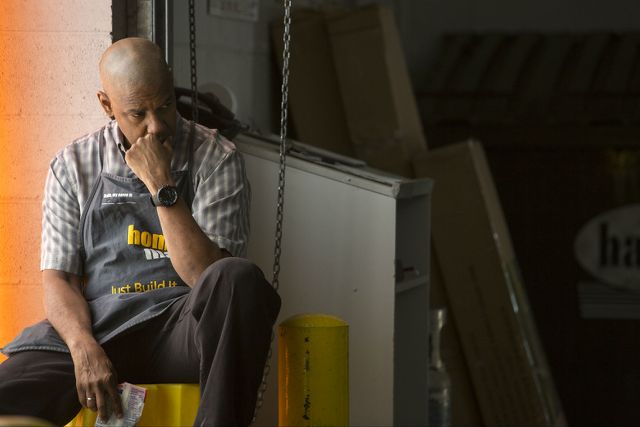
EQUALIZER II is like the first film, and that includes that stupid, blue, button-down shirt. This time around, Robert McCall drives a Lyft, instead of working for Home Mart. The only meaningful difference between this film and the first EQUALIZER is hair — Denzel has hair. Maybe Homer Simpson looks good with a bald head, but not Denzel Washington. It just makes the character look impotent. Like he's going through chemotherapy or something.

THE EQUALIZER franchise is based on a fair-to-midland TV show. So it's no minor miracle, that a movie adaptation, even one with so many flaws, is as good as it is. I don't remember much about this unremarkable, paint-by-the-numbers, action-thriller, but I do remember liking it...a little bit.

Final Verdict: 82 out of 100

Spoiler alert: You already know that Denzel's character lives, because you don't write EQUALIZER II without having a rough outline of EQUALIZER III. My only concern is for his health. I don't want him to have a nervous breakdown...from the exertion of acting like a badass-looking, out of shape, middle-aged man.