
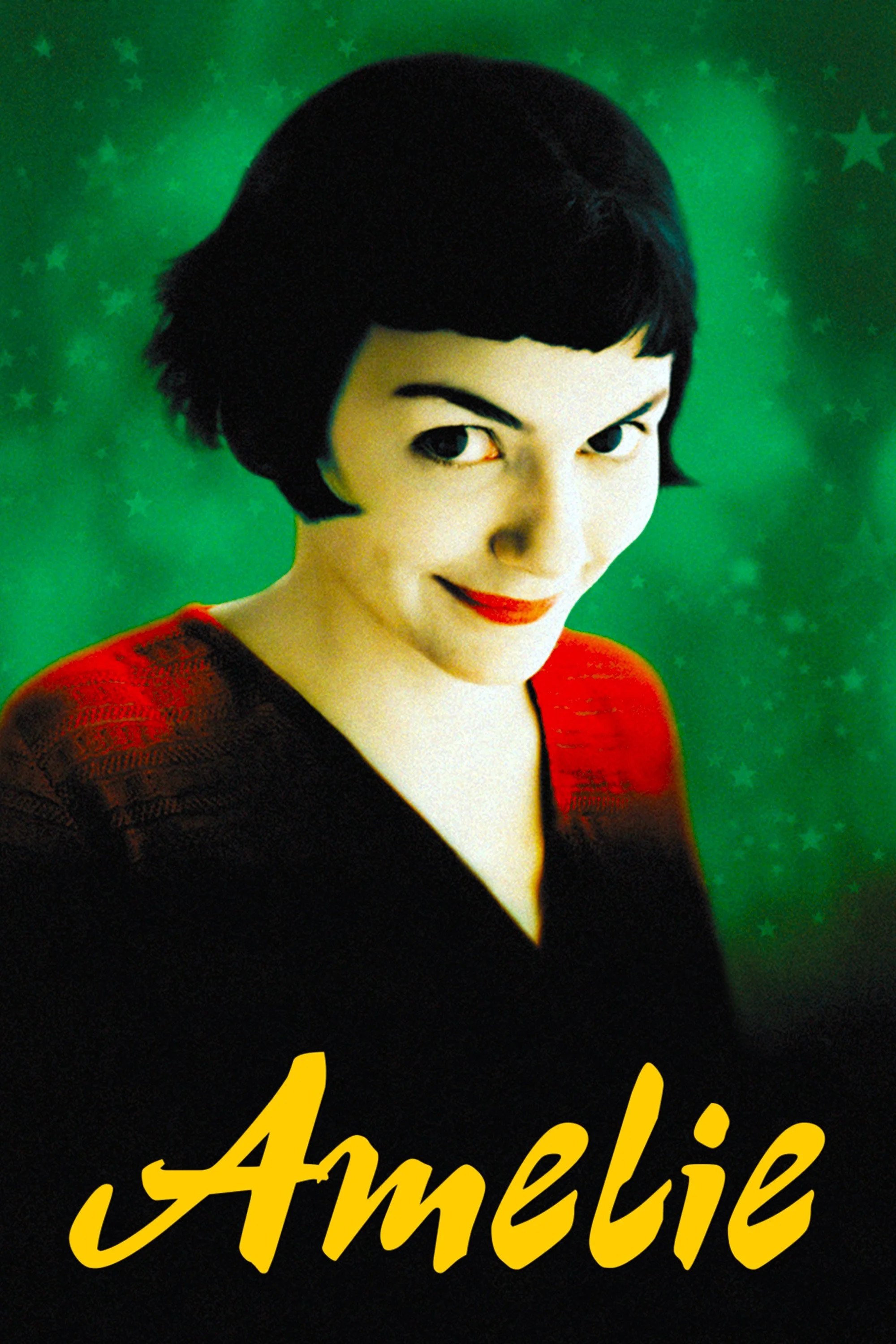
I rarely watch French-language films unless they involve talking elephants, but that poster kept haunting me for twenty-five years. Audrey Tautou's face — wide-eyed, dreamy, half-smiling like she knew a secret the rest of us didn't — stared out from theater lobbies, video store shelves, and eventually streaming thumbnails. I kept passing. Until now.
On the night Princess Diana died, I was watching HANGIN' WITH MR. COOPER. The show cut away for rolling coverage, and my main emotion was mild annoyance that reality had dared interrupt my sitcom. Amélie runs the same calculation. Jeunet treats one of the most mourned public events of the decade as little more than background noise — a dropped perfume bottle, a loose tile, the faint sound of a television in another room. History becomes a domestic accident that cracks open something far more important: her sealed inner world.
Amélie Poulain lives almost entirely inside herself. She notices everything — the texture of a sugar crust cracking under a spoon, the sound of stones skipping across a canal, the tiny rituals and private obsessions of strangers — but shares almost none of it directly. Other people move through the world socially; Amélie moves through it observationally, constructing elaborate circuits that let her intervene in lives without ever fully exposing her own. She returns lost treasures anonymously, orchestrates romances from hiding, communicates through scavenger hunts, photo albums, and carefully staged accidents. Even attraction arrives mediated through objects first and people second.
Jean-Pierre Jeunet understands that this creates a technical problem as much as a dramatic one. Interiority is difficult to film. A protagonist who experiences life richly but expresses it privately can easily become inert on screen. So AMÉLIE builds an entire cinematic language around externalizing her consciousness. The omniscient narration cataloging likes and dislikes, the fantasy digressions, the saturated reds and greens, the way Paris itself feels less like a city than a curated emotional terrarium — none of it exists merely for charm. The style is the psychology. Jeunet isn't decorating the story. He's solving it.
The question the film gradually circles, though, is whether that way of moving through the world comes with a cost. Raymond Dufayel — the brittle-bone painter downstairs — is where AMÉLIE stops merely charming and starts interrogating itself. Dufayel has spent twenty years sealed inside his apartment, endlessly repainting Renoir's Luncheon of the Boating Party, fixated on a single figure he can never quite understand: the young woman at the center of the canvas holding a glass of water, surrounded by people yet somehow detached from all of them. Before either of them realizes it, he's painting Amélie.
What gives Dufayel authority is that he understands her tendency from the inside. His isolation was imposed by circumstance; hers has become a lifestyle disguised as whimsy. He watches her orchestrate happiness for strangers with immense care while remaining emotionally unreachable herself, more comfortable constructing intimacy indirectly than risking direct participation. His critique lands: Amélie would rather be moved by the lives of other people than build a life with someone standing directly in front of her.
Amélie's kindness is inseparable from her sense of justice. She's not simply dispensing happiness at random — she's dispensing what she believes people deserve, like Dirty Harry. The film's two defining interventions, returning Bretodeau's childhood box and systematically tormenting the cruel grocer Collignon, use identical machinery while delivering opposite verdicts. One restores something lost. The other dismantles someone who earned it. Same anonymous hand, different sentence. Even her childhood pranks carried the same instinct. Disconnecting her father's television antenna during key moments of a soccer match wasn't helping anyone or correcting an injustice. It was punishment — a private verdict delivered from hiding.
The Madeleine Wallace intervention is where this logic turns unsettling. Madeleine's husband cheated on her, died, and left behind the evidence of his betrayal. Her grief wasn't confusion; it was accurate. Amélie intercepts the truth and replaces it with a forged letter describing a faithful man who loved her deeply all along. The prescription works. Madeleine becomes lighter, happier, more capable of moving forward. But what Amélie gives her is a more livable fiction. The film presents the gesture as generosity while leaving open a more uncomfortable possibility: that Amélie doesn't just improve lives. She rewrites them.
Nino Quincampoix is the film's most personal example of Amélie's tendency to fall in love with narratives before people. She encounters him first as a trail of objects and intermediaries — discarded photographs, chalk arrows, scavenger hunts, ghost train booths, telescopes — and gradually constructs an emotional reality around someone she barely knows. By the time she finally opens the door, they've exchanged almost no words. What fascinates her isn't simply Nino himself but the elaborate private mythology she's built around pursuing him.
To some extent, that's how attraction normally works. Everyone projects a little at the beginning. You fill in gaps and reality slowly revises the picture. What Amélie does feels different in degree to the point of becoming different in kind. She's not filling in missing pieces so much as constructing almost entirely from absence. The film reinforces this by giving Nino surprisingly little inner life of his own. Mathieu Kassovitz makes him charming, curious, and emotionally open, but we never really get inside him. He's less a person than the perfect object for Amélie's imagination to orbit.
Like Quixote transforming an ordinary peasant into the unreachable Dulcinea of his imagination, Amélie authors Nino long before she meaningfully knows him. The romance works emotionally because the film places us inside her projection rather than outside it. Whether the projection survives ordinary life is another question entirely.
Even Dufayel seems to understand this. His final message isn't really an endorsement of Nino specifically. The pronoun is almost incidental. What matters is that Amélie finally moves toward another person instead of endlessly circling connection from a safe distance. "Go get him" isn't romantic certainty. It's permission to stop hiding.
All of this unfolds inside one of the most seductive aesthetic systems of the last few decades. Jean-Pierre Jeunet floods Paris in saturated reds and greens, turns cafés into glowing storybook spaces, and films ordinary things with the reverence of treasured memories. The humor runs in the same vein — closer to a smile than a laugh, built from tiny behavioral details, visual digressions, and whimsical rhythms rather than punchlines. The film shares Wes Anderson's wavelength, though AMÉLIE feels warmer and less emotionally airlocked. I was surprised by how completely the film's visual world pulled me in. It doesn't merely depict Amélie's interior life. You end up living in it.
But the seduction is also part of the complication. Jeunet's Paris barely behaves like a real outdoor environment. The streets are strangely calm, the air almost motionless, as if the city itself has been sealed against intrusion. Nothing enters uninvited. The film processes everything through the same beautifying filter Amélie uses to process other people. The style isn't simply decorative; it's slightly complicit. AMÉLIE inhabits its protagonist's romantic worldview so completely that it occasionally forgets to question it. Dufayel's apartment is the lone exception — the one place where the fairy-tale register thins out and something heavier presses through the frame.
AMÉLIE never reconciles the tension between romance and avoidance, between imagination and participation. Dufayel remains trapped in the apartment even as he convinces someone else to step outside. The ending offers movement rather than certainty — not proof that Amélie has found the right person, but proof that she's finally willing to risk being wrong about one.
And despite all the complications, I don't think I want to live in a world where nobody thinks the way Amélie does.
Final Verdict: 88 out of 100