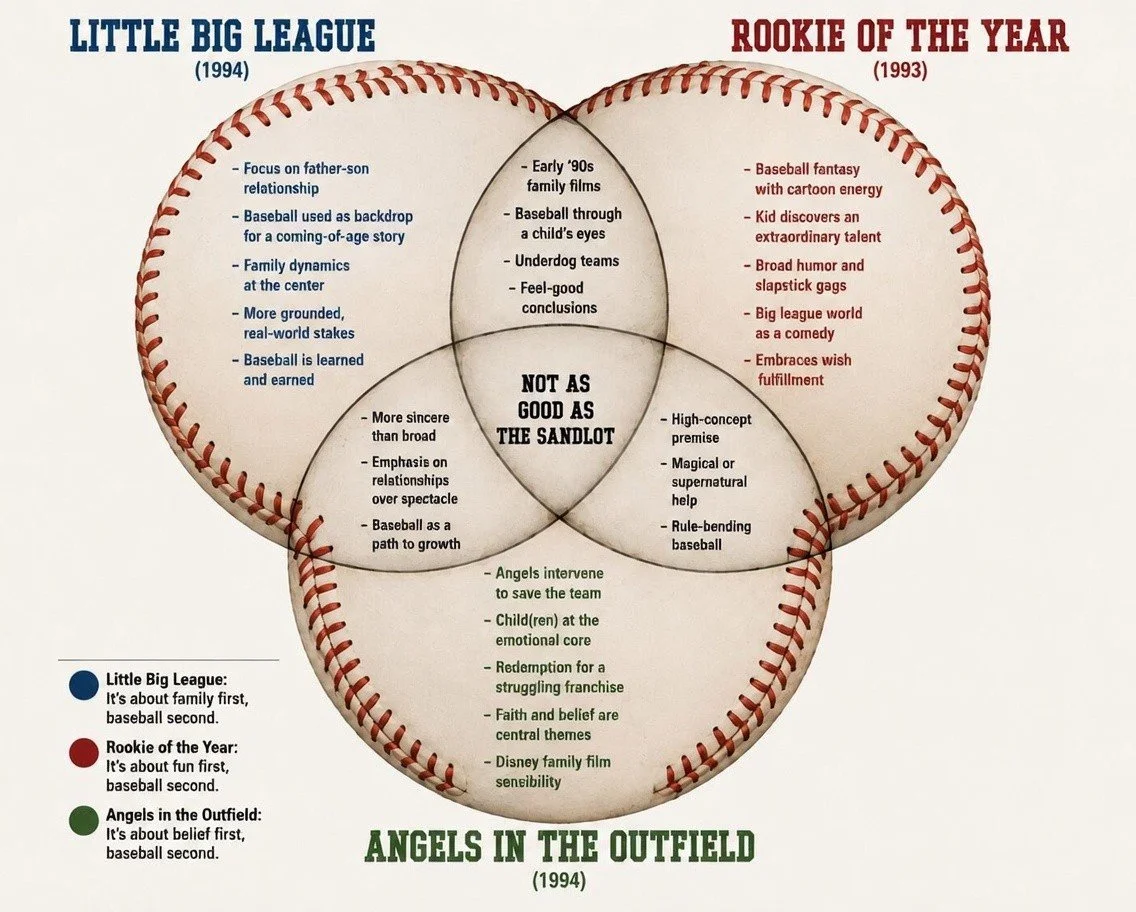
ANGELS IN THE OUTFIELD runs like it was assembled to spec. Every beat lands roughly where you'd expect it to, every joke gets its setup, every emotional cue arrives on schedule — and somewhere in that precision the movie misplaces the thing that would have made any of it matter. Tony Danza plays Mel Clark, a washed-up pitcher whose best years are a decade behind him, and the casting carries a small, useful irony: Danza himself was several years removed from playing a retired ballplayer on a hit sitcom, brought in to play a player whose career has already ended once and is now being asked, improbably, to start again. The film doesn't do anything with that irony. ANGELS IN THE OUTFIELD isn't interested in what its casting might be saying about itself — only in whether the next scene executes.
The film can't settle on why the angels arrived, let alone why they leave. Roger prays; Al answers. Yet Al also frames their presence as triage—an "as needed" intervention that comes and goes on its own schedule. Maggie reframes it again as emotional law: angels appear for kids looking for someone to love. Three explanations, none reconciled, and then a fourth rule arrives for the finale that contradicts them all. Championships, Al tells Roger, must be won on their own. The angels who spent the season catching fly balls and tilting games simply vanish. Mel Clark wins it unassisted. The film never asks the obvious follow-up: if the team had this much in them all along, what exactly were the angels for?
What ANGELS IN THE OUTFIELD is willing to say about belief turns out to be very little. Roger's prayer, when it finally comes, hedges its own address — "if there is a God... if you're a man or a woman" — a child covering his bases rather than reaching toward anything specific. Maggie's answer, when he asks whether angels are real, is no more committal: she believes in "the possibility of miraculous things happening," the sort of sentiment that could just as easily describe a lottery ticket. By the time she's defending Knox before the press, belief has been reduced further still, to something closer to a motivational poster — angels as "the footprints of love," summoned wherever someone needs looking after. There's no church in this movie, no clergy, no liturgy, nothing that anchors any of it in a tradition Roger or Maggie might hold. The film wants the comfort of religious language without the commitment of religious thought. It asks us to accept angels, but it rarely asks what believing in them would mean.
The 1951 original handles this same problem more gracefully, if only because it never tries to explain itself as thoroughly. Guffy McGovern's angel withdraws not because of an arbitrary championship clause but because McGovern breaks an actual promise — he punches a sportswriter at a commissioner's hearing after agreeing to stay civil, and the deal is off, on its own clear terms. The angels in 1994 leave because the film has reached the point where it requires human triumph; the angel in 1951 leaves because a man went back on his word. That's a sturdier piece of storytelling than anything ANGELS IN THE OUTFIELD manages with its own mythology, and it survives because the older film commits to the religious framework it's built on — Guffy calls a minister, a priest, and a rabbi to testify on his behalf, and the hearing plays as a genuine referendum on belief.
Roger's father appears twice, and uses the first appearance to make a promise no parent should make. Asked when the family will be whole again, he doesn't say never — he says when the Angels win the pennant, handing his son a condition that sounds achievable precisely because it isn't. He doesn't vanish after that; he resurfaces in a courtroom, where he signs Roger away for good, pennant race still very much underway. The cruelty isn't that he lies. It's that he frames the lie as a deal, something Roger can work toward, root for, pray over — and the film lets that framing stand almost until the end, as if a parent's abandonment were a puzzle a child could solve with enough faith and a winning record. J.P. gets a smaller, colder version of the same withholding. He won't ride in cars because he used to live in one with his mother, sleeping curled up in the front seat, and the film drops that detail and moves on, never circling back to what kind of life produces a boy who flinches at a car door. The film handles Mel Clark's mortality the same way. Al tells Roger, almost in passing, that Clark has six months left and doesn't know it yet, and then the film never returns to it, letting him pitch the pennant clincher and disappear into a freeze-frame like nothing was said. I remember sitting with that detail at nine years old and feeling bad about it for the rest of the movie, in a way the story itself never seemed to. Both boys are given backstories specific enough to suggest real damage and then asked to function as comic relief and good-luck charms for the rest of the runtime. Their pain opens the story; it rarely deepens it.
That treatment becomes harder to square with Maggie's later reframing of the angels as an emotional law: they appear for kids looking for someone to love. By that standard, Roger and J.P. should be the center of the miracle, not its witnesses. Instead, the angels spend most of their time chasing down fly balls and breaking slumps while the boys' loneliness remains largely untouched. The divine intervention the film promises is strangely selective — it fixes the team's roster, but leaves the kids' deeper wounds mostly where it found them.
George Knox never becomes specific enough as a person for any of this to land the way the film wants it to. We're told he spent a decade winning in Cincinnati without ever capturing the championship that mattered, we learn Ranch Wilder ended his playing career with a deliberate spike to the knee, and that's the whole file. The grudge against Wilder gives Danny Glover a recognizable temper to play, but a temper isn't a character, and there's nothing underneath the bitterness the film is willing to show us — what losing the championship cost him, what nursing a vendetta for decades has done to him. So when Knox tells the press he didn't believe in anything before this season and these boys gave him his reason to believe, the line is asking for a transformation the film hasn't earned, because the film never showed us what Knox believed before that. We've watched George Knox fulfill every function the story requires of him. We still don't know much about the man himself.
A movie about literal angels fixing baseball games should be having more fun than this one is. The premise hands the film permission to go anywhere — slapstick, mischief, real strangeness — and ANGELS IN THE OUTFIELD mostly declines the invitation. Al describes his own kind as "a very capricious crowd," but nothing about him plays that way; he arrives less like an emissary of the divine than a middle manager of supernatural logistics, polite, procedural, and fond of explaining the rules of his own intervention like a man reading from a union contract. Christopher Lloyd, an actor who has built a career on eccentricity, spends most of his screen time being affable and brief. The closest the film comes to cutting loose is Marvin Vincent Archer. Told to "run home" from first base, he takes the instruction literally, leaving the ballpark behind for his actual house—the one moment in the movie that feels like it's playing with its own premise instead of managing it. A film this unconcerned with plausibility owes its audience a little more delirium than that. ANGELS IN THE OUTFIELD plays it straight instead, and straight is the one register this story can't really afford.
That absence of delirium has a clear cause: there's no one on this roster specific enough to be delirious through. Whitt Bass is the closest thing to an exception, and even he barely qualifies. Ranch Wilder tells us, on the broadcast, that Bass has eaten bugs and flossed his catcher's teeth in the dugout, but we never see any of it. What we get is a Magic 8-Ball ("will I win, will I win, win, win?") and a string of stalling mound rituals—sniffing, yawning, lingering before every pitch—which add up to a guy who's odd in passing, not a character built from the ground up. He's basically the team's designated fool, and that's the whole part. Triscuitt Messmer is defined by his slump and his nickname. Danny Hemmerling is defined by a stat line—good glove, no bat—and the joke of him succeeding anyway. Ben Williams gets one spectacular catch and barely a line of dialogue to go with it. These aren't characters so much as job descriptions with uniforms attached, and a movie that can't be bothered to make its players into people was never going to know what to do with the angels helping them. ANGELS IN THE OUTFIELD has twenty-five archetypes in a clubhouse and calls it a team.
There should be more to a movie than watching a story unfold, and ANGELS IN THE OUTFIELD never gets there. It has a story — a clean one, beginning to end, every beat accounted for — and that turns out to be all it has. No fun sturdy enough to carry the premise past its own internal contradictions. No character specific enough to make the ending feel earned rather than scheduled. The angels show up, the team wins, the family comes together, and none of it leaves much behind once the credits roll, because the film was never building toward a feeling — only toward a result. That's the real difference between this and the movies it's been measured against in this review, the 1951 original included: those films wanted you to believe something. This one only wanted you to watch something happen, competently, on time, and then go home.
Final Verdict: 58 out of 100.
Sidenote: A comparative look at the trilogy.