
Rick Moranis…Danny O'Shea
Ed O'Neill…Kevin O'Shea
Shawna Waldron…Becky "Icebox" O'Shea
Devon Sawa…Junior Floyd
Todd Bosley…Jake Berman
Sam Horrigan…Spike Hammersmith
Brian Haley…Mike Hammersmith
Mary Ellen Trainor…Karen O'Shea
Susanna Thompson…Patty Floyd
Robert Prosky…Grandpa O'Shea
LITTLE GIANTS arrives with everything a 1994 family sports comedy is supposed to have. Two brothers, a misfit team, a girl who can play better than the boys, a big game, and a trick play with a name so good the Carolina Panthers ran it in an actual NFL game seventeen years later. The premise is solid. The cast is better than solid. Rick Moranis and Ed O'Neill are doing real work here, carrying the film with the kind of commitment that makes you want it to succeed. The problem is that LITTLE GIANTS is a movie that correctly diagnoses what it wants to say and then keeps prescribing the wrong cure.
The setup is this: Kevin O'Shea is a Heisman Trophy winner who never left Urbania, Ohio, because Urbania never stopped needing him to be its Heisman Trophy winner. He coaches the local peewee Cowboys the way he does everything — by winning, and by not particularly caring who gets left out in the process. His younger brother Danny owns a gas station. When Kevin cuts the misfit kids from tryouts — including his own niece Becky, who is demonstrably the best player on the field — Danny forms a rival team from the leftovers and challenges Kevin to a playoff game to determine who represents the town. This is not, the film would like you to believe, a completely insane response to the situation. Danny is a man who has spent his entire adult life in the shadow of his brother's mythology, and the Little Giants are his first real swing at it. You understand why he does it. You also understand why, in real life, two brothers with a family member caught in the middle would have talked it out. LITTLE GIANTS needs them not to, so it doesn't let them.
Moranis plays Danny like a man who never quite found his way out of his brother's shadow, something the film sets up clearly even if it doesn't always know what to do with it. This is a man who ran the class projector while his brother ran for touchdowns, who stayed in the same town, kept the same gas station, and spent his adult life living adjacent to a mythology that had no room for him. The gas station isn't just his business. It's where he went when everything else closed off. Moranis is a reactive performer by instinct — he's at his best responding to things larger than himself — and here that instinct is exactly right, because Danny has been responding to Kevin his entire life. The film's funniest moment is a prank call Danny makes to the state police after catching Kevin spying on practice. He places it as Thelma May Rogers, 86, of Urbania — who does not exist and is performed flawlessly.
State police? Oh, thank God. This is Thelma May Rogers. I'm 86. I live in Urbania. There are two men down the bridge from the Shell station...in the bushes spying on some kids. We're all so upset. I don't think men their age should be parading around in their underwear. Please, hurry.
Completely in character, it tells you everything about a man who has spent forty years finding indirect routes around his brother rather than through him. What the performance can't quite solve is the script's reluctance to let Danny's wound breathe — it knows what's wrong with him, it just keeps reaching for the football game as the answer when the real answer is something quieter, something the scoreboard can't deliver. Danny asking Patty Floyd to dinner in the final thirty seconds — a woman who never left Urbania either, whatever the intervening years held for both of them — tells you more about who he is than anything that happens on the field. It still took a peewee football game for him to finally ask.
Becky "Icebox" O'Shea is the most interesting character in LITTLE GIANTS and the one the film most consistently lets down. She's Danny's daughter, which is the script's smartest structural decision — it means her talent didn't come from the football obsessed branch of the family, that she arrived at it on her own terms, that she belongs to herself before she belongs to the story. Shawna Waldron plays her with a naturalness that the film establishes in the first act and then slowly squanders. The trouble arrives not from Junior Floyd, whose comment about cheerleading is casual enough to be almost a joke, but from Kevin. It's her uncle who sits her down and tells her explicitly that a quarterback is going to want a cute girl, not a teammate. That's the binary. That's what she acts on. The problem isn't that Becky would never have these feelings. The problem is that the film hasn't done the work to make you believe they would override everything she is — and the irony the film never registers is that Junior never actually asked her to change. Kevin told her what boys want, and he was wrong about this particular boy. You're not worried during the cheerleader detour. You're just waiting for her to put her jersey back on. And when she does return — because of course she returns — it's because the team needs her, which is the external motivation when the scene required an internal one. The better version of that moment is Becky deciding something about herself. This version is Becky getting a phone call.
The deeper problem with LITTLE GIANTS is that it's running three separate films simultaneously and doesn't quite know how to make them talk to each other. There's the film about Danny and Kevin, two brothers whose entire relationship is an unresolved argument about who gets to matter. There's the film about Becky, a girl trying to figure out who she is when the people around her keep telling her she has to choose. And there's the film about the misfit kids, the underdogs who deserved a chance and finally got one. In the best version of this movie those three things are feeding each other — Becky's arc deepens the Danny material, the kids' dignity gives the game real stakes, the brothers' reconciliation means something because everyone else's story has gotten there first. Instead they run alongside each other, occasionally passing in the hallway, resolving independently in the final ten minutes as if the film suddenly remembered it had several threads to close.
It doesn't help that the production was literally split between two directors, the second brought in to finish the football sequences after the first fell behind. Or that the NFL's financing arrived late and reshaped the film around branding that had nothing to do with the story it was trying to tell. There is also the matter of John Madden, who arrives at practice on his bus — Madden famously refused to fly — having taken a wrong turn on the way to Canton. He gives the kids a pep talk, Emmitt Smith and several other NFL players materialize alongside him, and then they leave. The film presents this without embarrassment. It is the most expensive non sequitur in the movie, and LITTLE GIANTS plays it completely straight. The seams are visible because there were actual seams.
None of this is the fault of the two men at the center of it. Ed O'Neill plays Kevin with a quiet and underappreciated intelligence — this is not Al Bundy with a Heisman Trophy, though the surface resemblance is there. The difference is Kevin was never humbled. He peaked, and the peak held, and he has been living inside that fact ever since with the genuine ease of a man who never had reason to question himself. O'Neill plays the obliviousness as something close to innocence, which is the right call — Kevin isn't cruel, he just hasn't developed the muscles you only build through losing. The "you're not pretty, you're beautiful" scene is the film's clearest evidence of what O'Neill can do when the script opens a door. It arrives without announcement, lands completely, and is gone before you can examine it too closely. That's the whole performance in miniature. Moranis, meanwhile, is doing something quieter and in some ways harder — playing a man whose damage is so internalized it barely shows on the surface, which makes the work almost entirely about what he withholds. Together they are doing exactly what the film needs. The problem is that even two performers working at that level can't fuse material the script has left deliberately separate. They just weren't given it.
LITTLE GIANTS wants you to believe something specific. It wants you to believe that the kid who couldn't catch, couldn't run, couldn't keep up — the one who got cut, who got laughed at, who sat under the bleachers — belongs out there anyway. That belonging isn't conditional on performance. That showing up is its own form of winning. It's a generous argument, and the film makes it with enough sincerity that you want to meet it halfway. Danny's halftime speech works. Watching these kids take the field again works. The film is, in those moments, trying. The trouble is that youth sports has its own ideas about belonging, and they are considerably less generous than the ones LITTLE GIANTS is selling.
I was never a good athlete. Baseball, track, swimming — it didn't matter the sport, I was reliably the worst person on whatever team I was on. Not because of size particularly, mostly a fundamental lack of coordination that no amount of showing up seemed to fix. In fifth grade I was on a little league team that made the playoffs. The rest of the team was genuinely good. I was the oldest kid on the roster and the least useful, which is its own particular humiliation. When the playoff game arrived the coach sat me for the entire game, which was the correct decision. At some point during the game I reached for a fruit punch Powerade from the cooler on the sideline. There was plenty — one of those five gallon dispensers, enough for everyone. The coach told me the Powerade was for kids who were playing in the game. I still drink a lot of Powerade. But I no longer drink the fruit punch variety, not because of some long ago trauma. It's the flavor. It was never good.
Ed O'Neill does what he can with the ending the film gives him. Kevin's turn — handing over the dealership, proposing the merger, the water tower compromise — happens quickly enough that you're asked to accept it on faith rather than evidence. The film has spent ninety minutes establishing that Kevin is a man who doesn't yield, and then he yields, and the movie treats this as earned because the scoreboard says so. It isn't quite. The handshake between the brothers is the real resolution, the thing the film was always building toward, and it arrives as an afterthought after the confetti. O'Neill plays it with enough quiet that you almost believe it. Almost.
There is a better version of LITTLE GIANTS sitting right there in the material — one where the mother's absence carries weight, where Karen fills the gap, where Becky returns to the field because she decides to, not because she's summoned, where the brothers' reconciliation grows out of something true instead of a trick play. You can see it in flashes: the "little princess" moment, O'Neill's quiet "you're beautiful," Moranis finding dignity in a man who has spent his life being the lesser brother. The actors are ready for that film. The script isn't, and neither is the production around it.
It's a funny image: a grown man picking apart a film made for children. But the truth is, I would have liked this even less as a child. I'm far less cynical now.
What's left is a movie that understands its problem and keeps reaching for the wrong solution — a story about belonging that still laughs at the kids it's defending, a story about brotherhood that resolves decades of damage in an afternoon. It gets the fumblerooski right. It misses the harder things.
Final Verdict: 58 out of 100
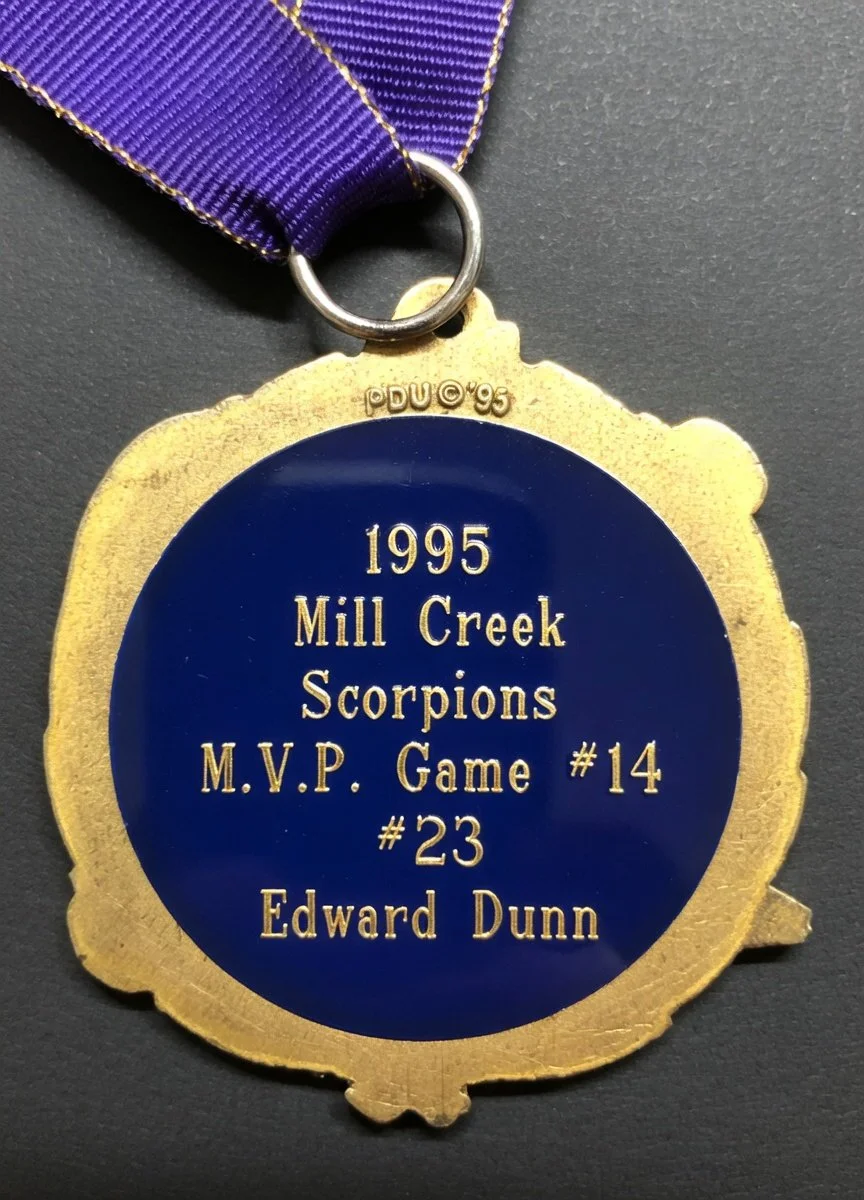
Sidenote: This is the MVP medal from game 14 of that little league season. The team was the Mill Creek Scorpions. Those things were essentially participation trophies — every team gave them out for something. I earned mine by getting the only hit I would record all year in the regular season, a pop fly that spun out of the first baseman's glove. I knew I was lucky. The first baseman knew I was lucky. The only things I was reliably good at were getting walked and stealing bases, neither of which requires you to actually hit anything. I was very proud of that medal anyway. I wore it like a necklace, waltzing around the aisles of Safeway.