
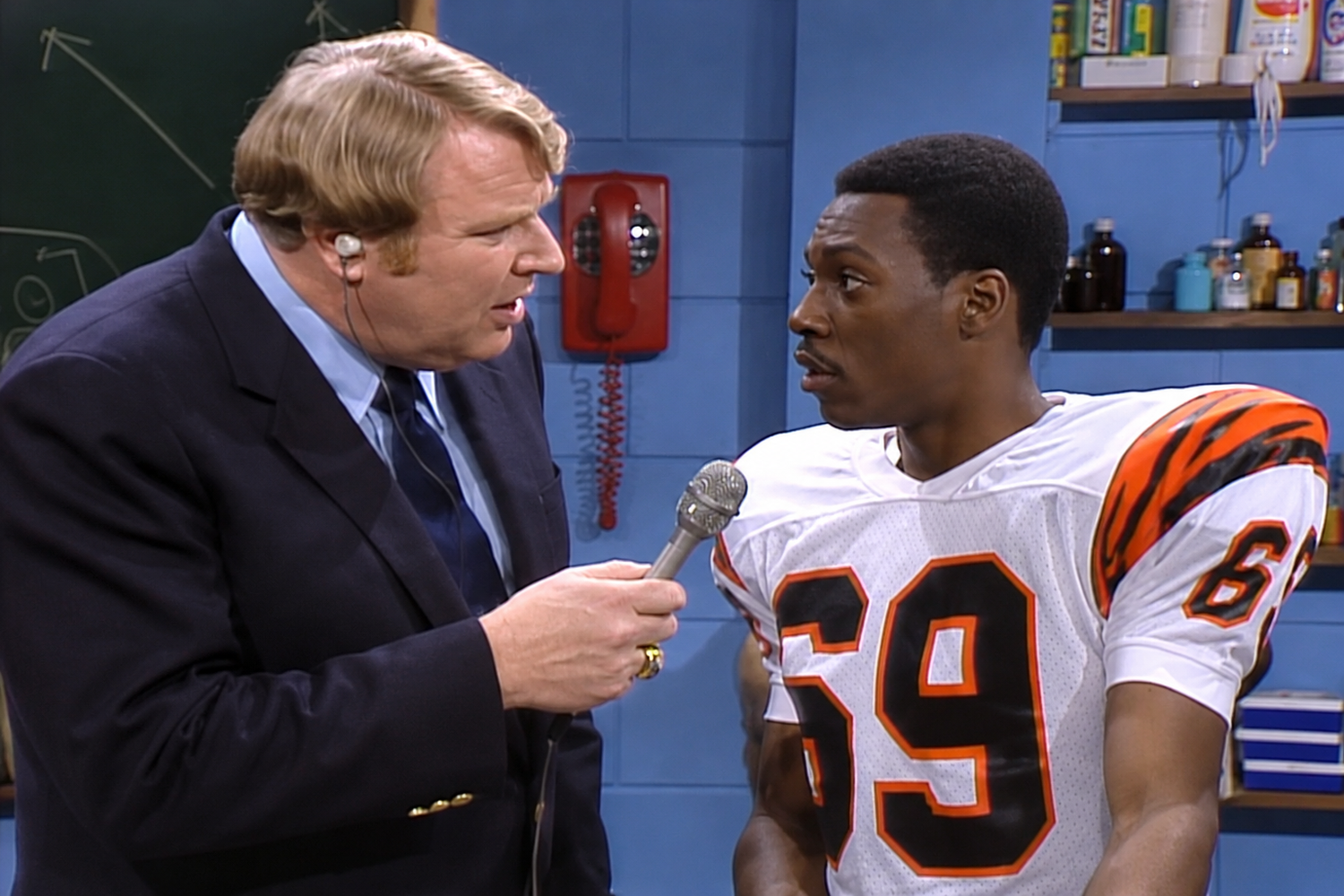
I'm not very good at playing video games; I prefer less interactive forms of media. I think it's a hand-eye coordination thing. But I've spent many hours watching people play Madden. I don't recall ever giving much thought to the man behind the game, which is a shame. He was a savant-like football genius, full of heart and charming eccentricities. His life would've warranted a biopic had the video game never existed.
Corporate biopics have been hard to avoid lately. Five arrived in 2023 alone: TETRIS, AIR, BLACKBERRY, FLAMIN' HOT and THE BEANIE BUBBLE. UNFROSTED followed in 2024, and this Thanksgiving week brings HERSHEY, which The Hershey Company itself calls a "strategic content platform." The formula isn't new. THE SOCIAL NETWORK and THE FOUNDER explored similar territory years ago, and David O. Russell, who directed MADDEN, already made one about the Miracle Mop in JOY. But the products have gotten smaller and the sales pitch more open. I'd call this subgenre the brandopic: a biopic whose real subject is a product, with a person attached to give it a face. The best of them, FORD V FERRARI in my book, use the product to get at the people. Most of the rest end the same way, with the unconventional thinker persevering and the skeptics proven wrong. MADDEN has that ending, and it carries the subgenre's central question right in its title: Madden is both the name of a video game and the name of an interesting man.
John Madden had a full life before anybody handed him a controller. The Raiders made him their head coach at 32, and he never had a losing season, finishing with a regular-season record of 103-32-7, the best winning percentage of any NFL head coach with more than 100 games at the time. He won one Super Bowl, in January 1977, and walked away two years later at 42, worn out, with a bleeding ulcer and a fear of flying that kept him grounded throughout most of his broadcasting career. In the booth he popularized the Telestrator, and he made turducken a Thanksgiving fixture. MADDEN fits most of that in, and the friendship with Al Davis is what holds it together. Davis is on the phone through the whole lost stretch after retirement, and the video game arrives as one more thing the two men fight over. Madden himself later expressed disbelief that a video game had become what he was best known for. When he reached the Hall of Fame in 2006, he said, "I'm a coach, always been a coach." The film seems to agree.
The problem MADDEN has to solve is that building a video game isn't inherently interesting. Nobody wants to watch a programmer erase and redraw a sprite. The film's workaround is to turn each technical obstacle into an argument between people. When Madden sees the first prototype, he doesn't complain about processing power. He complains that nobody has a face and that there are only seven men on a team, then walks out, which tracks with the real Madden's insistence on 11-on-11. The programmers get one burst of jargon about frame buffers and cycles per frame, and Madden responds by telling his driver to take him home. The movie assumes we won't follow the technology, so it keeps the jargon short and moves on. What it gives us instead is a playbook. Madden produces it with a dare, "Prove me wrong, kid," and the brandopic gets its skeptic right on schedule. I like that the film trusts people over process. The cost is the game itself. The first Madden barely appears, and the movie jumps ahead to 2001, where the players finally look like players. Having spent so much time establishing the technological limitations of the era, the film hardly gives us a chance to appreciate what was accomplished within them.
There's something to be said for the sheer audacity of casting Nicolas Cage as John Madden. The novelty alone holds your attention, and without it, this might have been something you'd stumble across on the History Channel. Cage wears a fat suit and a thick layer of Madden's mannerisms, yet he never turns Madden into a cartoon, which is harder than it sounds in a comedy about a man famous for sound effects. This Madden has the endearing peculiarities I wish I'd known more about, like announcing that he'd come back as a blimp or a seagull if he could, and the film lets him be hurt without making him explain it. Bale seems a little more locked in. Al Davis is a man with one setting, and Bale commits to it so completely that he can deliver a prescription for Peppermint Tums like a court order. Cage has to play a man who changes, which gives him more to juggle, and he's not always as convincing. Shane Gillis, as the neighbor Vince McGary, makes the movie about 25 percent better. Vince is the only person who's openly out of his depth, still living at his parents' house and describing the wizard game he's helping develop as educational, and Gillis plays him as someone with nothing to protect, which lets the movie loosen up.
None of the songs in MADDEN is a bad choice, but the music never takes a break. "Time Has Come Today" plays in the opening minutes, "Green Grass and High Tides" near the end, and in between, a scene without a song starts to feel like the exception. All that music does the feeling for us, and the serious moments never get to sit. Al's wife, Carol, has a stroke and spends 17 days in a coma, and it all goes by in roughly a minute, mostly through narration, on the heels of "Every Time We Say Goodbye." Within a few minutes, Al is playing N.W.A for a listener who isn't ready for it and insisting that the group's members are "fine young men." It's a good joke, but the film has hardly given the coma time to register. The comedy has its limitations, too. The funny parts are funny, but the movie never becomes outright hilarious, as its trailer seemed to promise.
So does MADDEN reconcile the biopic with the brandopic? Mostly. The game is one more thing Madden gets stubborn about, rather than the only thing that defines him, and the film touches enough of his life, as a coach, broadcaster, husband and father, that the product never swallows the man. Still, I'd have been more satisfied with a straight biopic that treated the game as one chapter, since his life never needed a product to justify it. This one isn't a failure, but I'm still not sure these movies are for me. The film ends on Madden's first Thanksgiving at home after retiring from broadcasting, where his granddaughter Evelyn beats him 48–0 at the game with his name on it, and then a voiceover returns to his father's advice to keep doing what you love for as long as you can get away with it. Madden figures he did. I'd lose to Evelyn too, which is why I'd rather watch somebody else play.
Final Verdict: 68 out of 100