A Man Called Otto (Retro-ish)

by Edward Dunn


A MAN CALLED OTTO (2022) PG-13 126 Minutes Director: Marc Forster Writer: David Magee Tom Hanks, Mariana Treviño, Rachel Keller
CAST Tom Hanks...Otto Anderson Mariana Treviño...Marisol Rachel Keller...Sonya Manuel Garcia-Rulfo...Tommy Cameron Britton...Jimmy Mack Bayda...Malcolm Juanita Jennings...Anita Kelly Lamor Wilson...Shari Kenzie Christiana Montoya...Luna Mike Birbiglia...Real Estate Agent Alessandra Perez...Abbie Peter Lawson Jones...Reuben Truman Hanks...Young Otto Kailey Hyman...Barb Lawrence Turner...Neighbor

I can buy Tom Hanks in a lot of roles. Mentally challenged? Sure. Man pretending to be a woman to score an apartment? Why not. But a convincing grumpy old bastard? That's a stretch. That's like asking Sean Penn to play someone brilliant. Hanks would need something spectacular—like a full Mel Gibson DUI meltdown—to make me believe he's capable of real curmudgeonry. To me, he's always been more George Clooney than grizzled misanthrope: pleasant enough, but not a reason to see (or skip) a movie. In A MAN CALLED OTTO, Hanks imitates a grumpy man without ever fully inhabiting the role. Still, he does a serviceable job with imperfect material, because even I'm not completely immune to that trademark Hanks charm.

The charm covers for more than Hanks's performance. A MAN CALLED OTTO keeps choosing the version of Otto's life with less friction in it, scene after scene. In the book, Ove is sixteen when his father is killed by a runaway railway carriage. He tells his school he'll be back in two weeks. He never returns. He works the railway for five years before Sonja asks what he'd want out of life, and he answers, without thinking, that he'd like to build houses. She doesn't laugh — she gets angry that he's done nothing about it — and days later she's back with brochures for a correspondence course in engineering: less a gift than a dare. The movie keeps the milestone and drops the dare. A "CLASS of '78" banner, a cap and gown, Sonya reading his diploma aloud in the car, in the same beat where he proposes. The funeral gets the same flattening. Ove's instructions are absolute — "No people. No messing about!" — and the book's payoff is that nobody listens: more than three hundred mourners show up anyway, a scale of defiance the story needs to make its point. Otto asks for "nothing overblown" instead, and receives exactly that, no defiance required. A correspondence course became a cap and gown. A funeral nobody wanted became a service everybody agreed to.

What Otto owns isn't the only thing that gets revised. Who he's allowed to be does too. In the book, Ove spends years as chairman of the Residents' Association, with Rune — vice-chairman, eventual Volvo man — at his side, until a steering committee votes him out over a fight about trash-room surveillance cameras. He calls it "the coup d'état." Years later, a different camera system comes up for a vote, and Ove is the only one who votes against it, distrustful of anything connected to the internet. The movie keeps the shape of the story — Homeowner's Association, a coup, a vote — but swaps out the mess. Otto is voted out for standing up for wheelchair access for his disabled wife, after a developer tells him "there's places for people like your wife." He shoves the man. And the neighbor who replaces him isn't a committee, it's Reuben, one specific friend, so an institutional grievance becomes a personal betrayal instead. Ove's version stays messy, and occasionally wrong. Otto's stays clean enough to still be right about it, out loud, on his own street.

Even the cars follow this rule. Ove and Rune spend their whole friendship trading upgrades — a Saab 96 against a Volvo 244 when they first move in, a Saab 9000i against a Volvo 760 decades later — one-upmanship neither of them ever calls off. Ove's last car is a blue Saab 9-5. Not long after he buys it, General Motors buys up the remaining Swedish shares in the company, and Ove spends an afternoon swearing about it, then vows never to drive an American car again for the rest of his life. Everything built since, he decides, is "like driving a computer." Otto inherits his loyalty instead of earning it: his father teaches him what makes a Chevy engine run, calls it "Dependable," and years later, telling Sonya the same story on their first dinner date, Otto ends on the identical word. No rivalry, no argument. Only inheritance. Near the end, Otto buys himself a new truck — an actual 2024 Chevrolet Silverado EV, a model that didn't exist yet when his own tombstone says he died — and takes Marisol's family for a ride in it. General Motors is the villain of one version of this story and the retirement gift in the other. Commercially convenient beats internally consistent, right to the end.

The Swedish film isn't only closer to the book — it's proof the remake's choices were choices, not casualties of adaptation. Its version of the threat to Rune isn't a real estate company. It's a privatized eldercare contractor called Consensus, a name that undercuts itself a scene later, when Ove threatens to report the company and the rep falls back on corporate boilerplate: only a private contractor carrying out decisions made somewhere else, nothing personal. A reporter separately produces the company's own financial statements, thin profits despite a shareholder's stake. Dye & Merika wants a neighborhood. Consensus wants a return on investment. A school interviews Sonja for a teaching job and turns her down — no plan for a teacher with physical disabilities, they tell her. Her answer is six words: "Either we die or we live." Ove's isn't a speech. He drives to the school that night and builds a wheelchair ramp himself, alone, finished by morning. The American screenplay keeps a version of that ramp — Tommy finds it in the garage years later, mentions it in front of Otto, and Otto is furious — but it doesn't linger on the building of it. Instead, Otto tells Marisol the story as it turns toward the neighborhood's inaccessible new construction, the confrontation that gets him thrown off the board. The Swedish film doesn't need an audience for Ove's ramp. The American film needs a board to vote on it.

All three versions keep her in the same place: dead before the story starts, present only in memory, which does most of the idealizing on its own. The intervention scene repeats almost word for word across adaptations, including the Swedish line already quoted above. The American film stages the same moment, mid-suicide-attempt, with the same function: "You're angry. And sad. So am I. But now we have to live." Neither is a conversation. Both are visitations. Only the Swedish film seems to notice this is a problem. Parvaneh, who never met Sonja, tells Ove he's "made her into some kind of saint" who'd probably rather have been ordinary. Ove tells her to be quiet. The scene doesn't fix anything — Sonja never gets a moment of her own where she's simply present and unremarkable, not in this version or any other. Naming the sainthood isn't the same as undoing it. The American film doesn't even name it.

None of this makes the film empty. It means the craft is there and gets used selectively. Otto refuses to buy Sonya a crib early in their marriage and builds one himself instead. Decades later, he finds it in the attic, still wrapped in plastic, alongside a memory of a very pregnant Sonya watching him put it together. Nobody explains why he kept it sealed all this time. When he finally gives it to Marisol's family, he sets their baby inside it himself: "See? It works. You like that? Good." The connection to the child they'd once been expecting is never spoken. The cat scenes show the same confidence. Otto throws it off his bed the first night and sets it up with a towel by the door instead. By morning it's back on the bed with him, asleep, and he's holding its tail in his palm, no comment on the reversal. Later, at Sonya's grave, mid-visit, the cat comes forward on its own and rests its head against his palm. Both moments pass without a word. This is the same movie that has a character spell out the "Dye & Merika" pun and then confirm it, in case anyone missed it. The filmmakers know how to let a scene sit in silence. They don't always choose to.

The math doesn't work, and it isn't close. Sonya's side of the shared headstone gives her death as 2018, which matches the year stamped on almost every present-day scene heading in the shooting script — the whole Marisol-moves-in, HOA-ousting stretch of the story happens inside that single year. Otto's side of the same stone gives his death as 2022. Four years, and the film doesn't visibly spend them: no aging on the kids, nothing different about the block, nothing anywhere on screen arguing for time having passed at all. The tombstone changed. Everything else stayed staged for 2018. The Silverado was one prop with the wrong date. This is the whole movie with the wrong date.

Otto has a crib nobody explains sitting in the same movie as a joke that explains itself twice — real craft, present and demonstrated, used only when convenient. The whole movie keeps making the same choice, right down to a truck the timeline has no room for. Hanks didn't write any of that. He shows up for the two or three scenes that ask something real of him, and he delivers, which is more than the script consistently earns. A MAN CALLED OTTO isn't hollow. It's a film that knew how to be better and chose, over and over, not to be.

Final Verdict: 63 out of 100.

Angels in the Outfield (Retro)

by Edward Dunn


ANGELS IN THE OUTFIELD (1994) PG 102 Minutes Director: William Dear Writers: Dorothy Kingsley, George Wells, Holly Goldberg Sloan Danny Glover, Tony Danza, Brenda Fricker
CAST Danny Glover...George Knox Brenda Fricker...Maggie Nelson Tony Danza...Mel Clark Christopher Lloyd...Al the Angel Ben Johnson...Hank Murphy Jay O. Sanders...Ranch Wilder Joseph Gordon-Levitt...Roger Bomman Milton Davis Jr....J.P. Taylor Negron...David Montagne Tony Longo...Triscuitt Messmer Neal McDonough...Whitt Bass Stoney Jackson...Ray Mitchell Adrien Brody...Danny Hemmerling Tim Conlon...Wally Matthew McConaughey...Ben Williams Israel Juarbe...Jose Martinez Albert Alexander Garcia...Pablo Garcia Dermot Mulroney...Mr. Bomman Robert Clohessy...Frank Gates Carney Lansford...Kit "Hit or Die" Kesey

ANGELS IN THE OUTFIELD runs like it was assembled to spec. Every beat lands roughly where you'd expect it to, every joke gets its setup, every emotional cue arrives on schedule — and somewhere in that precision the movie misplaces the thing that would have made any of it matter. Tony Danza plays Mel Clark, a washed-up pitcher whose best years are a decade behind him, and the casting carries a small, useful irony: Danza himself was several years removed from playing a retired ballplayer on a hit sitcom, brought in to play a player whose career has already ended once and is now being asked, improbably, to start again. The film doesn't do anything with that irony. ANGELS IN THE OUTFIELD isn't interested in what its casting might be saying about itself — only in whether the next scene executes.

The film can't settle on why the angels arrived, let alone why they leave. Roger prays; Al answers. Yet Al also frames their presence as triage—an "as needed" intervention that comes and goes on its own schedule. Maggie reframes it again as emotional law: angels appear for kids looking for someone to love. Three explanations, none reconciled, and then a fourth rule arrives for the finale that contradicts them all. Championships, Al tells Roger, must be won on their own. The angels who spent the season catching fly balls and tilting games simply vanish. Mel Clark wins it unassisted. The film never asks the obvious follow-up: if the team had this much in them all along, what exactly were the angels for?

What ANGELS IN THE OUTFIELD is willing to say about belief turns out to be very little. Roger's prayer, when it finally comes, hedges its own address — "if there is a God... if you're a man or a woman" — a child covering his bases rather than reaching toward anything specific. Maggie's answer, when he asks whether angels are real, is no more committal: she believes in "the possibility of miraculous things happening," the sort of sentiment that could just as easily describe a lottery ticket. By the time she's defending Knox before the press, belief has been reduced further still, to something closer to a motivational poster — angels as "the footprints of love," summoned wherever someone needs looking after. There's no church in this movie, no clergy, no liturgy, nothing that anchors any of it in a tradition Roger or Maggie might hold. The film wants the comfort of religious language without the commitment of religious thought. It asks us to accept angels, but it rarely asks what believing in them would mean.

The 1951 original handles this same problem more gracefully, if only because it never tries to explain itself as thoroughly. Guffy McGovern's angel withdraws not because of an arbitrary championship clause but because McGovern breaks an actual promise — he punches a sportswriter at a commissioner's hearing after agreeing to stay civil, and the deal is off, on its own clear terms. The angels in 1994 leave because the film has reached the point where it requires human triumph; the angel in 1951 leaves because a man went back on his word. That's a sturdier piece of storytelling than anything ANGELS IN THE OUTFIELD manages with its own mythology, and it survives because the older film commits to the religious framework it's built on — Guffy calls a minister, a priest, and a rabbi to testify on his behalf, and the hearing plays as a genuine referendum on belief.

Roger's father appears twice, and uses the first appearance to make a promise no parent should make. Asked when the family will be whole again, he doesn't say never — he says when the Angels win the pennant, handing his son a condition that sounds achievable precisely because it isn't. He doesn't vanish after that; he resurfaces in a courtroom, where he signs Roger away for good, pennant race still very much underway. The cruelty isn't that he lies. It's that he frames the lie as a deal, something Roger can work toward, root for, pray over — and the film lets that framing stand almost until the end, as if a parent's abandonment were a puzzle a child could solve with enough faith and a winning record. J.P. gets a smaller, colder version of the same withholding. He won't ride in cars because he used to live in one with his mother, sleeping curled up in the front seat, and the film drops that detail and moves on, never circling back to what kind of life produces a boy who flinches at a car door. The film handles Mel Clark's mortality the same way. Al tells Roger, almost in passing, that Clark has six months left and doesn't know it yet, and then the film never returns to it, letting him pitch the pennant clincher and disappear into a freeze-frame like nothing was said. I remember sitting with that detail at nine years old and feeling bad about it for the rest of the movie, in a way the story itself never seemed to. Both boys are given backstories specific enough to suggest real damage and then asked to function as comic relief and good-luck charms for the rest of the runtime. Their pain opens the story; it rarely deepens it.

That treatment becomes harder to square with Maggie's later reframing of the angels as an emotional law: they appear for kids looking for someone to love. By that standard, Roger and J.P. should be the center of the miracle, not its witnesses. Instead, the angels spend most of their time chasing down fly balls and breaking slumps while the boys' loneliness remains largely untouched. The divine intervention the film promises is strangely selective — it fixes the team's roster, but leaves the kids' deeper wounds mostly where it found them.

George Knox never becomes specific enough as a person for any of this to land the way the film wants it to. We're told he spent a decade winning in Cincinnati without ever capturing the championship that mattered, we learn Ranch Wilder ended his playing career with a deliberate spike to the knee, and that's the whole file. The grudge against Wilder gives Danny Glover a recognizable temper to play, but a temper isn't a character, and there's nothing underneath the bitterness the film is willing to show us — what losing the championship cost him, what nursing a vendetta for decades has done to him. So when Knox tells the press he didn't believe in anything before this season and these boys gave him his reason to believe, the line is asking for a transformation the film hasn't earned, because the film never showed us what Knox believed before that. We've watched George Knox fulfill every function the story requires of him. We still don't know much about the man himself.

A movie about literal angels fixing baseball games should be having more fun than this one is. The premise hands the film permission to go anywhere — slapstick, mischief, real strangeness — and ANGELS IN THE OUTFIELD mostly declines the invitation. Al describes his own kind as "a very capricious crowd," but nothing about him plays that way; he arrives less like an emissary of the divine than a middle manager of supernatural logistics, polite, procedural, and fond of explaining the rules of his own intervention like a man reading from a union contract. Christopher Lloyd, an actor who has built a career on eccentricity, spends most of his screen time being affable and brief. The closest the film comes to cutting loose is Marvin Vincent Archer. Told to "run home" from first base, he takes the instruction literally, leaving the ballpark behind for his actual house—the one moment in the movie that feels like it's playing with its own premise instead of managing it. A film this unconcerned with plausibility owes its audience a little more delirium than that. ANGELS IN THE OUTFIELD plays it straight instead, and straight is the one register this story can't really afford.

That absence of delirium has a clear cause: there's no one on this roster specific enough to be delirious through. Whitt Bass is the closest thing to an exception, and even he barely qualifies. Ranch Wilder tells us, on the broadcast, that Bass has eaten bugs and flossed his catcher's teeth in the dugout, but we never see any of it. What we get is a Magic 8-Ball ("will I win, will I win, win, win?") and a string of stalling mound rituals—sniffing, yawning, lingering before every pitch—which add up to a guy who's odd in passing, not a character built from the ground up. He's basically the team's designated fool, and that's the whole part. Triscuitt Messmer is defined by his slump and his nickname. Danny Hemmerling is defined by a stat line—good glove, no bat—and the joke of him succeeding anyway. Ben Williams gets one spectacular catch and barely a line of dialogue to go with it. These aren't characters so much as job descriptions with uniforms attached, and a movie that can't be bothered to make its players into people was never going to know what to do with the angels helping them. ANGELS IN THE OUTFIELD has twenty-five archetypes in a clubhouse and calls it a team.

There should be more to a movie than watching a story unfold, and ANGELS IN THE OUTFIELD never gets there. It has a story — a clean one, beginning to end, every beat accounted for — and that turns out to be all it has. No fun sturdy enough to carry the premise past its own internal contradictions. No character specific enough to make the ending feel earned rather than scheduled. The angels show up, the team wins, the family comes together, and none of it leaves much behind once the credits roll, because the film was never building toward a feeling — only toward a result. That's the real difference between this and the movies it's been measured against in this review, the 1951 original included: those films wanted you to believe something. This one only wanted you to watch something happen, competently, on time, and then go home.

Final Verdict: 58 out of 100.

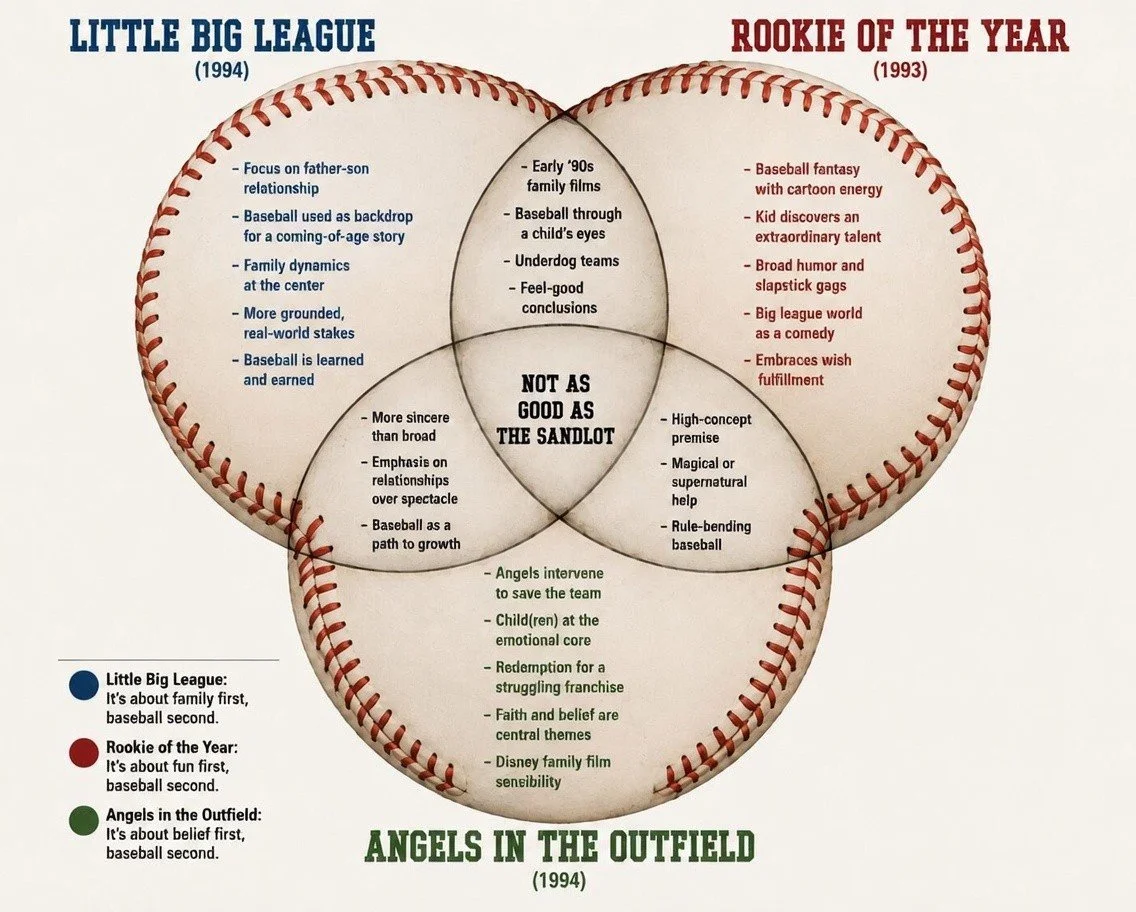
Sidenote: A comparative look at the trilogy.

A baseball-themed Venn diagram comparing Little Big League, Rookie of the Year, and Angels in the Outfield.